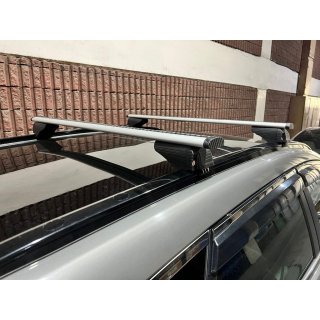
Integrated rails lie flush on the roof as a continuous strip without a gap, while standard rails sit raised above the roof on supports. The crossbar clamps for them are different, so racks of these types are not interchangeable.
Not guaranteed: the clamps are matched to the shape and groove of the roof rail on a specific model. Choose a product for your model and years, and if in doubt, send the manager a photo of the roof rail.
These are crossbars with a lock: the key blocks access to the mount. The lock makes it harder to remove the rack, but does not increase the allowable weight.
The lowest limit applies — the car roof from the owner's manual, the roof rails, and the crossbars. Count the weight of the box or basket as well and distribute the load evenly.
No. A roof box, basket, bicycle and ski mount are installed on crossbars. Before buying an accessory, check its mount against the crossbar profile.
The aerodynamic profile is quieter, but whistling is possible depending on speed and the position of the crossbars. If the rack is not needed, it is better to remove it — this reduces noise and fuel consumption.
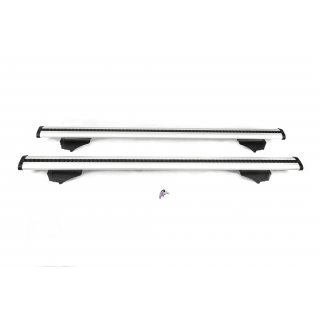
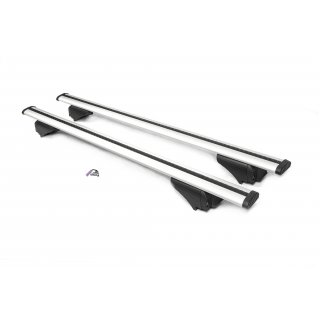
How to Choose and Install Crossbars for Integrated Roof Rails
Determine the rail type Make sure the rails sit on the roof without a gap. If there is a gap under the rail, a roof rack for standard rails is required.
Choose a kit for your model In the “Make and model” filter, select the vehicle and years, then check the series, length, and color in the variant selection.
Check the kit Unpack and inspect the two crossbars, clamps, keys for lockable versions, and the installation instructions.
Prepare the rails Wash and dry the rails at the installation points so that sand under the rubber pads does not scratch the surface.
Install and align the crossbars Place the crossbars on the rails at the distance specified in the instructions, straight across the vehicle and parallel to each other, with equal overhang on both sides.
Tighten and check Tighten the clamps alternately on the left and right, close the locks, and shake the crossbar by hand — it must not move. After the first few kilometers with a load, tighten the fasteners again.
Pros and Cons of a Roof Rack
The roof becomes a base for a roof box, basket, bicycle and ski mount
Model-specific crossbars fit factory integrated roof rails without drilling
Free up space in the cabin and trunk during trips
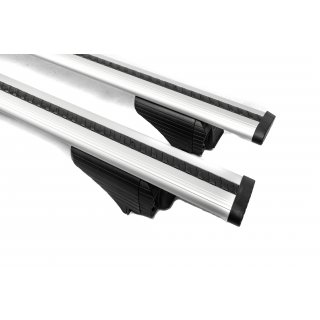
The aluminum profile is lightweight and does not rust
Can be removed when not needed; key-lock versions have a lock
Add noise at speed — whistling may occur even with an aerodynamic profile
Carrying cargo on the roof increases fuel consumption
Load capacity is limited by the lowest limit of the roof, rails and crossbars
Designed for a specific model and will not fit another type of roof rails
The car gets taller — with a box, take into account the height of the garage or parking entrance

 Acura
Acura Alfa Romeo
 Audi
Audi BMW
BMW Bentley
 Brilliance
 Bugatti
 Buick
Buick BYD
BYD Changan
 Cadillac
 Chery
Chery Chevrolet
 Chrysler
 Citroen
 Cupra
Cupra DAF
DAF Dacia
Dacia Daewoo
 Daihatsu
 Dongfeng
 Datsun
 Dodge
Dodge DS Automobiles
 FAW
FAW Ferrari
 Fiat
Fiat Fisker
 Ford
Ford GAC Motor (Trumpchi)
 Geely
Geely Genesis
 Great Wall
 GMC
GMC Honda
Honda Hongqi
 Hyundai
 Hummer
 JAC
JAC Jaguar
 Jeep
Jeep Jetour
 Infiniti
 Isuzu
Isuzu Iveco
Iveco KIA
KIA Lamborghini
 Lada
Lada Lancia
 LandRover
 Leapmotor
 Lexus
Lexus Li Auto
 Lifan
Lifan Lincoln
 Lotus
Lotus Lucid
Lucid MAN
MAN Maserati
 Mazda
Mazda McLaren
 MG
MG Mercedes-Benz
 Mitsubishi
 Mini
Mini Nissan
 Opel
Opel Peugeot
 Polestar
 Porsche
 Rivian
 Renault
 Rolls-Royce
 Saab
Saab Scania
 Sinotruk
 Seat
Seat Skoda
Skoda Smart
Smart SsangYong
 Subaru
 Suzuki
 Tesla
Tesla Toyota
 Volkswagen
 Volvo
Volvo Volga
Volga Xiaomi
 Xpeng
Xpeng Wuling
 Zeekr
Zeekr UAZ
UAZ