
































































 Author: Radomskyi Maksym Vasyliovych
Trunk chaos: does this problem sound familiar?
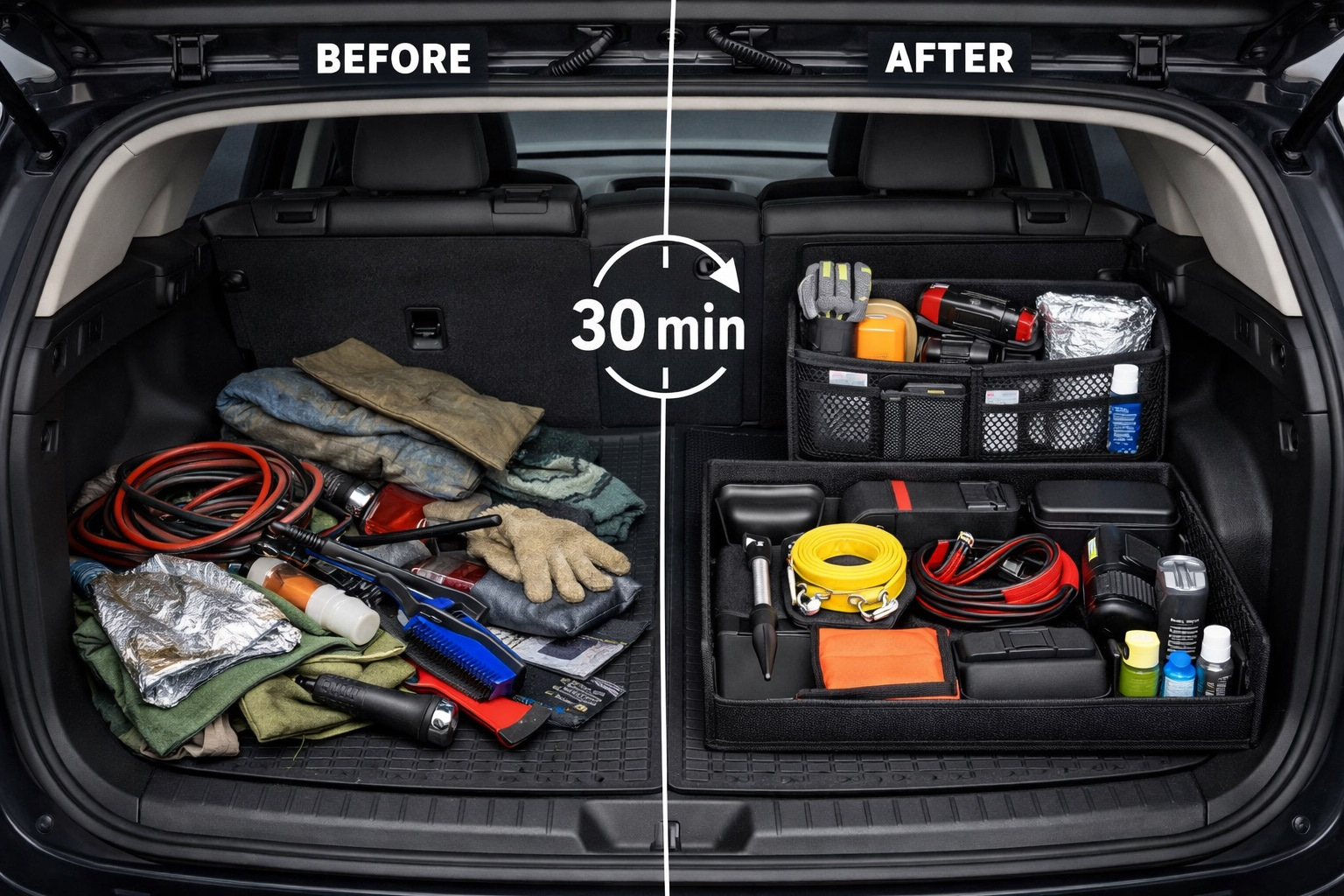
Every driver has faced trunk chaos at least once: after a trip to the store, bags are scattered all over, small items get lost among other things, and something heavy rattles at every turn. Familiar situation? Disorder in the trunk is not just an aesthetic inconvenience. Unsecured items can turn into dangerous projectiles during sudden braking, and searching for the right thing among the mess takes a lot of time and nerves. With an organized trunk, you no longer have to waste precious minutes looking for what you need among scattered items. The good news: you can tidy up very quickly — about 30 minutes and a few simple accessories are enough. Next, we’ll explain how to organize your trunk so that everything stays in its place and your trips become safer and more comfortable.
Essential trunk kit: what to always carry
The first step to order is to get rid of the unnecessary and leave only the essentials. There are items no car should be without — they should always be in the trunk. Everything else can be safely removed to free up valuable space. Essential items worth carrying at all times:
- First aid kit. A mandatory item for providing first aid. Make sure it meets current standards and that the contents are not expired.
- Fire extinguisher (minimum 2 L). It should be in working condition and preferably at least 2 liters — enough to extinguish even a small fire. Check the pressure gauge and expiration date regularly.
- Warning triangle. A foldable triangle with reflective elements to mark your car on the road in case of breakdown or stop.
- Tow rope. Essential if your car gets stuck or needs towing. A strong rope will help you get out of snow or mud quickly and save time in a critical situation. Useful both in winter and summer (for example, to pull a car out of mud).
- Jack and lug wrench. A standard set for changing a wheel. Needed in case of a flat tire to install the spare.
- Spare wheel or tire repair kit. A full-size spare (or space-saver) allows you to continue driving after a puncture. Alternatively, a repair kit: tire sealant + pump/compressor to patch the puncture and reach a tire shop.
- Jump starter or jumper cables. Battery cables or a portable jump starter (booster) will help start the engine with a dead battery without outside help. Especially useful in winter or on long trips.
- Flashlight. Preferably bright and autonomous (battery-powered or rechargeable). Useful at night or when repairing the car on the roadside. A headlamp or one with a magnet for mounting is a good option.
- Reflective vest. In many EU countries it’s mandatory, and in Ukraine it’s strongly recommended. Wear it if you leave the car on the road at night or in poor visibility — it’s a matter of safety.
- Multitool or tool kit. A universal multifunctional tool (knife, pliers, screwdrivers, etc.) or a compact wrench set helps with minor repairs or unusual situations. It takes up minimal space but can be a lifesaver on the road.
Winter emergency kit. In cold weather, supplement the above list with additional items for winter conditions:
- Snow shovel. Helps free the car from a snowdrift and clear snow around it. It’s best to have a compact folding or telescopic shovel that fits in the trunk.
- Brush and ice scraper. The brush removes snow from the body and windows, while the scraper removes ice from the windshield and side windows. These tools ensure proper visibility in winter.
- Warm blanket and gloves. In case of a stop or breakdown in freezing weather, a blanket keeps you warm, and gloves let you work with tools without freezing your hands. Especially important if you have to wait for help in the cold.
- Reserve of windshield washer fluid. A canister of winter washer fluid (antifreeze) will save you from running out in subzero temperatures. Always keep 1–2 liters in reserve.
- Snow chains or traction mats. Relevant for regions with heavy snow or mountainous areas. Chains on the wheels greatly improve traction on ice and deep snow. The set is easy to carry but can be a lifesaver in a critical moment.
Remember seasonality: in autumn, remove summer items (beach mats, folding chairs, etc.) and make room for the winter kit. Conversely, in spring, take out heavy winter gear you no longer need. Regularly check your trunk contents: once a month, take everything out and get rid of the unnecessary. Anything not on the list above is likely extra weight that only takes up space and increases fuel consumption. As famous tidying consultant Marie Kondo advises, keep only what you need in your car and assign each item its own place.
Different use scenarios: family, work, travel
Trunk organization largely depends on how you use your car most often. The needs of a family driver, entrepreneur, or traveler may differ. Let’s look at three typical scenarios and corresponding organization tips.
Family car
The trunk of a family car often serves as storage for all sorts of things — from strollers and toys to grocery bags and sports gear. To organize it all, divide the trunk space into zones by category: groceries separately, children’s items separately, sports equipment separately, and the emergency kit separately. This approach helps prevent losing things in a pile. For example, grocery bags can be secured in a corner of the trunk with a net or special hooks so they don’t tip over while driving. Small children’s items (toys, bottles, wipes) should be stored in a separate organizer or bag — this way they won’t scatter around the cabin and will be easy to access. After each trip, take a few minutes to put everything back in place (at least by category) — this prevents clutter from building up and keeps the trunk tidy.
Work vehicle
A business or service vehicle (for entrepreneurial activity, service calls, courier delivery, etc.) is often overloaded with equipment, tools, or goods. Here it’s especially important to arrange loads properly so nothing gets damaged and everything is easy to use. Keep heavy tools and devices in sturdy boxes or cases — this prevents scratching the trunk lining and stops them from sliding. Small parts or consumables should go into a multi-section organizer bag — it’s easier to keep order and find what you need quickly. If you transport liquids (oil, antifreeze, washer fluid), use a sealed container so leaks don’t spill over the trunk. Store documents and electronics separately from heavy items — ideally in a folder, pocket, or special bag to avoid crushing them. And always secure bulky equipment with straps or other fasteners so it doesn’t move around during sharp maneuvers.
Long trips
Long journeys usually mean a fully packed trunk — suitcases, travel bags, food, camping gear, etc. When loading, remember balance and accessibility. Place the heaviest suitcases and items at the bottom near the back seat — this shifts the center of gravity forward, improving vehicle stability. Lighter items and those you might need on the road (first aid kit, snacks, chargers) should go on top or closer to the trunk door for easy access. It’s important that the emergency kit (first aid kit, fire extinguisher, tow rope) isn’t buried under luggage — keep it to the side or on top so you can reach it in seconds. Use straps or an elastic net to secure large suitcases and bags if your trunk has attachment loops. This prevents shifting on turns and keeps things from falling when you open the trunk upon arrival. If you have too much stuff, consider installing a roof box, but keep the essentials inside the cabin or trunk — it’s safer and quicker to access.
Trunk organizer bags
Special organizer bags are designed specifically to keep the trunk tidy. A trunk organizer is a foldable container with sturdy walls, dividers, pockets, and carrying handles. It’s made of material that holds its shape and usually has several compartments. You can store all small and medium items that would otherwise be scattered around the trunk. First aid kit, fire extinguisher, compressor, tools — instead of lying separately, they’ll be neatly gathered in one place [oai_citation:17‡hotline.finance](. When choosing an organizer, pay attention to a few things. The material should be strong and preferably water-repellent to withstand loads and possible leaks. It’s good to have compartments of different sizes — this makes it easier to sort items by category (for example, car accessories separately, sports gear separately, etc.). Many organizer bags fold flat when not in use — saving trunk space. Sturdy handles are a useful addition for easily removing the bag from the car. And finally, an important detail — reliable fixation in the trunk. Most models have Velcro, straps, or carabiner hooks at the bottom to secure the organizer to the floor or walls. This prevents it from sliding while driving. To use it effectively, organize items by section: car accessories separately, leisure gear separately, and other categories separately. Don’t overload the compartments — if you stuff too much, the bag loses shape and it becomes harder to find things inside. Also, regularly check the contents and declutter. Even the best organizer won’t help if it’s full of useless junk. The benefits are immediate: your items are protected from impacts while driving (rigid walls and dividers keep contents from scattering even during sudden braking), and you save time — no more rummaging through clutter to find what you need, since everything has its place. Plus, it’s easy to maintain order afterward. Make it a habit to return everything to its place in the organizer after each trip or purchase — it takes just a few minutes, but your trunk will always look neat.
Trunk nets
A trunk net is another simple accessory for securing cargo. The elastic net (usually with a rubber cord around the edges) attaches to hooks or loops in the trunk and tightly holds items in place, preventing them from shifting while driving. Most often, the net is stretched horizontally across the trunk floor over the load. There are also vertical pocket-style nets that attach to the side or seat back — convenient for holding bottles, umbrellas, and other small items so they don’t roll around. The advantage of a net is that it adapts to the shape of items and takes up minimal space when not in use. It’s ideal for securing one-off irregular loads — for example, holding a box, watermelon, or plant pot so they don’t roll around while driving. However, for permanent storage, a net isn’t very suitable. If you try to keep a first aid kit, fire extinguisher, compressor, or other permanent accessories under a stretched net, they’ll stick out in the middle of the trunk and interfere with other luggage. So the net is more of an auxiliary tool “for occasional use.” It’s indispensable for temporary transport of various items but won’t replace a full-fledged organizer or box for daily order. To use a net, you need mounting points in the trunk — special hooks, loops, or rails. Many cars have them by default, but if yours doesn’t, it’s easy to fix. Universal hooks are available for sale and can be easily installed on the trunk walls or floor. They take up minimal space but allow you to securely attach the net. By the way, these same hooks are handy for hanging shopping bags so they don’t tip over and spill contents while driving.
Boxes and containers
Another approach to trunk organization is using solid boxes or containers. This could be a plastic box with a lid, a folding car crate, or an organizer chest. You can keep such a container in the trunk permanently or use it as needed. Many car owners, for example, carry a folding plastic crate: when folded, it takes up almost no space, and when unfolded, it holds groceries or other cargo [oai_citation:29‡automaniacs.us](https://automaniacs.us/blogs/car-care-101/trunk-organization-ideas?srsltid=AfmBOopxgSj7iUsGSQHXTfmvril2u7RMjcyns-DdDtQTSNasutUQf1gN#:~:text=1,Organizer). Such a box comes in handy when you suddenly need to transport many small items or don’t want things rolling around the trunk floor. For permanent use, choose a sturdy container — for example, a plastic or plywood box with a lid, or even a small cooler bag if you often carry food. A solid box is convenient for storing heavy and dirty items: tool kit, jack, canister, pump, tow rope, etc. It protects the trunk lining from dirt and leaks and prevents heavy items from sliding around while driving. To keep the container from sliding, place a non-slip mat underneath or secure it with straps or a net. If the box is large and strong enough, you can place other bags on its lid — creating an extra “level” in the trunk and saving space. The downside of plastic containers is that they take up space even when empty. So if you suddenly need the entire trunk volume, you’ll have to remove the box. However, a folding box solves this problem since it takes up almost no space when folded (as mentioned above).
Trunk mats
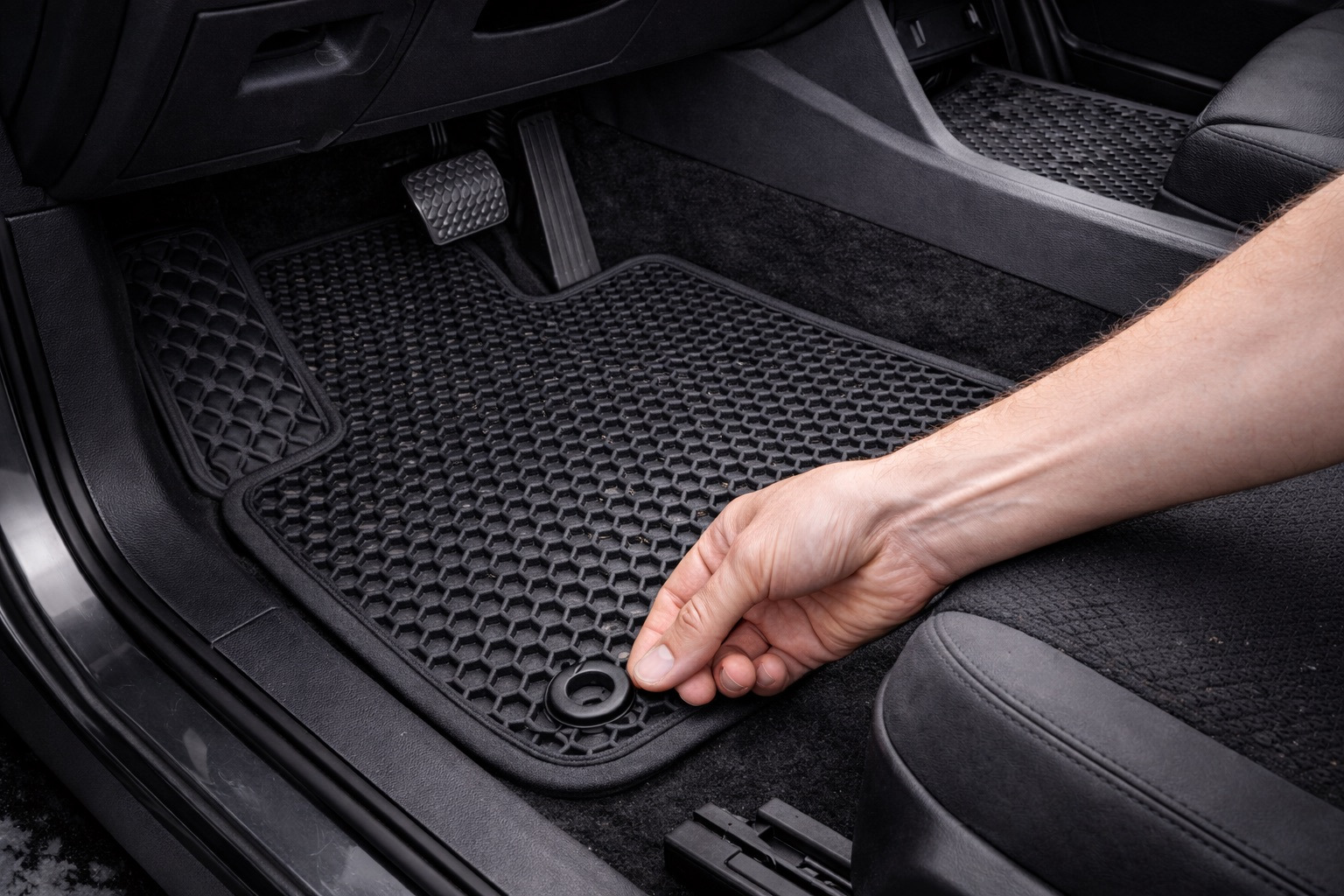
The trunk floor also needs attention and protection. For this, there are special trunk mats — also called cargo liners or inserts. These are custom-made mats shaped to fit your trunk, made of rubber or modern EVA polymer material. Their main role is to protect the trunk’s original covering from dirt, water, and damage. If you often transport dirty or wet items (garden tools, building materials, pets, wet clothes or shoes, etc.), the mat collects all the dirt and moisture, preventing it from reaching the trunk floor. Then you can simply shake it out or rinse it with water, and the trunk is clean again — no stains or unpleasant odors. A quality trunk mat usually has raised edges that further prevent liquids from leaking onto the car body floor (thus avoiding corrosion from trapped moisture). Besides keeping things clean, the mat can also serve an organizational function. Most EVA mats have a textured surface (cellular or patterned) that acts as an anti-slip layer. Items on such a mat don’t move while driving, even during sharp turns. Thus, the mat helps secure cargo “passively” through friction, reducing the need for extra fasteners. Modern EVA materials also have other advantages: they’re lighter than rubber, odorless, temperature-resistant, and custom-made for each car model. If your trunk still doesn’t have such a mat — it’s worth getting one. It’s an inexpensive accessory that makes keeping your trunk clean and organized much easier.
Comparison of trunk organization solutions
| Solution | Optimal use | Advantages | Disadvantages |
|---|---|---|---|
| Organizer bag | Storage of small and medium items on a permanent basis (emergency kit, tools, gadgets, care products, etc.). | Items are sorted into pockets, quick access; easy to remove from the car; folds flat when not needed; protects contents from impacts while driving. | Limited capacity — large items won’t fit; requires fixation (otherwise may shift); if overfilled, loses efficiency. |
| Elastic net | Securing irregular or single loads (shopping bags, boxes, round items) during a trip. | Very compact and lightweight; adapts to item shapes; quick to attach and remove; inexpensive. | Not suitable for permanent storage — items under the net take up space in the middle of the trunk; requires mounting points; doesn’t hold very heavy loads. |
| Box / container | Transporting heavy, dirty, or bulky gear (tools, fluid canisters, jack, spare parts) permanently or as needed. | Handles significant weight; protects trunk from dirt and leaks; can place other items on top; some models fold flat. | Takes up space (especially when empty); may slide while driving (needs securing); heavier than a bag or net. |
| Trunk mat | Base of the trunk in any car. Especially useful for frequent transport of dirt, liquids, pets, etc. | Protects from water, dust, stains; precisely covers the entire trunk floor. | Doesn’t organize items by itself (auxiliary accessory); organizer Velcro may not stick to some mat materials; requires periodic cleaning from accumulated dirt. |
You can tidy up your trunk quickly, and the result is worth it. Spending about half an hour and using affordable accessories (like the organizers, nets, boxes, or mats described above), you’ll get a neat, safe, and convenient trunk space. Let’s agree — it’s nice when your car is in order: everything has its place, and you can find what you need instantly. This makes your trips more comfortable and gives you confidence — because you always know you have everything you need at hand. An organized trunk is a small life hack that greatly enhances your driving experience. So take 30 minutes today, tidy up your trunk — and feel the difference!