24.01.2026
1636
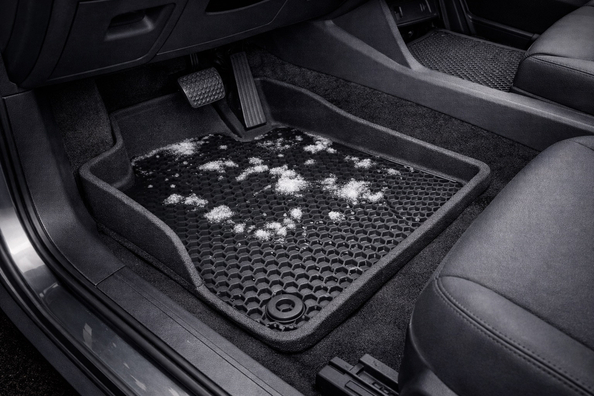
When it’s snow, slush, and road chemicals outside, your car’s interior turns into a “reception area” for water and dirt from your shoes. At that moment, standard mats often lose not because they’re bad, but because they lack water “capacity”: drops spread across the surface, water runs over the edge, and the floor under the mat starts getting wet. That’s exactly when the question comes up: is it worth paying extra for EVA mats with raised edges?
3D EVA mats and versions with high edges promise a simple solution: turn the mat into a “tray” that keeps water inside. But in reality, it’s important to understand what “3D” actually means, what kinds of edges exist, and in which scenarios this truly helps. If you’re already choosing, check out the 3D EVA mats category — it’s easier to compare formats and комплектації there.
The term “3D” in the world of car mats is often used in different ways. For some manufacturers, 3D is simply a mat that precisely follows the floor shape (using templates), for others it’s a mat with a raised perimeter contour (edges), and sometimes it’s a combination of both approaches.
Put simply, 3D isn’t “magic” — it’s precision and volume. Precision gives a proper fit, and volume (edges) gives you extra water capacity. For the basics on how EVA material works and why the “cells” hold dirt, read what EVA mats are (basics).
The higher the edges, the more of a “tray” you get — but the more carefully you need to check the fit near the pedals, the sill, and the door seals. Otherwise, the mat can press, deform, or create inconvenience.
Edges are a solution for scenarios where water and dirt come in “volume,” not just in drops. If you have mostly dry weather and a clean parking garage, the difference between a standard set and EVA mats with edges may be minimal. But if you have a Ukrainian winter, active driving, and passengers, edges often justify their price.
When snow sticks to your footwear, it melts inside the cabin. The “cells” collect water, but without edges some moisture can “escape” over the side, especially with active foot movement. Winter EVA mats with edges add water capacity and keep it inside.
Road chemicals aren’t just stains — they also increase the risk of dampness under the mat if water reaches the floor. Edges reduce the chance that this “cocktail” will run over the side, especially in the driver’s area and near the door sill.
Kids bring not only snow into the car, but also small debris, spilled water, juices, and snacks. Edges help localize micro-mishaps: liquid won’t immediately flow under the seats or into upholstery seams.
After a walk, paws are wet and there’s sand in the cabin. Edges are useful where dirt often accumulates around the perimeter, not just in the “center” of the mat. Paired with regular washing, this results in a noticeably cleaner interior.
The more entries and exits, the more dirt. Edges are a way to reduce water spreading across the floor and make daily maintenance easier. But for such vehicles, secure driver-side fixation is critical. Checks and нюances are described in driver mat safety around the pedals.
For winter scenarios, it’s also useful to read the separate guide winter use of EVA mats — it covers cleaning frequency, drying, and how to avoid water accumulating under the mat.
| Situation | Need edges? | Recommended height/format | Explanation |
|---|---|---|---|
| City winter: snow + slush every day | Yes | Medium/high edges, 3D shape | A lot of meltwater; важно to keep the volume inside the mat |
| Road chemicals, dirty slurry | Yes | Medium edges + accurate templates | Less chance dirty water will run over the edge and wet the floor |
| Kids in the cabin (water, snacks, snow on shoes) | Preferably | Medium edges, full set | Localizes small “accidents” and debris; easier cleanup |
| Dog/pets, frequent walks | Preferably | Medium edges + regular washing | More dirt along the edges; edges prevent it from spreading across the floor |
| Dry climate/parking, rarely dirty | Not necessary | Low edges or standard EVA | Little water volume — the extra cost may not be noticeable |
| Taxi/frequent entry-exit | Yes | Medium edges + driver fixation | High загрязнение intensity; edges save time on cleaning |
| Out of town/private sector (lots of mud) | Yes | High edges, 3D format | Maximum volume of dirt and water; you need capacity and perimeter protection |
Edges aren’t a “must-have” for everyone. There are scenarios where standard EVA mats (without pronounced edges) will deliver почти the same result, and the price difference won’t be justified.
Sometimes the smarter option is to choose quality EVA mats made to templates, but without a high edge, and simply shake/rinse them more often. How to do this quickly and without “jumping through hoops” is described in how to wash EVA mats correctly.
The more “serious” the edges, the more nuances there are. They aren’t critical if the mat is chosen correctly, but they’re exactly why some people get disappointed in the 3D format — even though the issue wasn’t the edges, but compatibility and fitment.
A high edge works only when it stands evenly around the perimeter. If the mat isn’t for your model or is made with inaccurate templates, the edges can “twist,” create gaps, or press against plastic. In that case, water can find a way over the edge, and the main “tray” idea is lost.
Sometimes the edge comes close to the door area. If it’s too high or shaped incorrectly, the door seal can press on the mat, and the mat can prevent the door from closing properly or leave marks on the seal. This isn’t “normal” — it’s a sign of poor compatibility.
In the driver’s footwell, every extra millimeter can matter. The mat must not curl, interfere with the pedals, or slide. So when choosing EVA mats with edges, pay attention to fixation, the presence of clips, and the correct driver-side shape. Required checks are described here: driver mat safety around the pedals.
Edges make the mat a “bowl,” which means water will accumulate inside. That’s good for the car’s floor, but bad if you don’t pour that water out for a week. The solution is simple: periodically remove the mat, drain the water, rinse, and dry. Step-by-step methods are in how to wash EVA mats correctly.
| Pros | Cons | How to offset the cons |
|---|---|---|
| Better удерживают water and dirt inside | Water accumulates in the “tray” and needs draining | Drain regularly, rinse, and dry the mats |
| Less chance of soaking the floor under the mat | If templates are inaccurate, edges can deform | Choose for your car model, check the perimeter fit |
| More convenient in winter and slush | High edges sometimes get in the way around the doors | Choose a reasonable edge height, verify compatibility with body/sills |
| Better localize small “accidents” (water/coffee/juice) | It may be harder to shake out debris “in one move” | Rinse with a water stream, use the right angle when draining |
| Neat look and a more “premium” feel inside | Price is higher than standard solutions | Choose edges only where your use case justifies it (winter/kids/dog/frequent trips) |
| Less dirt spreads around the cabin | Higher requirements for driver-side fixation | Mats with clips/fasteners, check the pedal area after installation |
To decide whether it’s worth paying extra for EVA mats with edges, and which ones you need, use this short algorithm. It helps “tie” the choice to real-world use rather than marketing names.
If you want the most accurate choice for your conditions, combine this algorithm with the winter tips from winter use of EVA mats and a базовое understanding of the material from what EVA mats are (basics).
3D EVA mats with edges aren’t “showing off” — they’re a practical tool for those who regularly deal with water and dirt in the cabin. They pay off the most in winter, in slush, with frequent driving, in family cars, and wherever it’s important to keep a volume of moisture inside the mat. At the same time, high edges require accurate templates, proper fixation, and разумный maintenance.
If your use case fits “winter + water + active use,” choosing an edge format makes sense. You can browse options and select EVA mats with edges in the catalog — it’s easier there to compare format, height, and комплектація.
Most often, 3D means a more precise interior-fit shape and/or raised perimeter edges. This gives better control over water and dirt, especially in winter. The key is compatibility with your car and correct fitment.
Low — if you want a minimal lip without the risk of pressing. Medium — a universal option for most drivers. High — if you have a lot of water/dirt (winter, private sector, driving outside the city), but they require максимально accurate templates and fixation.
This can happen if the mat is selected incorrectly or the edges are too high for a particular interior. A quality set for your model should fit without pressing or deformation. If in doubt, уточнюйте compatibility by year/body/restyle.
They’re safe if the mat has the right shape around the pedals and reliable fixation (clips/factory mounts). After installation, be sure to check that the edges aren’t curling up and don’t interfere with the pedals.
Regularly drain the accumulated water, rinse the mat, and dry it. Edges retain moisture — that’s a plus for the floor, but you shouldn’t “forget” water inside for long. Detailed steps are in how to wash EVA mats correctly.
If winter in your city means road chemicals and constant slush, edges will make a noticeable difference. If you don’t drive much and clean the mats regularly, a standard EVA set may be enough without paying extra for high edges.
Shipping to EU
Wholesale and retail
Own warehouse
Опис продукту
Подарунки не надаються при оформленні покупки у кредит під 0,01% або при покупці частинами.