
































































 Author: Radomskyi Maksym Vasyliovych
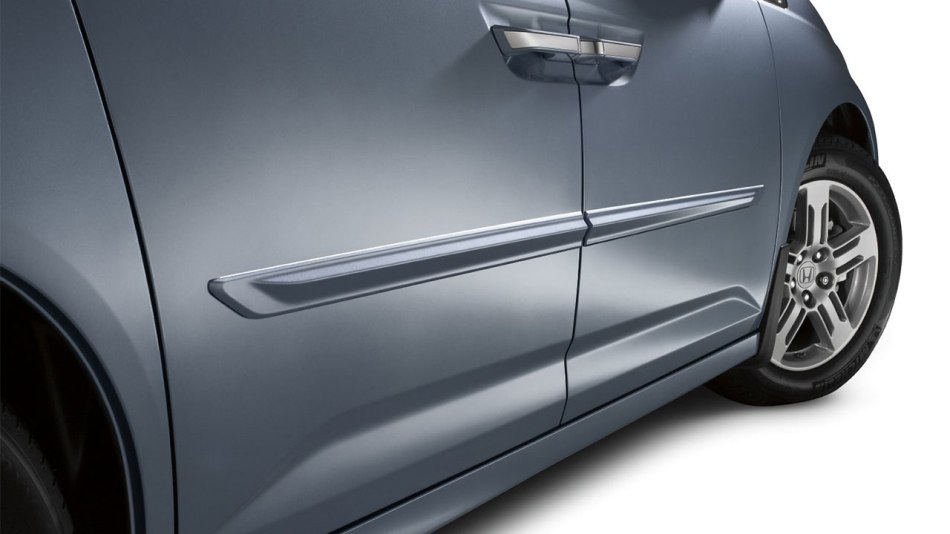
A molding is an add-on strip on the body, glass, or in a car’s interior that simultaneously protects the paintwork from minor impacts and scratches, covers seams and joints between parts, and highlights the body lines. Most often, moldings are installed on doors, bumpers, fenders, and sills; less often—on the roof and around the perimeter of the windows. They are made from plastic, rubber, chrome-plated plastic or metal, stainless steel, and carbon fiber.
Contents
- What is a molding on a car
- What moldings are for
- Where moldings are installed
- What moldings are made of and how they differ
- How moldings are mounted: self-adhesive tape or factory mounting points
- How to choose moldings for your car
- How to care for moldings
What is a molding on a car
The word comes from English (moulding — “profile,” “trim”): in construction, that’s the name for a decorative strip on a wall. In a car, it’s the same kind of strip, only on the body. At first, moldings were purely practical—a wide rubber or plastic strip on the side took the hits from neighboring car doors and shopping carts at the supermarket. Over time, they also became a design element: a chrome strip along the windows or a thin line on the doors makes the car look visually longer and more “premium.”
Today, a molding is any add-on strip mounted on top of the body, glass, or an interior panel. Some are installed at the factory as standard parts, while others are aftermarket tuning that the owner adds.
What moldings are for
At first glance, moldings may seem like decoration, but most of them perform several tasks at once:
- Body protection. A molding protrudes beyond the door surface and is the first to take a light impact: a neighboring car’s door in a tight parking lot, a branch, a cart, a small stone kicked up by the wheels. The scratch ends up on the trim, not on the paint.
- Decoration. Chrome, gloss black, or carbon-look moldings change a car’s character—making it more elegant, sportier, or more solid. They accent body lines and can visually adjust proportions.
- Concealment. Moldings cover technological seams, panel joints, mounting points for other elements, and also minor imperfections—an uneven joint or a trace of repair.
- Sealing and sound insulation. Rubber moldings around glass and door openings improve cabin tightness: less noise, moisture, and dust inside.
Where moldings are installed
By installation location, moldings are divided as follows:
- Door moldings — the most common. They run as a horizontal strip along the side and protect doors from dents and scratches; on SUVs they often come as a set for four doors.
- Bumper moldings — narrow inserts on the bumper that take minor touches during parking.
- Fender and wheel-arch moldings — protect fender edges from stones and dirt thrown up by the wheels. Often come together with arch extensions.
- Sill moldings — a strip along the lower part of the body between the wheels.
- Window moldings — trim around the side windows, windshield, and rear window. They can be decorative (often chrome) or serve as a seal.
- Roof moldings — cover the seam between the roof and the side panel.
- Interior moldings — decorative strips on the dashboard, door cards, and center console.
What moldings are made of and how they differ
The material determines both the look and how well the molding really protects the body. A comparison of the main options:
| Material | Strengths | Weaknesses | Where it fits |
|---|---|---|---|
| ABS plastic (black, painted) | lightweight, holds its shape, easily follows body curves | can crack from a strong impact | door and bumper moldings, wheel-arch trims |
| Rubber | absorbs impact, does not crack, seals joints | over the years it can harden and fade in the sun | protective strips, glass edging |
| Chrome-plated plastic | metal-like shine at low weight | the chrome layer is sensitive to abrasives and aggressive chemicals | window, door, grille decor |
| Stainless steel | does not rust, strong, durable | more expensive than plastic, harder to bend into complex shapes | window trim, sill plates |
| Carbon | lightweight, rigid, sporty look | the most expensive option | sport and premium models |
Separately, moldings are also classified by purpose: protective (wide, with a noticeable protrusion, often rubber or with a rubber insert), decorative (thin chrome or glossy strips that provide almost no impact protection), and combined—a plastic base with a chrome or rubber insert. If the main goal is to protect doors in tight parking spaces, choose a protective profile; if it is to refresh the look, choose a decorative one. Both types are collected in the car door moldings section, and shiny options are in the chrome moldings category.
How moldings are mounted: self-adhesive tape or factory mounting points
With double-sided tape
Most aftermarket and universal moldings are self-adhesive: double-sided mounting tape is already applied on the back. There is no need to drill the body, and the result depends on preparation:
- degrease the surface with isopropyl alcohol and wipe it dry with a lint-free cloth; glass cleaners are not suitable—they leave a film;
- apply in warmth: 3M, for its automotive mounting tapes, advises not working when the panel temperature is below 16 °C and, if needed, warming the panel with a heat gun to 16–43 °C;
- remove the protective liner from the tape immediately before installation, and press the molding along its entire length;
- for the first hours after installation, it is better not to wash the car or leave it in the rain—the adhesive gains strength gradually.
That is why moldings are not glued outdoors in winter: in a cold garage the tape may only partially bond, and the trim will come off at the car wash.
In factory mounting points
Vehicle-specific moldings for a particular car are often installed in place of the factory ones—on clips or into factory mounting holes. Such a molding precisely follows the door shape, but you need to select it based on the actual parts on your car: after a facelift, the shape of door moldings changes on many models.
How to choose moldings for your car
- Define the goal. Protection from impacts—a wide profile with rubber or plastic; decoration—chrome, gloss black, or carbon.
- Vehicle-specific or universal. A vehicle-specific set is designed for a particular body and model years, so the fit is precise. Universal moldings and chrome sold by the meter fit any car, but you need to cut them to length and mark everything carefully. You can see what is available specifically for your brand in facets such as moldings for Toyota, and options for any car are in the universal moldings section.
- Check the year and facelift. Pre-facelift and facelift versions of the same model often have different doors, so compare your factory moldings with the product photos.
- Consider the style of the whole car. Chrome moldings look better together with other chrome covers—for handles, mirrors, grille—while gloss black matches a “black package.”
How to care for moldings
Plastic and carbon moldings are washed along with the body using regular car shampoo. Rubber ones dry out and fade over time, so once a season it is worth treating them with a rubber care product. Chrome requires the most attention: abrasive polishes, stiff brushes, and acidic wheel cleaners destroy the thin chrome layer. We explained how to safely clean chrome parts in a separate article about cleaning chrome at home.
If the edge of a self-adhesive molding starts to lift, do not wait until airflow tears it off: remove the trim, clean off the old tape, degrease the surface, and reattach it with new double-sided tape in a warm room.
We deliver with Nova Poshta throughout Ukraine.