 Author: Radomskyi Maksym Vasyliovych
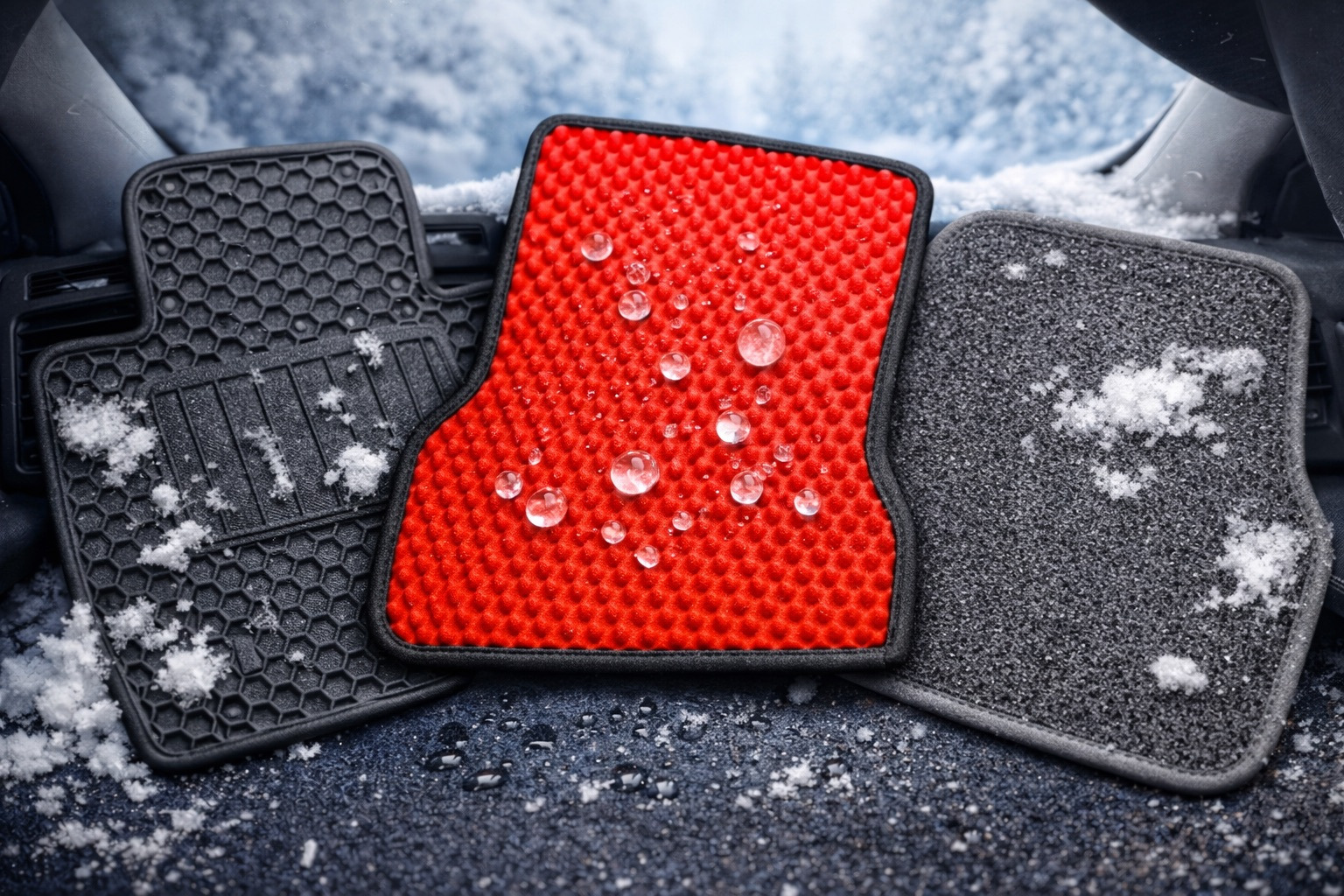
Winter and the off-season — a survival test for any floor mats: wet snow melts, water mixes with de-icing agents and sand, and dirt acts as an abrasive. The result: fogged windows, odors, stains on the carpet, and the eternal «mud pouring» after every trip.
In this article, we’ll break down EVA vs rubber vs textile mats without myths: how they behave specifically in wet conditions, which are easier to wash, which retain the «slush» of snow and dirt better, and which interior mats are best for your driving style. At the end — a purchase checklist and ready-made scenarios for different needs.
Contents
- 1) What matters most in winter and the off-season
- 2) EVA vs rubber vs textile: fact-based comparison
- 3) Numbers: how much water a mat can hold (theory + practice)
- 4) How to choose winter mats: 10-point checklist
- 5) Winter care: how to wash and dry to avoid odor
- 6) Ready-made solutions for different conditions (city/highway/off-road)
- 7) Legal and trust aspects: documents, TM, responsibility
- 8) FAQ
1) What matters most in winter and the off-season
When it’s wet outside, the key parameter is not «looks nice/doesn’t look nice», but moisture control. For winter conditions, mats should solve 5 tasks:
- Retain water and dirt so they don’t spread onto the carpet.
- Not interfere with pedals and not slip (safety issue #1).
- Be easy to clean (you won’t be «brushing out» sand daily in winter).
- Not become stiff in cold or crack when shaken.
- Not accumulate odor: moisture + organic matter = «swamp» in a few days.
The takeaway: in winter, the winner is not the softest material, but the one that best manages water and dirt without causing pedal/slip issues.
2) EVA vs rubber vs textile mats: honest comparison
2.1 In short: “who’s good at what”
- EVA — relies on structure (cells/pockets): water and sand “sink” into the cells and don’t move around. Plus — lightweight, easy to wash, quickly look “like new”.
- Rubber — relies on a solid waterproof tray, especially with high edges. Maximally “shields” the carpet from puddles. Downside — heavier, sometimes with odor, and without proper geometry/fixation may “slide”.
- Textile — comfort and “home-like” look, but moisture is absorbed into the pile. Good in dry weather (dust/small debris), but in winter often means a wet mat that needs drying.
2.2 Comparison table (winter/off-season)
| Criterion | EVA | Rubber | Textile |
|---|---|---|---|
| Water/snow retention | 4/5 — moisture “sinks” into cells, less splashing | 5/5 — especially with edges, works like a tray | 2/5 — absorbs, but stays wet and dries slowly |
| Dirt and sand | 4/5 — sand “falls” into cells | 4/5 — traps, but dirt often smears on surface | 3/5 — some dirt in pile, needs vacuuming |
| Cleaning | 5/5 — water jet/wash + shake | 4/5 — easy to “pour out”, but heavier, sometimes needs scrubbing | 2/5 — hard to wash, often needs dry cleaning/drying |
| Odor in humid season | 4/5 — with regular rinsing and ventilation | 3–4/5 — depends on material/quality and care | 2/5 — wet pile = odor risk |
| Cold/frost | 4/5 — usually elastic, but material quality matters | 4/5 — good rubber stays flexible in frost | 3/5 — doesn’t stiffen, but water in pile may freeze |
| Safety (slip/pedals) | 4/5 — with proper shape and fixators | 4/5 — with fixation and precise fit | 3–4/5 — depends on base (rubberized/spikes) |
| Comfort and look | 4/5 — modern look, practical | 3/5 — utilitarian | 5/5 — maximum “OEM” coziness |
| Typical “winter mats” scenario | Excellent (city/off-season) | Maximum protection (snow/puddles) | Only if dry or as a second set |
Note: ratings are practical guidelines for winter conditions. Actual results depend on shape (fit), edge height, fixators, and material quality.
2.3 Important nuance: edges on rubber mats
For “maximum protection”, high edges are key in rubber mats: they hold water and prevent overflow onto the carpet during maneuvers/braking. Typical declared edge height on “tray-type” rubber mats is around 3.5 cm (depending on model/manufacturer).
3) Numbers: how much water a mat can hold (theory + practical logic)
Honestly, a mat’s “capacity” depends on geometry, not just material. Below is a transparent formula + examples to compare without marketing fluff.
3.1 Formula (for a “tray” with edges)
Theoretical capacity ≈ Mat area (m²) × Edge height (m) × Useful volume coefficient (0.5–0.8)
- The coefficient accounts for relief, floor slope, and the fact that you don’t fill the mat “to the brim”.
3.2 Example for a rubber mat
Front mat area approx. 0.25 m², edge 0.035 m (3.5 cm), coefficient 0.6:
0.25 × 0.035 × 0.6 = 0.00525 m³ ≈ 5.25 L
So a “tray” with high edges can theoretically hold several liters of liquid before overflowing (in reality less, but the order of magnitude is clear).
3.3 Example for EVA with cells
In EVA, the key is not edges but the “micro-volume” of cells across the surface. Estimate:
Theoretical cell capacity ≈ Area (m²) × Working layer depth (m) × Void fraction (0.4–0.7)
Example: 0.25 m² × 0.01 m × 0.6 = 0.0015 m³ ≈ 1.5 L
This doesn’t mean “EVA is worse”. It means EVA often handles daily city moisture/snow (200–800 ml per day) more efficiently, while rubber “trays” win if you regularly bring in a lot of water/melted snow.
3.4 Textile: different math
Textile mats act like a sponge: they absorb. Sometimes a plus (no splashing), but a minus — need drying, otherwise risk of odor and “permanent dampness” inside.
3.5 Quick takeaway by numbers
| Scenario | Usually better | Why |
|---|---|---|
| City, short trips, light wet snow daily | EVA | Moisture and sand “settle” in cells, easy to rinse |
| Work/construction/rural, lots of mud | Rubber with edges | Maximum “tray” and overflow barrier |
| Dry climate / winter without de-icers, comfort priority | Textile or “summer/winter” set | Comfortable, but needs drying in wet season |
4) How to choose winter mats: 10-point checklist (safety + practicality)
- Exact fit for your car model. “Universal” ones almost always lose in protection and safety.
- Fixators/clips or anti-slip base. The mat must not slide under pedals.
- Pedal area. Nothing should block full pedal travel or foot movement.
- Edges or sill protection. Critical for winter (especially driver’s mat).
- Dirt management. EVA — cell quality and rigidity; rubber — relief depth and edge height; textile — base density and rubber backing.
- Washing/drying. Can you realistically do it 1–2 times a week in season?
- “Out of the box” smell. Strong odor often signals cheap compounds/plasticizers.
- Compatibility with car mounts. If OEM fixators exist — holes must match.
- Rear row. One-piece mat is often more practical (fewer “gaps” for dirt).
- Warranty and service. In season, quick replacement/spare parts matter.
If you’re looking for EVA solutions for winter: see selection and car-specific options here — EVA interior mats (catalog).
5) Winter care: 7 rules to avoid odor and “mud” underfoot
- Don’t keep water for weeks. Every 3–7 days (depending on weather) — remove, drain/shake, rinse.
- Rinse under pressure. EVA and rubber love a water jet: faster than “wiping with a rag”.
- Dry properly. The mat must dry completely before returning to the cabin (especially textile).
- Ventilate the cabin. 5–10 minutes daily in season really reduces humidity and odor.
- Avoid harsh chemicals unnecessarily. Neutral plastic/rubber cleaners are usually enough.
- Check under the mat. Every 2–3 weeks ensure the carpet underneath is dry.
- Textile — only with drying. If you can’t dry it — better have a winter EVA/rubber set.
6) Ready-made solutions: what to choose for your style (ideal for “ready-to-buy” traffic)
6.1 City + de-icers + dirty shoes (most common)
Recommendation: EVA or rubber with edges. If you value quick cleaning and neat look — EVA often wins. If you bring in lots of water/snow (SUV, kids, frequent trips) — rubber with high edges gives maximum “tray”.
6.2 Highway + snow + frequent long trips
Recommendation: rubber with edges or EVA with proper fit and fixation. On highways, safety is key: the mat must not move even a millimeter.
6.3 Rural / construction / hunting / fishing
Recommendation: rubber with edges. Here “overflow” is not theory but reality. You need maximum capacity and easy “pour/wash”.
6.4 Want maximum comfort and “OEM” look
Recommendation: textile as base + winter set (EVA or rubber). That is: textile for dry season, and in wet season — winter mats that don’t fear water.
7) Legal and trust (E-E-A-T): who we are, basis of statements, documents
7.1 About expertise and responsibility
Material prepared by the Digital Designs team (DD Tuning group) as a manufacturer and importer of car accessories. We write from practice: how mats behave in wet season, what’s easier to wash, common buyer mistakes, and what truly affects results (fit, fixators, edges, care).
Legal note: this article is informational and not a technical regulation, official expertise, or public offer. Specifications, sets, and compatibility may vary by car model, year, trim, and product batch.
7.2 Intellectual property documents
Digital Designs has official registrations in the State Register of Industrial Property of Ukraine. You can verify them in the open Special Information System of UKRNOIVI (SIS) for industrial property search.
- Document (invention/technical solution):registry record
- Document (invention/technical solution):registry record
- Trademark Digital Designs:registry record
7.3 A few facts about EVA material (to understand the logic)
Scientific reviews describe EVA foam as a material with cushioning and thermal insulation properties, also “moisture-resistant/protected” due to its closed-cell structure.
For “solid” EVA polymer, low water absorption (fractions of a percent) is typical, but for mats, the key is different: EVA mats usually don’t absorb water like fabric — water is mainly retained by geometry (cells/relief) and rinses off.
8) FAQ: quick answers to popular questions
- Which interior mats are best for winter?
- If your priority is maximum water protection: rubber with high edges. If you want everyday practicality and quick cleaning without puddles on the surface: EVA. Textile — better as a second set or for dry season.
- EVA or rubber: which is better for the off-season?
- In the city, where there’s plenty of dirt but not much flooding, EVA is very convenient: sand and water don’t spread around. If you often bring in lots of water (snow on boots, kids, SUV) — rubber with edges may be more practical.
- Can I combine sets?
- Yes, that’s one of the smartest options: winter mats (EVA/rubber), and textile — for dry season comfort.
- What’s more important: material or shape?
- In real life, shape often wins: precise fit, correct pedal zone, fixators, edges/sill protection. Even the best material won’t help if the mat “moves” or has gaps.
- Where to see EVA mats for my car?
- Here’s the selection page: EVA interior mats.
Conclusion: which type to choose (1-minute decision)
- Want maximum protection from water and dirt → choose rubber mats with high edges.
- Want a practical daily city option (moisture/snow/sand) → often the best balance is EVA (especially with proper fit and fixation).
- Want comfort and “premium” look → textile, but in winter better have a second set.
Next step: if you’re choosing mats — go to selection: mats (catalog).
Author: DD Tuning Team
Created: prepared with AI assistant participation; final editing and verification — DD Tuning team.
Updated: