 Author: Radomskyi Maksym Vasyliovych
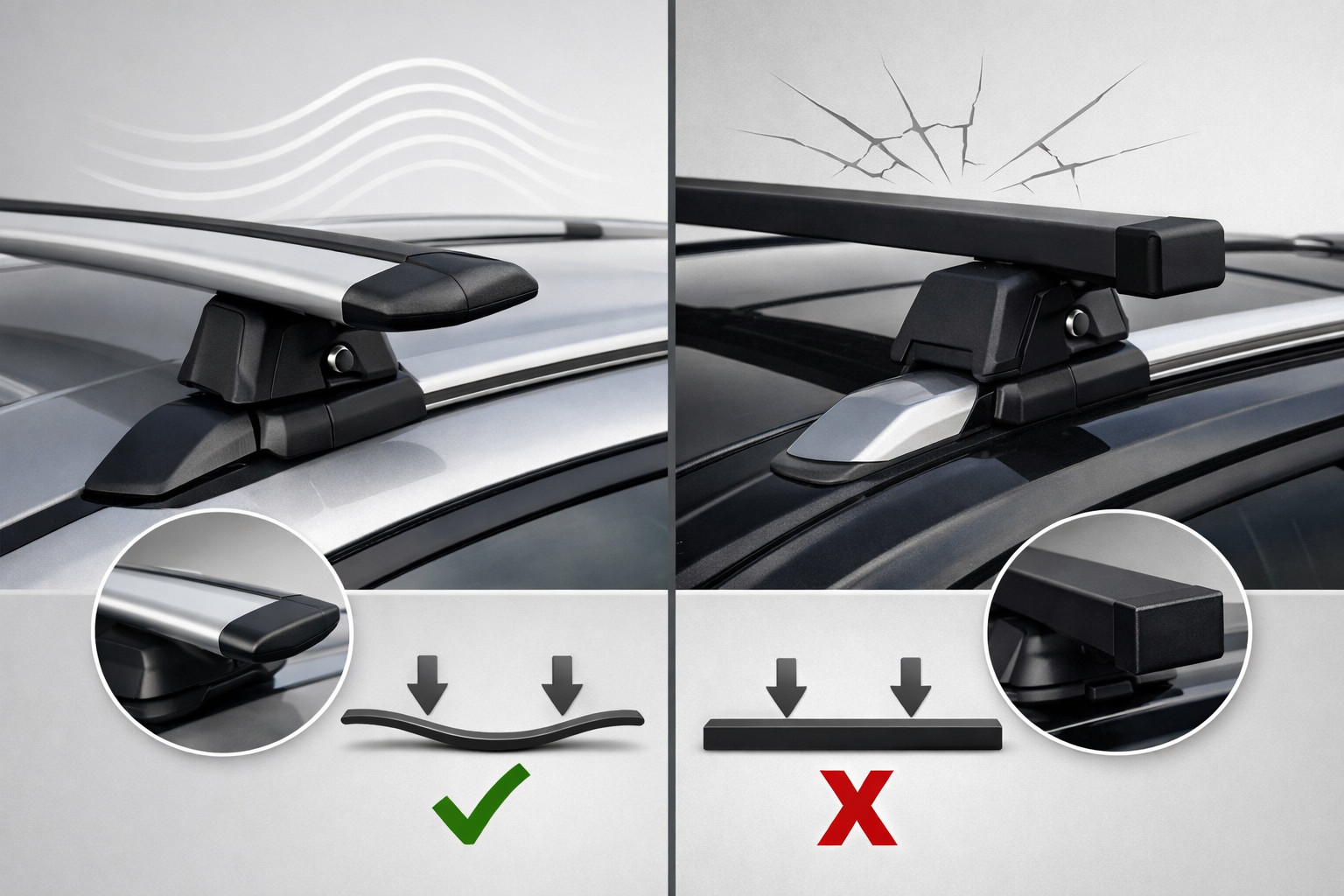
The difference between aerodynamic and rectangular crossbars most often shows up not as “stronger/weaker,” but in noise and air resistance at speed. An aero profile (teardrop/wing-shaped) usually produces less whistling and “rumble,” while rectangular/square bars more often create turbulence and challenge cabin sound insulation.
If you look at typical market ratings, load capacities for many models are quite close (often around 75–100 kg per set/pair). So the key practical dilemma is what matters more to you: highway comfort or a lower price and a simpler design—taking into account installation quality and correct комплектність.
What the choice really comes down to
Aerodynamic crossbars optimize airflow around the profile: fewer disturbances mean less noise and less aerodynamic drag. Rectangular crossbars look “simpler,” but because of the square section the flow separates from the edges more often, creating a characteristic whistle or hum at certain speeds.
Strength is a different story: the profile shape is hard to compare directly without a specific model and knowing exactly what’s certified (bar/set limit, the vehicle’s roof rating, mounting method). In practice, “quieter” is more often decided by the profile, while “stronger” is about staying within all limits and installing everything correctly.
Which criteria you should compare
Installation and completeness. Even the best profile can be noisy if the crossbars are assembled incompletely (missing/not installed rubber inserts, caps not closed where required, a T-slot component seated incorrectly). Quietness often comes down to small details.
Noise at speed. Focus on the profile and whether the manufacturer claims reduced noise/sound energy and reduced drag. For example, Thule WingBar claims a 13 dB noise reduction versus its predecessor and a significant reduction in noise energy.
Service life and weather resistance. Over the long run, material quality, corrosion protection, seal performance, and mounting stability under vibration matter.
Practicality. Ease of installing accessories (availability of a compatible T-slot/system), clear instructions, removal/installation speed, access to mounting points.
Price and the “cost of quiet.” Aerodynamic systems are often more expensive, so it makes sense to assess what speeds you drive at and whether you take regular highway trips.
Quick comparison of options (table)
| Option | Strengths | Weaknesses | Who it’s for |
|---|---|---|---|
| Aerodynamic crossbars (wing/airfoil) |
|
|
|
| Rectangular/square crossbars |
|
|
|
Detailed breakdown of each option
Aerodynamic crossbars
Noise. The idea is controlled airflow: a wing-shaped profile reduces disturbances and, accordingly, sound effects at speed. In the Thule WingBar example, the manufacturer claims a 13 dB noise reduction and a significant reduction in noise energy versus its predecessor. Important: this isn’t a guarantee for every vehicle, but the direction is clear.
Drag and system “fatigue.” Lower drag theoretically means less load from airflow and less “wobble” in the wind. WingBar press materials state reduced drag force compared to the predecessor. In real use this is most noticeable on long trips, where noise and vibration accumulate.
Strength. In a typical segment, rated limits are often close. For example, in a specific comparison Thule SquareBar and Thule WingBar Evo have a maximum load of about 100 kg, but that doesn’t mean all aero/square systems are always like that. Safety is determined by the lowest limit in the whole setup: crossbars + accessories + the vehicle’s roof rating.
Installation as a factor in quietness. If you don’t install the required rubber elements or leave certain areas open, an aero profile can lose part of its effect. So the rule is simple: assemble it as per the manual and check fitment.
Rectangular/square crossbars
Noise. Square edges and flow separation at the corners generate turbulence more often. Because of this, on the highway rectangular crossbars often start “whistling” at noticeably lower speeds than aerodynamic equivalents. The exact threshold depends on the vehicle, wind, bar height above the roof, and any additional accessories.
Strength. The profile alone doesn’t guarantee weakness or strength: internal reinforcement, joint stiffness, and how the manufacturer tested the system matter. For example, in the Thule SquareBar example the maximum load is stated at about 100 kg—meaning a “square” bar can be perfectly workable for typical tasks (within the rating and with correct mounting).
Practicality. Rectangular crossbars are often easier to maintain: it’s easier to visually assess positioning and more obvious how an accessory is supported. If you install/remove cargo infrequently and noise isn’t critical, this can be a rational compromise.
Which option is better for different scenarios
| Scenario | What to choose | Why |
|---|---|---|
| Frequent highway driving / long routes | Aerodynamic crossbars | Less turbulence and lower noise at speed; in test/claimed data for a wing profile there’s usually a significant advantage |
| City driving, short distances, occasional use | Rectangular/square | The noise difference matters less, and savings can be noticeable with similar rated load capacity |
| Cabin comfort is important (frequent conversations, kids, sensitivity to noise) | Aerodynamic crossbars | Even with similar load ratings, a wing/airfoil profile typically produces fewer “whistling” components |
| Budget is limited, need reliable basic load carrying | Rectangular/square | With correct installation and respecting the lowest load limit, the system can be practical |
| Planning many accessories (mounts, boxes, racks), compatibility required | Whichever type has the more accurate mounting system | It’s not only about the profile: compatibility with your accessories and properly closed/installed elements are key |
Use-case scenarios and what to choose (table)
| Scenario | What to choose | Why |
|---|---|---|
| You often drive 100–130 km/h and hear background noise from the bars | Aerodynamic | This is exactly where the turbulence difference shows; an aero profile is usually quieter |
| Loads are infrequent, mostly short trips, the main thing is that it holds | Rectangular/square | In many cases the rated limits are sufficient, and city noise is less often an issue |
| You care about precise adjustment and neat installation | Aerodynamic | The quietness effect is stronger when installation follows the instructions and all parts are installed as intended |
| You don’t want to spend time fine-tuning completeness | Rectangular/square | They’re often less sensitive to small completeness nuances, though checking torque is still necessary |
Common mistakes when choosing
- Focusing only on profile shape rather than the lowest limit of the whole system. Bar ratings may look the same, but the vehicle roof rating or accessory limits may be lower.
- Ignoring installation as a noise factor. If aerodynamic crossbars are assembled incompletely or not fixed as per the manual, noise can appear even with the “right” profile.
- Choosing based on claimed “-dB” without understanding the conditions. These figures depend on the vehicle, configuration, and installed accessories. Compare the direction and profile type, not only absolute numbers.
- Not considering compatibility and accessory mounting. If you need specific mounts, check whether the system fits your tasks (T-slots/mounting elements).
- No re-check after installation. Even correct installation can “settle” after the first drive. For example: Thule recommends checking the mounting after a short run (often specified as a check after ~50 km).
When a more expensive solution makes sense
More expensive usually means an aerodynamic profile and a more refined hardware system. It’s worth paying for if you truly notice cabin noise at speed or regularly drive long distances. In these scenarios, the “less turbulence — less noise” effect is usually the most noticeable.
Higher cost is also often justified if you want to combine crossbars with different accessories and rely on convenient within-system compatibility. Premium brands’ materials emphasize design elements for correct fitment and reduced noise factors, not just the profile itself. A practical guide to correct roof rack installation can be found on the page how to choose a roof rack.
If you rarely drive fast and the main task is to carry something once a month and noise isn’t a problem, rectangular crossbars may offer a better “price/practicality” balance.
Conclusion
In short: quieter is almost always delivered by aerodynamic crossbars, because the profile suppresses turbulence and reduces aerodynamic drag. Strength within the same segment is often similar—the deciding factors are not the shape itself, but correct installation, mounting quality, and staying within the lowest limit of the entire system.
Practical verdict: choose an aero profile if you drive on the highway and want to minimize whistling/humming in the cabin. Choose rectangular if budget matters more and your trips are mostly urban or short, and noise isn’t critical for you.
Pros and cons
Aerodynamic crossbars usually create less turbulence, so a whistle or hum appears less often at speed.
For aerodynamic models, brand materials often cite reduced noise and noise energy (for example, for Thule WingBar, -13 dB and a reduction in noise energy are claimed).
Lower aerodynamic drag is possible: in the WingBar example, reduced drag force is claimed compared with the previous model.
Within one segment, the rated loads for different types of crossbars are often similar (often around 75–100 kg per set/pair), so overall system compatibility matters more.
Aerodynamic crossbars may start to make noise if installation is incomplete: rubber inserts are missing or the intended elements are not closed.
The difference in noise for rectangular crossbars often becomes apparent earlier and at lower speeds due to turbulence, which can be noticeable in the cabin.
"Strength" is not limited to the profile shape: real safety is determined by the lowest limit of the entire setup (crossbars + accessories + the car's roof rating), and this is harder to verify without specific data.
For rectangular profiles, the noise threshold and character depend on the car, the height of the crossbars above the roof, and additional accessories, so the result is harder to predict with certainty.