08.05.2026
376
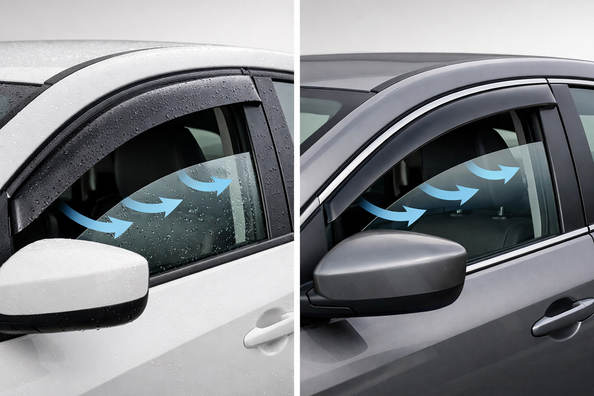
For frequent cabin ventilation, it’s usually worth choosing not just “which wind deflectors are cheaper,” but which type won’t cause glass-related issues in daily use. If an in-channel set fits your model precisely and the window regulator doesn’t work under strain, this is usually the most convenient option: it looks cleaner, has no external adhesive tape, and makes it easy to keep the window slightly ajar in rain or heat.
But there’s no universal answer. If your car has sensitive auto-up/anti-pinch, you’ve already experienced window squeaks, or you simply want the easiest installation with no interference in the window channel, stick-on deflectors are more practical. One more important point: both types only reduce buffeting and air blasts—they don’t make the car silent.
The idea is simple: for frequent ventilation you need a deflector that lets you regularly open the window to a small gap without rain getting into the cabin, without extra noise, and without conflicts with the window regulator. So the key factor isn’t the look by itself, but reliable daily operation.
In-channel models are strong when you want a cleaner, near-OE result and proper compatibility with a specific door channel. Stick-on models are strong where fast installation, lower risk of glass rubbing, and predictable operation on cars with sensitive window electronics matter most.
| Option | Strengths | Weaknesses | Who it’s for |
|---|---|---|---|
| In-channel | Clean look, no external tape, convenient for regular ventilation in rain and heat | May conflict with the glass or auto-up, sensitive to fit accuracy | Those who want daily ventilation and have a vehicle-specific set with no window regulator issues |
| Stick-on (on the frame) | Easier installation, less risk to the window mechanism, quick basic rain protection | More visible from the outside; results depend on surface prep and adhesive quality | Those who value easy installation and smooth, trouble-free window operation |
DD Tuning expert comment: the most common mistake is buying the first cheap set you see and judging only the shape of the plastic. In reality, what matters is fit accuracy for your specific model, how the glass behaves after installation, and following the curing/settling time in the first days. If the window closes with resistance after installation, the issue should be addressed immediately, not left to “wear in.”
This is the logical choice for those who ventilate the cabin often and want the cleanest result. These deflectors sit in the window channel, so from the outside they look more subtle and don’t have an adhesive strip on the door frame. For daily opening the window a few centimeters, this is often the most convenient format.
Their weak point is demanding compatibility. If the channel shape, seal, or the deflector itself isn’t matched perfectly, you may get noise, glass rubbing, marks on tint, or the window bouncing back while closing. After installation, these sets often need a settling period with the windows fully raised—from a day to several days—and that should be considered too.
This option is simpler and more predictable to install: the deflector is bonded to the outer part of the door frame and doesn’t go into the window channel. That’s why on cars with sensitive window regulators or auto-up/anti-pinch, the stick-on type often proves calmer in everyday use.
The compromise is different: the exterior look is a bit more noticeable, and durability depends heavily on installation. If you bond it in cold weather, on a dirty surface, or without proper pressure, the edges may lift or you may get adhesive residue after removal. For city driving and short trips this is often enough, but for the cleanest result, stick-on models are rarely the first choice.
For both types there’s one shared rule: the material and brand matter, but even more important is how specifically the set is made for your body style. A poorly fitted deflector will be noisier or won’t last as long regardless of the mounting method.
If the car is parked daily under the sun and you regularly leave the windows slightly open, a vehicle-specific in-channel set usually offers the best balance of rain protection and a normal look. This is the case where paying extra is often justified.
If the car spends a lot of time on the highway, you should look not only at the type but also at fit accuracy. A well-fitted in-channel option can be quieter and cleaner, but a bad set will cause more complaints than a quality stick-on one.
For cars with frameless doors, sensitive auto-up/anti-pinch, or a history of glass issues, it’s safer to start with stick-on solutions. For taxis, service vehicles, and fleets, more expensive vehicle-specific sets make sense when consistent quality across identical body styles matters.
| Scenario | Best choice | Why |
|---|---|---|
| Daily ventilation in the city | Vehicle-specific in-channel | Convenient for regular use, look cleaner, work well with a small window opening |
| Car with sensitive auto-up/anti-pinch | Stick-on | Lower chance the deflector will interfere with the glass travel |
| Need the easiest installation | Stick-on | No need to go into the window channel; easier to control the result |
| Maximum clean look matters | Vehicle-specific in-channel | Less noticeable on the doors and no external adhesive strip |
| Frequent highway trips | Quality vehicle-specific set, more often in-channel | At speed, fit accuracy is critical; a good set works better than a cheap universal one |
| Fleet or several cars of the same body | More expensive vehicle-specific sets | Consistent quality, predictable installation, and fewer random issues over long-term use |
Paying extra makes sense when you truly ventilate daily, drive a lot in rain or on the highway, and don’t want to redo the installation. In these conditions, a more expensive vehicle-specific set wins not by “status,” but by more precise fit, more stable operation, and a lower chance that the glass or adhesive will start annoying you after a month.
If you’re choosing with minimal risk, start from the window deflectors category, separately check why vehicle-specific kits usually win in daily use, and before installation review how to install deflectors correctly so you don’t ruin the fit or the adhesive base.
From a customer’s experience: a driver parked the car daily and wanted to ventilate the cabin regularly without rain getting inside. At first he looked at a cheaper universal option, but chose a quality in-channel set for his model, waited the proper settling time after installation, and as a result got normal window operation without bounce-back and a clean look with no external tape. For his scenario, it turned out to be more practical than replacing budget kits several times.
For frequent cabin ventilation, the best choice in most cases is quality in-channel deflectors for your specific car model—provided they don’t create resistance for the glass. If you have sensitive auto-up/anti-pinch, there’s a risk of rubbing, or you simply need an easier installation, a quality stick-on option will be the smarter and calmer choice in use. This conclusion is based on real selection experience, installation practice, and real daily-use scenarios—not on an abstract difference in the names of the types.
| ✔ | Inset deflectors require precise fitment: if the set is not fitted perfectly, squeaking, glass rubbing, or the window regulator protection may trigger. This is especially critical for cars with sensitive window electrics. |
| ✔ | Stick-on models are more visible from the outside, and their durability depends heavily on proper surface preparation and the installation temperature. If applied in the cold or onto a dirty frame, there is a risk of the edges peeling off. |
| ✔ | Deflectors do not eliminate noise completely, but only reduce it. The level of comfort still depends on the shape of the doors, the seals, and the fit accuracy. |
| ✔ | After installation, some kits require keeping the windows closed for one to several days. If this is not done, the fit may be compromised in the first few days. |
| ✔ | Model-specific inset deflectors are well suited for everyday ventilation: they look neater and allow you to keep the window slightly open in rain or heat. For city driving, this is a convenient option without an external adhesive strip. |
| ✔ | Stick-on deflectors are easier to install and are less likely to interfere with the glass movement. This is practical for cars with sensitive auto-closing or when you do not want to interfere with the window channel. |
| ✔ | Both types reduce drafts and air bursts while driving. As a result, you can ventilate the cabin more comfortably even if the window is opened only slightly. |
| ✔ | A model-specific kit for a particular car usually provides better everyday compatibility than a universal set. In the article, this is directly linked to fewer problems during long-term use. |
| ✔ | With proper installation and the required curing time after fitting, deflectors can be useful in rain, heat, and during frequent highway trips. A more expensive kit makes sense if you really use ventilation every day. |
| ✘ | Inset deflectors require precise fitment: if the set is not fitted perfectly, squeaking, glass rubbing, or the window regulator protection may trigger. This is especially critical for cars with sensitive window electrics. |
| ✘ | Stick-on models are more visible from the outside, and their durability depends heavily on proper surface preparation and the installation temperature. If applied in the cold or onto a dirty frame, there is a risk of the edges peeling off. |
| ✘ | Deflectors do not eliminate noise completely, but only reduce it. The level of comfort still depends on the shape of the doors, the seals, and the fit accuracy. |
| ✘ | After installation, some kits require keeping the windows closed for one to several days. If this is not done, the fit may be compromised in the first few days. |
Shipping to EU
Wholesale and retail
Own warehouse
Опис продукту
Подарунки не надаються при оформленні покупки у кредит під 0,01% або при покупці частинами.