10.01.2026
955
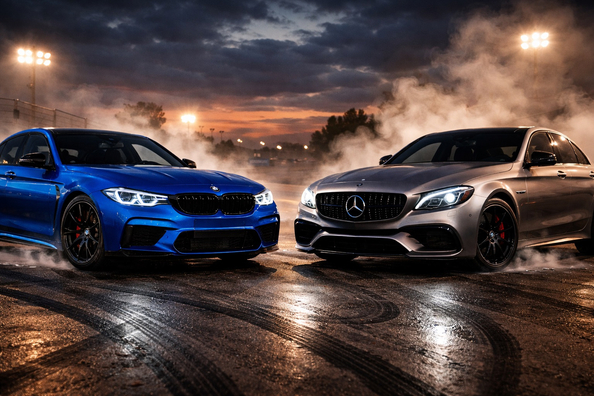

The BMW M5 (F90 body) and Mercedes-AMG E63 S are two legendary German supersedans that embody extreme power and luxury. It is especially interesting to compare models from the same production year, such as 2021, when both manufacturers refreshed these cars. In 2021, BMW carried out the M5 facelift (LCI), while Mercedes introduced the updated E63 S (W213 Mopf). Both cars are equipped with twin-turbo V8 engines, all-wheel drive, and the latest driving technologies. Let’s take a closer look at their technical specifications, performance, pricing, and other aspects to find out which one leads on paper and on the road.
For clarity, the main technical specifications of the BMW M5 F90 and Mercedes-AMG E63 S 2021 model year are presented in the table below. Both cars share many similarities, but there are also important differences in power, acceleration, and other parameters.
| Specification | BMW M5 F90 (2021) | Mercedes-AMG E63 S (2021) |
|---|---|---|
| Engine | 4.4 L V8 Twin-Turbo (S63) | 4.0 L V8 Twin-Turbo (M177) |
| Power (max.) | 600 hp (441 kW) standard 617 hp (460 kW) Competition | 603 hp (445 kW) (612 hp in European version) |
| Torque | 750 Nm @ 1,800 rpm | 850 Nm @ 2,500 rpm |
| 0–100 km/h | ≈3.3 s (Competition) ~3.4 s (standard) | ≈3.4 s (factory data) |
| Top speed | 250 km/h (limited) 305 km/h with M Driver’s Package | 250 km/h (limited) 300 km/h with Drivers Package |
| Transmission | 8-speed automatic (Steptronic) | 9-speed automatic (AMG MCT) |
| Drive | All-wheel (M xDrive, 100% RWD mode available) | All-wheel (4MATIC+, Drift Mode available) |
| Curb weight | ≈1,980 kg | ≈2,010 kg |
| Fuel consumption (combined) | ~12.5–13 L/100 km (17 MPG) | ~11.5–12.5 L/100 km (18 MPG) |
Note: Power in hp is given in metric horsepower. Acceleration data are approximate factory and tested results. Both cars feature all-wheel-drive systems with the ability to disconnect the front axle for drift mode. Fuel consumption is shown according to the EPA (US) standard for comparison; actual figures may vary.
The high-performance luxury sedan market naturally comes with high prices. Let’s look at the approximate cost of the BMW M5 and Mercedes-AMG E63 S in 2021 across different markets:
Thus, in terms of cost, both cars belong to the same segment and depend more on the specific market and condition. Buyers in Ukraine often consider importing from abroad, as the official price of new cars is very high.
Both the BMW M5 F90 and Mercedes-AMG E63 S have significant strength and performance reserves, offering great tuning potential. The stock 0–100 km/h acceleration is already around 3.3–3.4 seconds, but enthusiasts and tuning studios can further improve these figures. Let’s look at each model’s potential:
BMW M5 F90: The 4.4-liter S63 engine is known for its flexibility in increasing power. Without major modifications, a Stage 1 remap can add +100 hp – up to ~700 hp and ~850 Nm. For example, G-Power tuning packages allow ~740 hp on stock turbos (without particulate filters in the exhaust, as in US markets). Deeper tuning with hardware upgrades yields impressive results: Stage 2 – around 780 hp and 950 Nm, Stage 3 – up to 820 hp and 1000 Nm of torque. With such upgrades, the M5 can accelerate 0–100 km/h in under 3 seconds (~2.9 s recorded) and exceed 330 km/h top speed. Importantly, the M5’s chassis and transmission can handle such loads, although long-term reliability under extreme tuning depends on build quality and maintenance.
Mercedes-AMG E63 S: The 4.0-liter twin-turbo V8 from AMG (code M177) also responds well to tuning. The renowned Brabus offers the “Brabus 800” kit for the E63 S, increasing power from ~612 hp to 800 hp and torque to 1000 Nm. After such an upgrade, 0–100 km/h drops to ~3.0 s (vs ~3.4 s stock), and the top speed limiter is removed, reaching ~300 km/h. Other tuners (Renntech, AC Schnitzer, etc.) also offer ECU remaps, upgraded turbos, exhaust, and intercoolers. Results are similar – easily exceeding 700–750 hp without sacrificing reliability if serviced properly. It’s worth noting that tuning the E63 S requires attention to its complex suspension (air elements) and electronics – excessive power increases may require brake and suspension upgrades to maintain balance.
Thus, both supersedans have huge tuning potential. With the right budget and expertise, they can be turned into true “supercar killers” while retaining sedan comfort and practicality. There are even projects where M5 Competition and E63 S were pushed beyond 800+ hp, allowing them to compete with hypercars in straight-line races.
High-performance cars require particularly careful maintenance. Both the BMW M5 and Mercedes-AMG E63 S feature complex technology that lasts long with proper care, but misuse or saving on service can lead to issues. Let’s look at the reliability and maintenance specifics of each model:
BMW M5 (F90): Modern versions of the S63 engine are much more reliable than earlier ones, though previous generations had known issues. Earlier, premature wear of rod bearings (especially under aggressive high-rpm driving) and turbocharger failures due to overheating or oil starvation were noted. In the F90 version, most of these problems were resolved – improved cooling, materials, and bearing design. However, basic rules remain: frequent oil changes (more often than the ~10k km interval, ideally every 5–7k km under spirited driving), monitoring oil level (S63 can consume oil under load), and timely replacement of spark plugs and ignition coils (they operate under high stress). Owners also note that to prolong turbo life, it’s best to let the engine cool after hard driving (avoid shutting off a hot engine immediately). The M5’s suspension is strong (adaptive dampers), but rough roads can cause premature wear of bushings and shocks – repairs are costly. Overall, with proper care, the M5 F90 shows high reliability for a 600-hp car – many owners drive tens of thousands of kilometers without major issues.
Mercedes-AMG E63 S (W213): The M177 (4.0 V8 Biturbo) engine is also considered reliable but has its quirks. One common owner complaint is increased oil consumption. Under spirited driving, the engine can use noticeable amounts of oil, so regular level checks and top-ups are necessary. This is due to design (thin piston rings for reduced friction) and high turbo temperatures. Another potential issue is turbo lifespan: like BMW, the two turbos located in the “hot V” operate under heavy load. If oil changes are delayed or poor-quality oil is used, turbo bearing wear may occur. Symptoms include whistling, exhaust smoke, and power loss. Additionally, with direct injection, carbon buildup on intake valves can occur over time, affecting performance (solved by walnut blasting). The 9-speed AMG Speedshift MCT gearbox handles 850 Nm but also requires maintenance – oil changes every ~60k km are recommended, especially with frequent track use. The AMG Ride Control air suspension provides comfort and handling benefits but may need attention over time: air struts can lose pressure or the compressor may fail. Signs include body sagging, uneven height, or suspension errors on the dashboard. Repairing air struts or compressors is expensive, so owners should be prepared for such costs at 50–100k km. Both cars come with powerful steel brakes, but heavy use (track) can cause fast wear; optional carbon-ceramic brakes are more durable but very costly. Overall, the Mercedes E63 S is reliable with proper service – owners note that the chassis and engine handle high loads well. Timely maintenance (including costly oil, spark plug, and filter changes) ensures consistent performance without failures.
Maintenance costs: Service for these models is significantly more expensive than for mass-market cars. For example, in the UK, manufacturers offered service packages: M5 – ~£999 for 3 years, E63 S – ~£1,620 for 3 years. In Ukraine, official maintenance is also costly: an oil change alone can cost several hundred dollars due to ~9 liters of premium synthetic oil and filters, while scheduled service (brakes, fluids, etc.) easily exceeds $1,000. Therefore, future owners should budget substantial funds for upkeep.
Both cars received positive reviews from automotive journalists and enthusiasts. Reviewers note that the BMW M5 and Mercedes-AMG E63 S go “neck and neck” in performance, and the choice largely depends on personal preference. Here are some quotes and summarized opinions:
Overall, both journalists and owners agree that these two models represent the pinnacle of engineering in the sports sedan class. The BMW M5 focuses more on combining business-class comfort with explosive performance, while the Mercedes-AMG E63 S captivates with emotion and the spirit of a sports car in a sedan body. The choice often comes down to which driving style and image suit the buyer best.
Summing up this comparison, it’s safe to say there’s no wrong choice between the BMW M5 F90 and Mercedes-AMG E63 S – both offer stunning performance and luxury. However, there are nuances that may tilt the balance depending on the owner’s preferences:
In conclusion, choosing between the M5 and E63 S is a choice between two sides of perfection. For the pragmatic driver who wants to balance daily comfort and performance while staying under the radar – the BMW M5 is the ideal partner. For the charismatic leader who wants every drive to express a passion for speed and style – the Mercedes-AMG E63 S becomes an extension of their personality. Whichever sedan you choose, you’ll own a car that delivers excitement on every kilometer of the journey.
Shipping to EU
Wholesale and retail
Own warehouse
Опис продукту
Подарунки не надаються при оформленні покупки у кредит під 0,01% або при покупці частинами.