

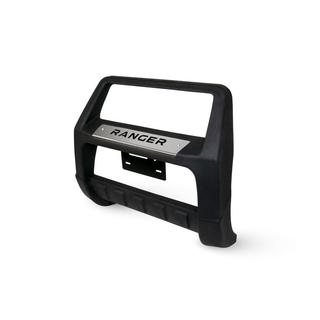
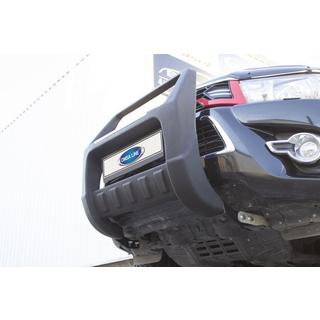
2
Article: 2617OKJ101
price 255 GBP
Made to order
Delivery time: 1-2 days
A bull bar (front bar) is a protective tubular bar mounted in the factory mounting points in front of the bumper. It takes the first impact, shielding the bumper, radiator grille, and headlights. This section features vehicle-specific bull bars, front bars, and front guards for a particular make, model, and model years: most options are for vans and panel vans, SUVs, pickups, and crossovers. Almost all are made of stainless steel. They differ by shape (tall bar, “horseshoe”, low tube, or a combination with “whiskers”), finish (mirror chrome or black “Black”), and tube diameter—from 42 to 76 mm, most commonly 60 mm.
| Type | What it protects | For which vehicles and tasks |
|---|---|---|
| Tall bar (classic bull bar, “safari”) | Bumper, radiator grille, and partly the headlights; may be with or without a lower grille | SUVs, pickups, vans that often drive off-road |
| “Horseshoe” | Center of the bumper, grille, and lower air intake, without side “ears” | Crossovers and minibuses when you don’t want to overload the front end |
| Low front bar, lower tube, “whisker” | Lower edge of the bumper—against curbs, stones, bollards; slightly reduces ground clearance | City driving and parking; the most subtle-looking option |
| Bull bar “with whiskers”, combined | Main bar plus single or double lower tubes that protect the bumper corners | For example, Mercedes Viano, Renault Trafic, Ford Connect, Opel Movano |
| Rear bar or rear corner guards | Rear bumper or only its corners | Reversing and parking; with a tow bar, corner guards are often more convenient |
A bull bar is also called a “kenguryatnik”, front bar, or front guard; worldwide you’ll see bull bar or roo bar. On the website, bull bars are collected in the bull bars and side steps section together with side steps, rear bars, and running boards; compact bars are also available for minivans and station wagons.
The front end is the most vulnerable: the plastic bumper, radiator grille, headlights, and the radiator itself are the first to suffer both from minor contact and from off-road driving. A bull bar covers these areas with metal.
Designs differ in height, width, number of tubes, and how much of the bumper they cover. In the catalog they may be listed as “bull bar”, “front bar”, or “front guard”; you may also find lower/upper tubes and “whiskers” as separate items.
The letters and numbers in the name—WT002, WT003, WT004, WT005, WT018, WT022, QT006, QT007, Kelebek WT011, Shark, ST014, etc.—identify the design. The same series is produced for different vehicles, so it’s easy to compare shapes by product photos and quickly find the style you like.
Material. Almost all bull bars in the catalog are made of stainless steel (“stainless” marked in the name). This metal won’t rust even if the top layer gets scratched, it resists road chemicals, and it doesn’t need painting. The surface is polished rather than chrome-plated, so nothing peels over time, and light scratches can be removed with polishing compound. A cheaper market alternative is mild steel with paint or thin chrome: easier on the budget, but once the coating chips, moisture gets underneath and rust appears after a few winters.
Finish: chrome or Black. About half of the models come in two versions: classic mirror (main finish—chrome) and black marked “Black”. The black version is the same stainless steel in a different finish: it’s less visually dominant on the body and pairs well with black grilles and wheels.
Tube diameter. Product pages offer tube diameters from 42 to 76 mm; the most common is 60 mm. Diameter is the outside measurement, not the wall thickness: “60 tube” means 60 mm across. A thicker tube looks more rugged and suits large SUVs and vans, while a thinner one (50–51 mm) looks lighter on crossovers and compact vehicles. On some models you can choose the diameter on the product page; others combine two tubes of different diameters.
With lettering or without. Many models include a plate with the vehicle brand name; some have a version without lettering. In the lettered version, the center is typically a plate instead of a tube—compare the photos of both versions. The choice does not affect mounting.
Bull bars in the catalog install into factory mounting points. The set includes the stainless steel bar itself and a mounting kit, so you don’t need to buy hardware separately. No welding or drilling of structural body elements is required: the brackets match the location of factory holes on the frame or bumper reinforcement.
During installation it’s important to keep a gap between the tube and the bumper: under strong pressure the bar flexes slightly, and the gap prevents it from pressing into the plastic. Mounting points are usually under the bumper—on the frame, longitudinal members, or reinforcement—so it’s more convenient to work on a lift or over a pit. Before final tightening, center the bar, check clearances and license plate visibility. Bolted joints must be tightened securely—this affects whether the protection works in an impact. If you don’t have the experience or tools, have it installed at a workshop.
This section includes over a thousand vehicle-specific bull bars and front bars. You can select yours using the “Make / Model” and “Vehicle type” filters—SUV, pickup, minibus, commercial vehicle, compact van, minivan, passenger car.
The largest selection is for Volkswagen, Nissan, Mitsubishi, Ford, Toyota, Renault, and Mercedes-Benz. Most of the range is made by the Turkish manufacturer CAN; there are also models from Omsa Line, GBT, and Libao.
A bull bar is often complemented with other heavy-duty body accessories: side steps, a matching rear bar, roll bars for pickups, and a tow bar. If you’re looking specifically for protection of the lower part of the bumper, also check the front guards section.
The first similar designs appeared on pickups in the USA—wooden frames used to herd cattle. Protective bars became widespread in Australia, where drivers on rural highways protected radiators from collisions with kangaroos—hence the English name roo bar, and locally the name “kenguryatnik”. In Germany this bar is called Frontschutzbügel, and in the UK and Australia—bull bar. Since then, the design has evolved from a roughly welded heavy-tube frame into a neat, vehicle-specific accessory engineered for a particular body.
This description was prepared with the help of AI based on the analysis of over 1 million phone calls between DD Tuning managers and customers, plus the company knowledge base. We collected the questions customers ask most often and the answers proven in practice.
Shipping to EU
Wholesale and retail
Own warehouse
Опис продукту
Подарунки не надаються при оформленні покупки у кредит під 0,01% або при покупці частинами.

