 Author: Radomskyi Maksym Vasyliovych
In winter, a carbon overlay turns cloudy not because of the fiber itself, but because of the clear coat above it: salt, road chemicals, sand, and water drying on the surface gradually dull it, while harsh washing and an ice scraper leave scratches. Keeping the gloss is simple: wash the part gently and regularly, especially after salted roads, don’t let water dry in droplets, apply non-abrasive wax or a ceramic coating before the season, and never chip ice off the spoiler or mirrors. Below is what exactly damages the clear coat and how to care for carbon mirror caps, spoilers, and diffusers until spring.
Contents
- Why carbon turns cloudy and yellows
- What winter does to the clear coat on a carbon part
- How to wash carbon overlays in winter
- Wax or ceramic: how to protect carbon before winter
- How caring for matte carbon is different
- Snow and ice on the spoiler and mirrors: what not to do
- What to do if the clear coat is already cloudy
Why carbon turns cloudy and yellows
Natural carbon is a carbon-fiber fabric impregnated with resin and topped with a clear coat. The clear coat is what gives that deep gloss, and it is the first to give up. Manufacturers of carbon parts and detailing studios agree: it’s not the weave that ages, but the top clear layer. Under UV exposure, temperature swings, and weather, it oxidizes, becomes dull, a “milky” film or a yellowish tint appears, while the fiber underneath remains the same.
That leads to the main care rule: everything you do to a carbon overlay, you are doing to the clear coat. If the clear coat is intact and clean, the part will look like new for years. If you scratch it, rub it with abrasives, or constantly leave it under a salty film, clouding will come sooner.
Don’t confuse natural carbon with “carbon-look” film: film has different rules—we covered those separately—how to care for carbon film. And about the difference between manufacturing technologies, read the article “Dry or wet carbon”.
What winter does to the clear coat on a carbon part
UV is the main enemy of clear coat in summer. In winter, other factors add to it, and the parts that take the worst beating are those sitting in the stream of grime: mirror caps, front lips, diffusers, and side skirts.
| What causes damage | What it looks like on carbon | What to do |
|---|---|---|
| Road salt and chemicals | Gray film, streaks, dull spots that don’t disappear after a simple rinse | Wash the part after driving on salted roads, without waiting for spring |
| Sand and fine gravel | Fine scratches and a “web” on the clear coat, especially on the diffuser and side skirts | Rinse the dirt off with water first, only then touch it with a sponge or cloth |
| Water drying in droplets | White spots, streaks, localized clouding | After washing, dry with a soft microfiber towel |
| Ice scraper, stiff brush, shovel | Deep clear-coat scratches that polishing may not remove | Brush snow off with a soft brush; let ice melt |
| Aggressive chemicals at touchless car washes | Wax or sealant strips off faster, leaving the clear coat unprotected | After such a wash, refresh protection more often |
American carbon aero body kit manufacturer APR Performance explicitly advises in its care instructions to clean carbon parts after driving on salt-treated roads and not to let water dry on the surface: according to them, this leads to hard-water spots, clouding, white stains, and deterioration of the clear coat.
How to wash carbon overlays in winter
Carbon with factory clear coat is washed with the same products used for a car’s paintwork. APR puts it this way: if a product is safe for your car’s paint, it’s safe for carbon too—just avoid acidic and aggressive cleaners.
- First—thorough rinsing. Sand and salt must be rinsed away with water before you touch the part with a sponge; otherwise you’ll drag abrasives across the clear coat.
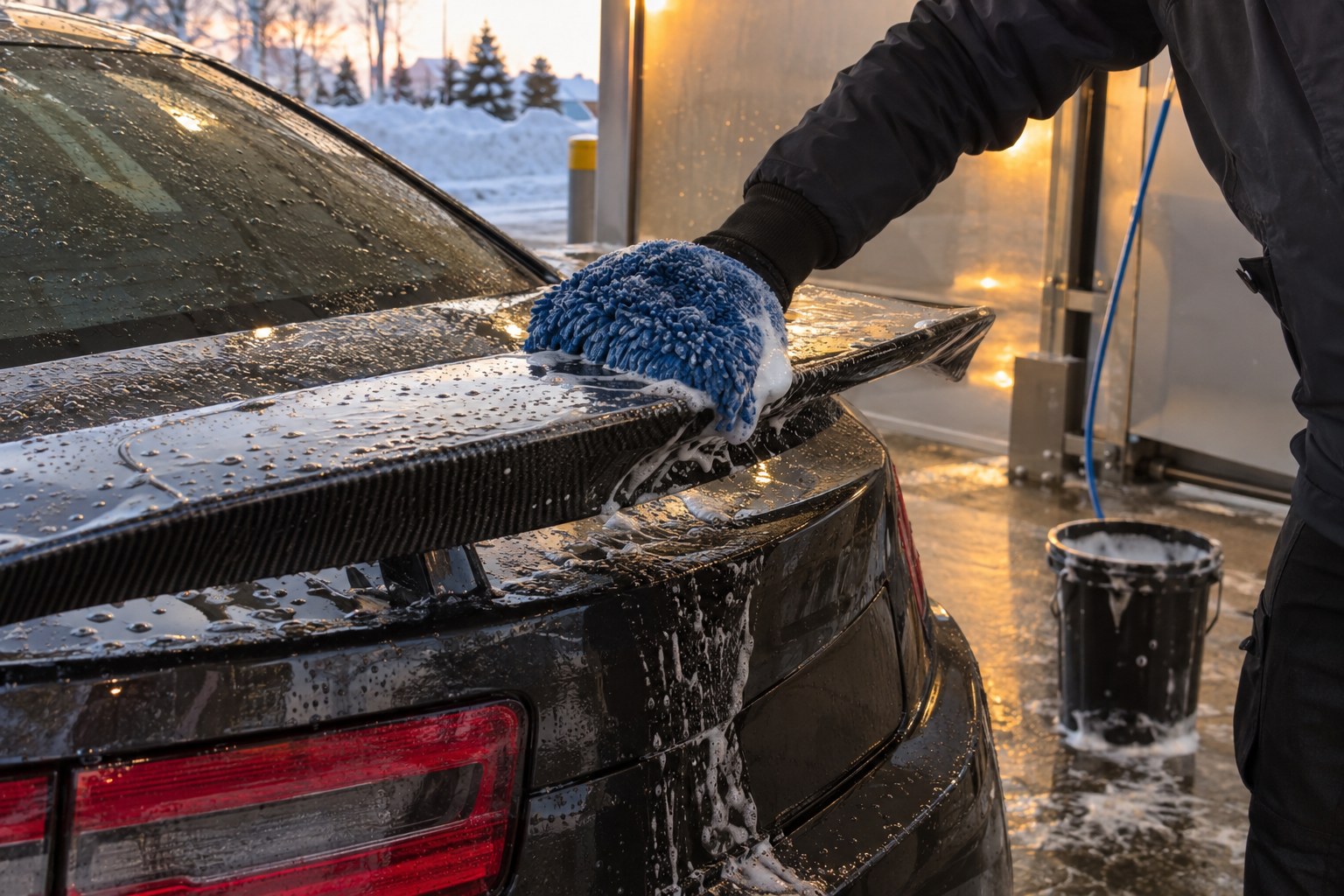
- A gentle car shampoo and a separate clean microfiber towel or wash mitt. The two-bucket method (one bucket with shampoo, the other with clean rinse water) reduces the risk of scratches.
- Pressure washer—not up close. Keep the jet at the distance recommended in your vehicle manual (often about 30 cm), and don’t aim it at overlay edges and joints at an angle.
- Brush automatic wash—with caution. Dirt trapped in the brushes leaves micro-scratches in the clear coat, and repeated washes gradually make the surface dull. For cars with carbon aero parts, hand washing is safer.
- Dry after washing. Don’t let droplets dry or freeze on the part—wipe it with a soft microfiber towel.
- Don’t wash in direct sun and don’t pour boiling water on a frozen part: a sharp temperature change isn’t good for the clear coat, and the water will freeze again immediately.
Wax or ceramic: how to protect carbon before winter
A protective layer on top of the clear coat is a “sacrificial” barrier: salt and grime stick to it instead of the clear coat and rinse off more easily. Before winter, the choice is:
- Non-abrasive liquid wax. APR recommends periodically applying a non-oxidizing liquid wax, as you would on the body, and avoiding paste wax: pastes often contain abrasives that gradually wear away the clear coat.
- Ceramic coating (SiO₂). According to APR, with proper care an additional layer isn’t mandatory, but ceramic extends the part’s lifespan. Its service life depends on the specific product; for example, British car-care brand Auto Finesse claims up to 12 months of protection for its coating.
- Refresh during the season. If you frequently use touchless washes with strong chemicals, wax or sealant will wear off faster—check whether water still beads on the part.
Wax and ceramic are applied to a clean, dry part in a warm indoor space: on a cold, wet surface the products won’t bond well. Check the temperature range in the instructions for the specific product.
How caring for matte carbon is different
Matte carbon looks “dry” precisely because its top layer isn’t smooth. Any product that levels the surface brings back gloss—and you can’t undo that. So for matte parts the rules are stricter:
- don’t polish and don’t apply regular wax: glossy spots will appear;
- don’t wash in a brush automatic;
- hand-wash with a gentle shampoo, using straight top-to-bottom motions, without circular movements;
- protect only with products that explicitly say “for matte finishes.”
Gloss carbon, on the other hand, can be carefully polished and waxed like regular paint.
Snow and ice on the spoiler and mirrors: what not to do
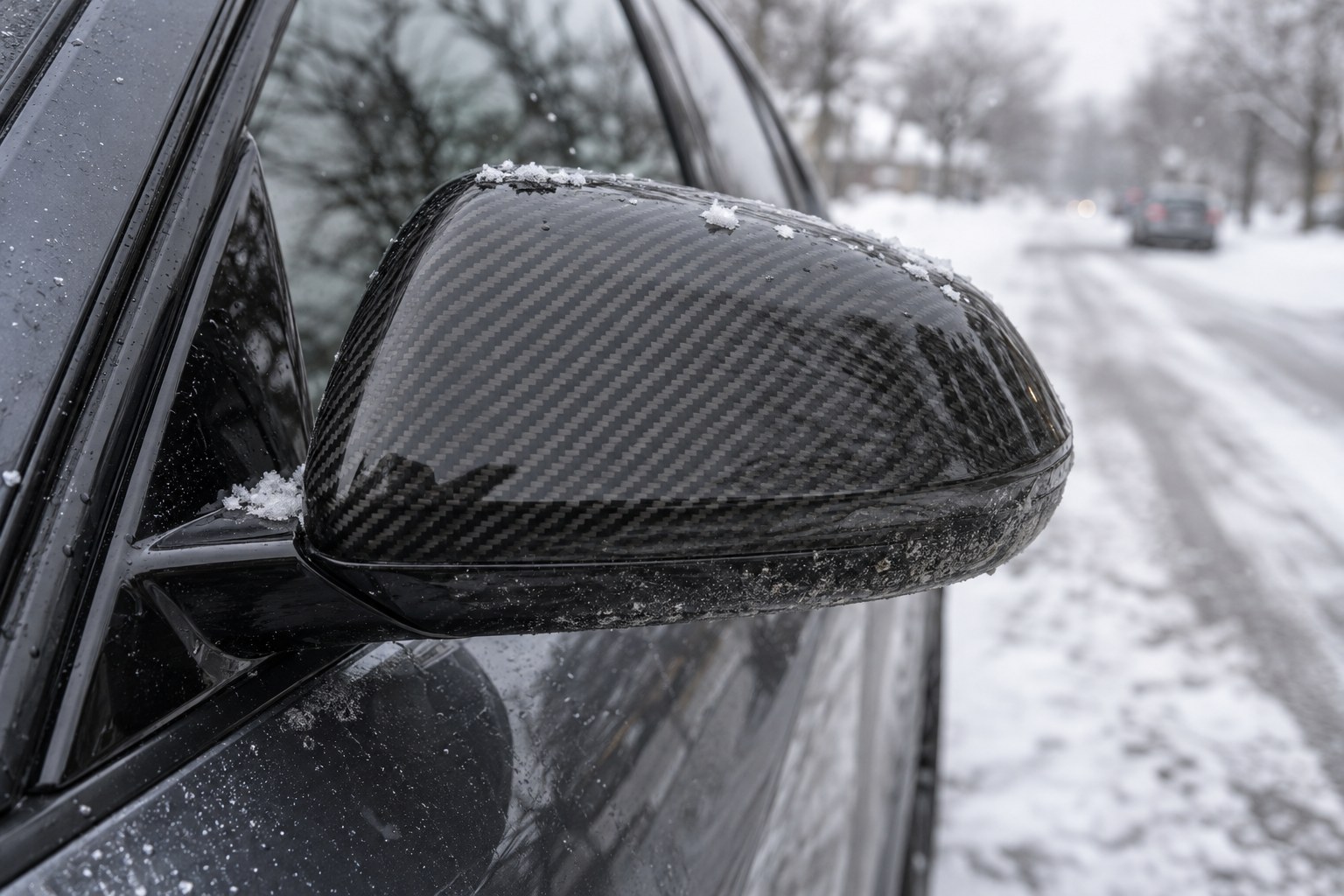
The trunk-lid spoiler and mirror caps are the first to get covered in snow and ice. The part itself isn’t afraid of it—unsafe cleaning methods are.
- Don’t chip ice off with a scraper and don’t tap the spoiler: a plastic scraper on carbon leaves clear-coat scratches, and a hit to a thin edge can easily chip the clear coat.
- Brush snow off with a soft brush in the direction of the weave, without pressing.
- Let ice melt: in a warm parking garage or after a drive it will come off on its own.
- Don’t leave glass de-icer on carbon: if it gets on it—rinse with water.
- A car cover should be clean and dry only: synthetic covers, according to APR’s observations, can leave residue on the clear coat, so it’s worth inspecting the part periodically under the cover.
What to do if the clear coat is already cloudy
Surface clouding and light oxidation of the clear coat are usually removed by polishing: the part is washed, clayed to remove embedded particles, polished, and immediately sealed with wax or ceramic. This job is best entrusted to a detailing shop: an aggressive compound and a machine with too much pressure can cut through the clear coat down to the resin.
Deep yellowing is a different story: if the resin under the clear coat has changed color, polishing won’t fix it—the part needs to be re-cleared. That’s why it’s cheaper to preserve the clear coat than to restore it.
If you’re just choosing carbon mirror caps, a spoiler, or a diffuser—see the catalog of carbon overlays, including for BMW and Porsche Taycan, and about choosing mirror caps specifically—read the article “Carbon mirror caps: benefits and features”.
We ship via Nova Poshta throughout Ukraine.
How it works
- Rinse off salt and sand with water Rinse the trim, spoiler, and diffuser thoroughly before touching them with a sponge. Keep the pressure washer at the distance recommended in the vehicle manual, and do not direct the jet at the edges of the parts.
- Wash with a mild car shampoo Use a non-aggressive shampoo, a clean microfiber cloth or mitt, and, if possible, two buckets: one with shampoo and one with clean water for rinsing.
- Wipe the part dry Do not let drops dry or freeze on the carbon: dried water leaves white spots and hazes the clear coat.
- Apply protection On a clean, dry part in a warm room, apply liquid non-abrasive wax, sealant, or ceramic coating. For matte carbon, use only products for matte surfaces.
- Remove snow and ice without a scraper Brush off snow with a soft brush, and let ice melt in the warmth or after a drive. Do not use a scraper on carbon.
- Repeat after salted roads Wash carbon parts after driving on salted roads and check whether the water still beads up — if not, renew the wax.