08.10.2026
36
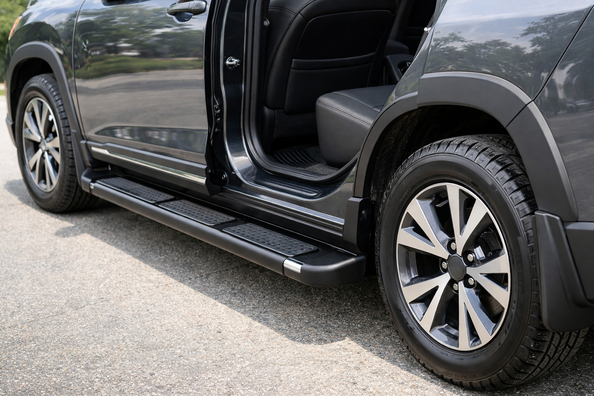
This upgrade plan is for an owner of a tall crossover or a large SUV where it’s awkward for the driver or passengers to get in, and the lower part of the doors and the outer sills get dirty quickly. If the goal is practical rather than decorative, the logic is simple: first make a convenient step for entry, then cut off dirt from the wheels, and only after that protect the areas that get scratched by shoes.
There’s no ready-made universal kit for every vehicle here: the result depends on body height, generation, door opening shape, the presence of fender flare extensions, and who most often gets into the car. For a family scenario with kids or elderly passengers, the priorities are one thing; for frequent trips onto rocks or ruts, they’re another.
This upgrade has two separate tasks. The first is to provide a clear foothold so you don’t have to hop into the cabin or wipe your clothes against a dirty body side. The second is to reduce the amount of water, snow, sand, and small stones that fly onto the sills and the lower edge of the doors.
It’s important not to mix up different types of upgrades. External side steps help you get in. Mud flaps reduce wheel-thrown dirt. Inner door-sill plates don’t make entry easier; they only take the scratches from shoes. If you buy only sill plates, they won’t solve the high step-in problem.
The first priority for a tall body is wide side steps or running boards with a proper foot platform. A good reference is a platform about 127–152 mm wide: it’s easier for kids, elderly passengers, and anyone who doesn’t want to pull on the steering wheel or pillar while getting in to place their foot. Solutions that are too narrow or tucked too tightly under the body often look neat, but in daily use turn out to be less comfortable.
The second step should be mud flaps. They won’t make the car spotless, but they genuinely reduce the stream of dirt onto the steps, the lower door edge, and the sill itself. If you’re installing both steps and mud flaps, the steps go on first and only then the mud flaps: this matters for both compatibility and proper fitment.
If the vehicle often goes onto serious off-road terrain, regular low steps can eat into usable ground clearance and snag. In that scenario it’s better to look at either retractable options, or removable or protective rocker rails with a platform—where entry assistance is combined with protection for the lower body.
| Upgrade | Why it’s needed | Who really benefits |
|---|---|---|
| Wide side steps 127–152 mm | Provide a stable step for getting in and out | Families with children, elderly passengers, owners of tall vehicles with a high step-in height |
| Retractable running boards | Make entry easier, but when retracted they affect ground clearance less | Those who want convenience in the city but don’t want a constant low protrusion along the side |
| Removable or protective rocker rails with a platform | Combine entry assistance with better protection over uneven terrain | Those who drive not only on asphalt, but also over rocks, ruts, and broken access roads |
| Mud flaps | Reduce the flow of dirt, water, and small stones onto the sills and doors | Almost everyone who drives in rain, snow, on gravel, or on muddy roads |
| Inner door-sill plates | Take wear marks and scuffs from shoes | Those who often carry passengers and already have scratches on the inner sill |
| Illuminated sill plates | Work mainly as a visual accent | Those who knowingly choose a decorative part and don’t expect easier entry |
DD Tuning expert comment: the most common mistake is buying something nice-looking instead of what solves the task. People choose narrow steps because they’re less noticeable, or illuminated plates because “they’re sills too,” and then wonder why getting in didn’t become easier. The second typical mistake is not checking compatibility with fender flare extensions and installing mud flaps before the steps.
After steps and mud flaps, it’s logical to move on to protecting the inner sill. Plates here make sense not as decoration, but as a sacrificial layer: the inner edge is most often scratched by soles, kids’ shoes, heels, or bags. This is especially noticeable on light-colored bodies and on vehicles where people often get into the second row.
The second stage is also a good time to refine your scenario. If after a few weeks you see the step is convenient but there’s still a lot of dirt along the side, it means you should take a closer look at the mud flaps’ shape and size. If the issue isn’t dirt but the sill contacting rocks or ruts, then the next step isn’t decorative parts, but stronger protection for the lower body.
This group includes sill plates, including illuminated ones. They’re pleasant in everyday use because they hide wear and let you stop worrying about the factory paintwork, but they have almost no effect on the actual entry process. If the main complaint is “it’s hard to swing my leg in,” sill plates are not the first purchase.
This also often includes long side platforms that visually make the body look bulkier. If they’re wide and positioned correctly, they can be useful. But when the choice is made purely for appearance, without evaluating step height and entry geometry, you can end up with an upgrade that collects more dirt than it helps.
What’s wasted money is anything that doesn’t match your specific scenario. The first typical mistake is overpaying for illuminated sill plates when what you needed was a proper step. The second is steps that are too narrow or too short, where it’s uncomfortable to place your foot—especially for second-row passengers.
Another mistake is buying complex and expensive automation just because it tucks under the body, even though the vehicle hardly ever drives where every centimeter of ground clearance matters. For city use, regular wide steps and properly chosen mud flaps are often enough. For serious off-road use, on the contrary, decorative platforms can turn out to be unnecessary and vulnerable.
| Scenario | What to install first | What can be postponed | What isn’t required |
|---|---|---|---|
| Urban tall crossover, daily driving | Wide side steps, then mud flaps | Inner sill plates | Retractable running boards, illuminated plates |
| Family vehicle, kids or older passengers get in often | Wide steps with a full platform, then mud flaps | Sill plates after the first signs of wear | Decorative solutions without a practical foot platform |
| City plus dirt roads or trips onto rough roads | Either retractable running boards or protective rocker rails with a platform; then mud flaps, if compatible | Inner sill plates | Low decorative steps that reduce ground clearance without real benefit |
In short: first stage is entry, second is fighting dirt, third is protection from wear marks. In that order, spending usually delivers a noticeable result.
More expensive solutions make sense in two cases: when you need to combine easy entry with better ground-clearance retention, or when standard parts can’t handle your driving conditions. Then it’s logical to look not at random universal accessories, but at the right categories: running boards as the basis for convenient entry, mud flaps to fight dirt, and sill plates to protect the inner edge from shoes.
Paying extra is justified if the vehicle frequently changes surfaces, has a tall body, and carries passengers who truly need help getting in. It’s not justified when an expensive module is chosen only for looks, and the task could be solved with a simpler set of wide steps and well-matched mud flaps.
From a customer’s experience: on a large family crossover, they initially wanted to install only sill plates because shoe scratches had appeared. After consultation, they started with steps, then added mud flaps, and left the plates for the second stage. As a result, the kids started getting in without a jump, and the lower doors and the steps themselves became noticeably cleaner in rainy weather.
For a tall crossover or SUV, the most sensible order is: first wide side steps or another comfortable foot platform, then mud flaps, then inner sill plates. If the vehicle often sees uneven terrain, it makes sense to consider retractable or protective solutions right away, which are less harmful to ground clearance.
The key is not to confuse useful with decorative: lighting and nice plates don’t replace a proper step, and a random universal kit doesn’t always match the geometry of a specific body. This material is based on real selection experience, practice, and real-use scenarios—so the order of upgrades here isn’t “for the picture,” but for everyday convenience.
| ✔ | Wide side steps with a proper stepping surface really make getting in and out easier, especially for children, elderly passengers, and people who find it difficult to swing a leg into the cabin with a high step. |
| ✔ | Mud flaps noticeably reduce the amount of water, snow, sand, and small stones thrown onto the sills and lower edge of the doors, so the vehicle stays cleaner for longer in rain or on gravel. |
| ✔ | Inner sill covers are useful as a protective layer against scuffs and scratches from shoes, heels, or bags, especially if passengers often sit in the second row. |
| ✔ | Retractable or protective sills with a platform are suitable for vehicles that sometimes drive over stones, ruts, or broken driveways: they provide convenient access without such a strong compromise in ground clearance. |
| ✔ | The correct sequence of upgrades makes the result predictable: first the steps, then the mud flaps, and only after that the inner sill protection. |
| ✘ | Illuminated sill covers are often bought instead of a real step, but they do very little to help you get into the car and mainly serve a decorative purpose. |
| ✘ | Overly narrow or short side steps look neat, but in everyday use they are uncomfortable to place your foot on, especially for second-row passengers. |
| ✘ | Low decorative steps can reduce ground clearance and catch on uneven surfaces, so they are a weak solution for serious off-road use. |
| ✘ | Mud flaps do not remove dirt completely; they only reduce its flow, so without the right shape and compatibility, the effect may be limited. |
Shipping to EU
Wholesale and retail
Own warehouse
Опис продукту
Подарунки не надаються при оформленні покупки у кредит під 0,01% або при покупці частинами.