 Author: Radomskyi Maksym Vasyliovych
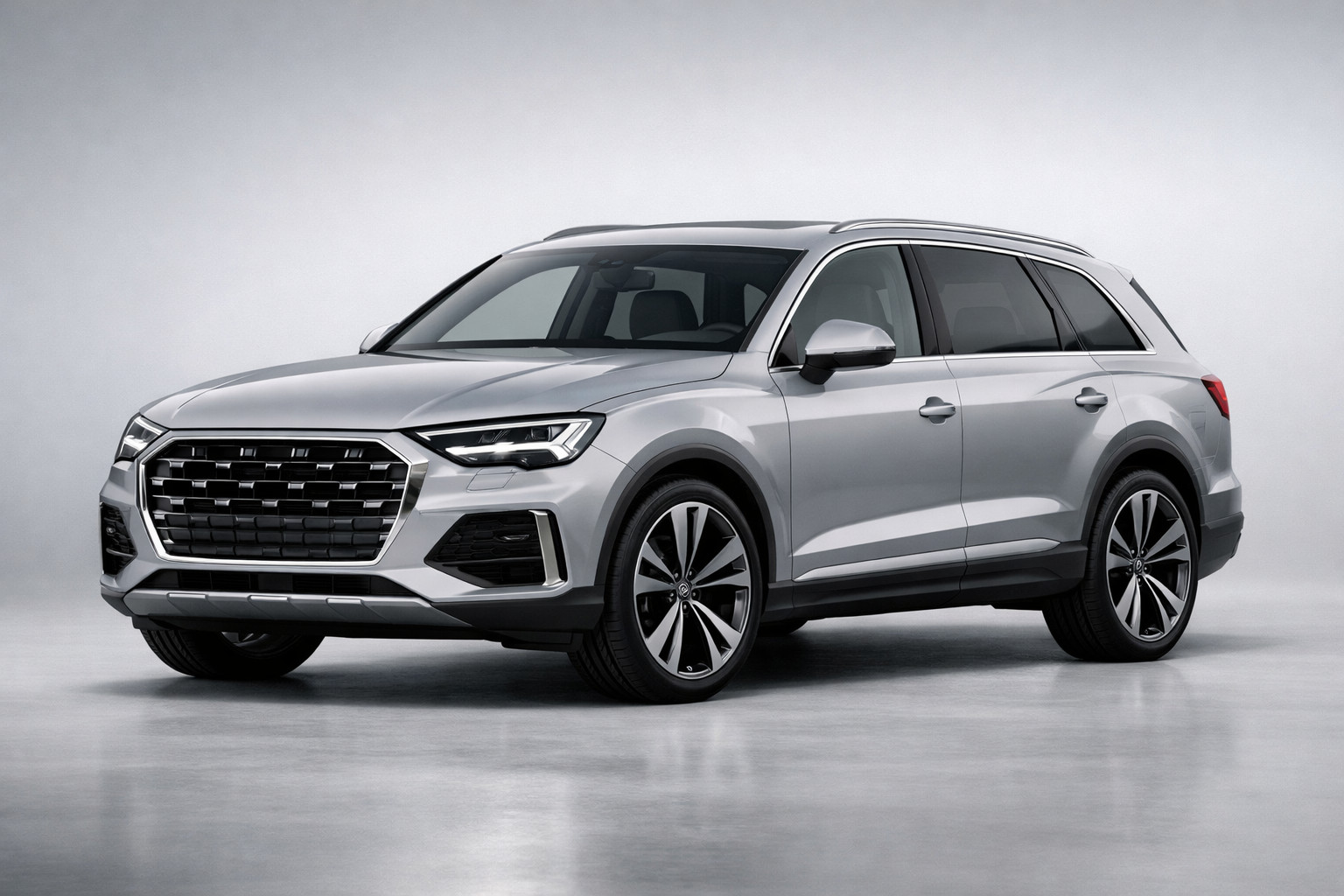
The third-generation Audi Q7 was officially unveiled on June 9, 2026, and conceptually it’s not an attempt to make a big crossover the sportiest of them all, but the opposite — the most comfortable, quiet, and spacious vehicle possible for family use, long trips, and towing. Orders in Europe opened in summer 2026, while in the US it’s effectively a 2027 model year, so the specifications show noticeable market differences.
An important nuance: there is no full reliability statistics and no large-scale owner feedback yet, because production vehicles are only just reaching the market. So the new Q7 is best judged through official specifications, first tests, and the practical logic of using a large family crossover.
The model and its place in the market
The new Q7 plays in the large premium crossover segment, where buyers typically choose between Audi, the BMW X5, and the Mercedes-Benz GLE. Audi’s main bet isn’t razor-sharp responses, but space, highway comfort, all-wheel drive, and a very richly equipped interior. This is a vehicle for those who value quietness, seating comfort, a third row, and towing capability — not the feeling of a light body in corners.
Against its rivals, the Q7 looks especially strong where an all-around family format is needed. For the US, seven seats come standard, while in Europe 5-, 6-, and 7-seat configurations are available. In other words, the model is aimed not only at business trips, but also at real family use with kids, luggage, and long routes.
Generations and model history
The Q7 has long been Audi’s core large crossover. The first generation brought the brand into this class in the mid-2000s, the second moved to a lighter architecture and became more technological, and the third generation for 2026 shifts the focus not to a revolution in shape, but to deep digitalization, comfort, and interior versatility.
| Generation | Years | What matters |
|---|---|---|
| First | 2005–2015 | A big, heavy crossover with a strong emphasis on space and the model’s status in the Audi lineup. |
| Second | from 2015 until the generational change | Lighter platform, more modern driver aids, several updates over the lifecycle. |
| Third | premiere in 2026 | A new generation with revised hardware, a different interior, a broader electronics suite, and new powertrain versions depending on the market. |
For the buyer, this means one simple thing: the Q7 2027 is not just another cosmetic refresh, but a separate new generation. So compatibility of accessories, interior parts, and exterior add-ons with older Q7 models needs to be checked very carefully.
Engines and transmissions
At launch, the European lineup looks sensible: a 3.0-liter diesel V6 in two power outputs — 245 or 299 hp — with a mild-hybrid system. For this class, it’s a logical engine: plenty of torque, relaxed highway cruising, and a chance at moderate fuel consumption. In the US, the focus is different: the base Q7 gets a 2.9-liter gasoline V6 with 429 hp, and the SQ7 gets a 4.0-liter V8 with 591 hp.
| Version | Engine | Power | Transmission and drivetrain | Practical takeaway |
|---|---|---|---|---|
| Q7 for Europe | 3.0 L diesel V6 | 245 hp | mild hybrid; for the market an emphasis on all-wheel drive is stated | The most logical option for long trips and high mileage. |
| Q7 for Europe | 3.0 L diesel V6 | 299 hp | mild hybrid; for the market an emphasis on all-wheel drive is stated | The same character, but with a better reserve of pull under load. |
| Q7 for the US | 2.9 L gasoline V6 | 429 hp | 8-speed automatic transmission, permanent all-wheel drive | Very quick for a family crossover, but without diesel efficiency. |
| SQ7 | 4.0 L gasoline V8 | 591 hp | 8-speed automatic transmission, permanent all-wheel drive | The version for those who want not only space, but also very high performance. |
Fuel consumption also depends on the market. The European diesel is quoted at around 7.1–8.0 L per 100 km, but real-world tests already show noticeable variation. The American gasoline Q7 is officially rated at about 10.7 L in the combined cycle, and the SQ7 at roughly 14.7 L. Put simply: the new Q7 can be either a relatively economical long-distance cruiser or a very fast, but much more expensive-to-run crossover.
Body, dimensions, and chassis
The Q7 remains a large vehicle with no attempt to pretend it’s more compact. Wheelbase is 2995 mm, length 5050 mm, width 2012 mm, height 1808 mm. This translates into a roomy second row, proper seating geometry, and a trunk that truly works in a family scenario, not only in a brochure.
| Parameter | Value |
|---|---|
| Length | 5050 mm |
| Width | 2012 mm |
| Height | 1808 mm |
| Wheelbase | 2995 mm |
| Cargo volume behind the third row | 428 L |
| Cargo volume behind the second row | 1243 L |
| Maximum cargo volume | up to 2212 L |
| European cargo volume in the 5-seat version | 806 L |
| European cargo volume in the 7-seat version | 722 L |
| Towing capacity | up to 3493 kg |
| Curb weight | about 2330 kg |
| Ground clearance | an official unified value for all markets should not yet be considered fully confirmed; it depends on the suspension and version |
Chassis-wise, the new Q7 also stays true to the class. In the US, the regular Q7 comes standard with steel springs, air suspension is optional, and on the SQ7 adaptive air suspension is standard. All-wheel steering is available, but early tests describe the character the same way: very smooth, very quiet, yet with light steering and noticeable body mass. In other words, it’s a comfortable large crossover, not a vehicle for spirited driving.
Interior, comfort, and safety
The interior is one of the main reasons to consider the Q7. The dashboard is built around digital displays, including a separate 12.3-inch screen for the passenger. Also claimed are an advanced audio system with speakers in the headrests, a panoramic roof with segment-by-segment transparency control, two wireless chargers, and powerful USB-C ports even for the third row. In practice, this means the car is designed for long family trips, where devices are constantly being charged and quietness is appreciated.
In terms of safety and driver assistance, the package is very dense: remote parking, parking maneuver memory, reversing along a saved trajectory, automatic doors, and assistance on certain highways without constant hands-on steering. But you need to check the specific market and trim level: some functions may differ depending on the country and the initial batches of vehicles.
Everyday use
In daily life, the Q7 makes sense for large families, those who often drive on highways, carry a lot of things, or tow a trailer. The model’s strengths show not in the city on short hops, but on long trips: a high seating position, good sound insulation, a large trunk, and plenty of second-row space. The third row is useful, but as in most vehicles like this, it’s better suited for kids or occasional adult trips than for constant transport of tall passengers.
The weaker point in the everyday scenario is the cost of ownership. The vehicle itself is expensive, large wheels can worsen ride comfort and raise tire costs, and complex electronics mean post-warranty servicing is unlikely to be cheap. On top of that, there simply isn’t full long-term data on the third generation yet.
Strengths and weaknesses
From a future owner’s perspective, the new Q7 looks very strong as a calm, large family crossover for travel. But it doesn’t hide its compromises: weight, price, and a not-so-engaging character haven’t gone anywhere.
| Pros | Cons |
|---|---|
| Spacious interior and flexible 5-, 6-, and 7-seat configurations | High starting price right from the entry point |
| Very strong comfort and quietness on the move | The third row is more auxiliary than truly adult-friendly |
| Serious towing capability — up to 3493 kg | High weight and light steering reduce the sense of composure |
| Powerful engines with different character depending on the market | On large wheels, the ride can become harsher |
| Very rich interior equipment and driver aids | There’s still no clear long-term reliability statistics |
Who this model may not suit: those who want sharper responses, lower body mass, and lower running costs. Who it will suit: those looking for a large, quiet Audi with a genuinely useful third row, strong highway manners, and a reserve of comfort for years ahead.
Tuning and accessories
For the new Q7, the smartest direction for upgrades is not decorative, but practical. First and foremost: protection for the interior and cargo area, solutions for family trips, sound deadening, cargo-space organization, side steps for easier entry, and exterior accessories for long routes. With the third generation, it’s important to check compatibility very carefully: even if a part fit the previous Q7, for the 2026 body it may no longer match in mounts or shape.
What to check out for this model
- Audi Q7 2026- — the model page that’s a convenient starting point for checking compatible accessories specifically for the new generation.
- Audi Q7 soundproofing — a useful direction if you want to make an already quiet cabin even calmer on the highway and on rough asphalt.
- Audi tuning — the brand section where it’s easy to track new arrivals and universal solutions while the third-generation catalog is still being filled.
If you approach accessories from a practical point of view, the first items that usually make sense are floor mats, scuff plate protection, cargo-area solutions, and sound deadening. Large wheels, decorative elements, and exterior body kits for a vehicle like this are more a matter of taste than real benefit.
Conclusion
The new Audi Q7 2027 looks like a very strong continuation of the model: it doesn’t try to be the sharpest in its class, but it delivers what big Audis are typically valued for — space, quietness, comfort, towing capability, and a modern interior. If you need a large family crossover for highways, travel, and regular use across multiple scenarios, the Q7 looks convincing. If you want more lively handling or a lower cost of ownership, it’s worth looking more broadly.
It’s also important to evaluate the third generation carefully for now: long-term statistics aren’t available yet. The conclusions about practicality, the appropriateness of accessories, and typical configurations in this article are based on real selection experience, practice, and real-world use cases of large family crossovers.
Pros and cons
A spacious cabin with flexible 5-, 6-, and 7-seat configurations makes the Q7 convenient for families and trips with luggage. In the US, the third row comes standard, while in Europe you can choose the layout that suits your needs.
The new Q7 is clearly geared toward comfort on long journeys: the material explicitly mentions good sound insulation, quiet operation, and smoothness on the highway. This is a strong point for those who often drive long distances, not just around town.
The model has serious towing capability — up to 3493 kg. For owners of trailers, boats, or a large caravan, this is a practical advantage that is not often found in this class.
The engine range includes a more economical diesel for Europe and powerful gasoline versions for the US, including the 591 hp SQ7. This makes it possible to choose either a more rational option or a very dynamic one.
The cabin is equipped with useful features for everyday use: a separate screen for the passenger, wireless charging, USB-C for the third row, and an advanced audio system. This makes life easier on long family trips.
The starting price is high right from the outset, so the Q7 can hardly be called an affordable family crossover. On top of that, ownership is not cheap due to the large wheels and complex electronics.
There is a third row, but it is described more as an auxiliary one than a fully adult-sized row. It is not the best choice for regularly carrying tall passengers.
Despite its large size and technical sophistication, the Q7 does not give the impression of sharp handling: mention is made of light steering, noticeable body mass, and an not very lively character. Those looking specifically for driving excitement may not like the model.
There is still no long-term reliability data or widespread owner feedback for the third generation. This makes it difficult to assess real-world costs and typical problems.