03.09.2026
238
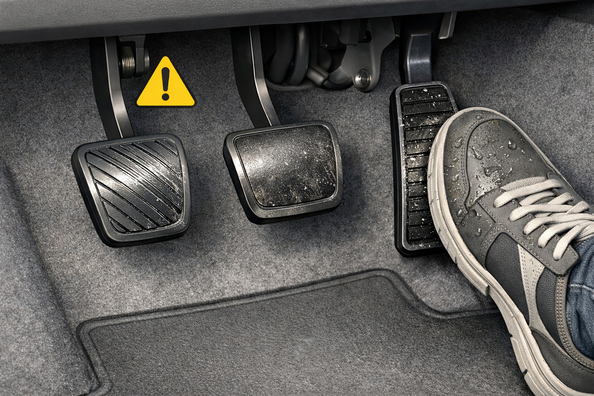
A slippery or worn pedal isn’t a minor detail—it’s a precision problem. When your foot slips off the brake or clutch, you modulate force worse, take longer to find stable support, and get tired faster in city traffic, in the rain, or in winter.
Most often the cause is simple: worn tread on the rubber pad, exposed metal or plastic, a wet sole, dirt on the pedal, or play in the pad itself. It’s also worth checking the floor mat under your feet: sometimes it feels like the pedal is slippery, but in reality your foot is thrown off because the mat creeps into the pedal’s travel.
A pedal holds your foot not through pressing force, but through the contact surface. As long as the rubber pad has a pronounced texture, it grips the sole even in daily driving. When the texture wears down and the surface becomes shiny and smooth, traction drops sharply.
The issue gets worse in wet weather. Water, salt, dust, and traces of grease create a thin slippery film, so even a normal pedal can feel worse. On manual cars this is especially noticeable on the clutch and brake, because your foot often works at an angle and under repeated load.
DD Tuning expert comment: the most common mistake is looking for a “better” pad without checking whether the factory rubber has worn out and whether the floor mat is sliding under your feet. The second typical mistake is installing a rigid decorative pad on a dirty pedal or without fully clipping it in. If the fit is loose, the problem will return very quickly—even if the new part looks high-quality.
| Symptom | Likely cause | What to do |
|---|---|---|
| The pedal slips only in rain or snow | Wet sole, water and dirt on the pedal surface | Clean the pedal, dry the footwell, check your shoes and floor mat |
| It slips even in dry weather | Worn pad texture or exposed metal | Replace the pad with an OEM one or a direct replacement |
| Your foot seems to “slide” sideways | Smooth rigid pad or a slippery sole | Assess the pad material, switch to a grippier solution, check your shoes |
| The pedal feels unstable under your foot | Play, incomplete clipping, loosened mounting | Remove it, clean the mounting area, reinstall properly or replace |
| The problem is worse on the clutch | Localized wear from daily use with the left foot | Inspect the clutch pedal specifically, without relying on the condition of the other pedals |
| The pedal seems OK, but pressing is still uncomfortable | Floor mat or debris interferes with foot movement | Secure or replace the mat, remove debris from the pedal area |
The longest-lasting fix isn’t “upgrading” an old surface, but restoring a proper working surface. If the factory pad is worn, cracked, or missing, a direct replacement usually gives the most predictable result.
Before installation, don’t just wipe the pedal—degrease and dry it. After cleaning, let it dry for about a minute, then install the new pad without skewing it, fully seated into the grooves and clips. If the pad is tight, sometimes a thin wire or another careful auxiliary tool can help with installation, but without deforming the part itself.
If the issue appears only in wet weather, a combination of three things often helps: a clean pedal, a dry mat, and shoes with a normal rubber sole. This doesn’t replace a new pad if the old one is already bald, but it reduces some of the slipping caused specifically by operating conditions.
Gluing an old pad back on is a weak solution. If the texture is already worn, glue won’t restore grip, and if the part also has play, it will start moving under your foot again.
Various DIY coatings like rubberized sprays don’t last long in a high-wear area like this. The same goes for the idea of “just washing the pedal” when the rubber is already smooth: it will get cleaner, but it won’t get grippier.
Anti-slip tape can quickly reduce slipping if you need to wait for a proper replacement. But as a permanent fix it’s weak: the tape edge wears, collects dirt, and doesn’t always hold up under daily use.
If the factory pad is worn down to a smooth surface or you can already see metal, the logic is simple: you need a replacement, not experiments. In that case it makes sense to look at pedal covers with a proper working surface, not just a decorative look.
If you’re choosing an alternative rather than an OEM pad, it’s important to look not only at the material but also at the mounting type. Before buying, it’s worth quickly checking the basic criteria in how to choose pedal covers: for daily driving, secure fixation matters more than visual effect.
If the pedal itself isn’t worn, and the problem happens because the surface under your feet slides around or creeps into the pedal travel, don’t start with the pad—start with the floor. This cause is covered separately in the article about the floor mat under the pedals.
| Solution | When it works | When it’s not worth spending money |
|---|---|---|
| Cleaning and drying the pedal | When the problem appears after rain, snow, or dirty shoes | When the pad is already worn, shiny, or cracked |
| Replacing with an OEM or direct-fit pad | When the rubber texture is gone, there’s play, or metal is exposed | When the main cause is the floor mat or a slippery sole, and the pedal itself is fine |
| A cover with reliable mechanical fastening | When you need a tight fit and the factory option isn’t available | When choosing a smooth decorative piece without pronounced texture |
| Anti-slip tape | When you need a temporary fix while waiting for replacement | When you need a long-term solution for daily driving |
| Changing footwear or controlling sole dryness | When slipping happens only with a specific pair of shoes or in wet weather | When the pedal is slippery even when dry and the safe texture has already been lost |
| Securing or replacing the floor mat | When the issue is interference with foot movement rather than the pedal itself | When the pedal shows obvious physical wear and the mat has nothing to do with it |
From a customer’s experience: a driver complained that in city traffic jams his foot kept sliding off the clutch after rain. At first, simple cleaning helped—but only for a few days. On inspection, it turned out the rubber pad had already become smooth and was slightly lifting at the edge; after replacing the pad and checking the floor mat, the problem disappeared without any additional modifications.
If the pedal is slippery only sometimes, start simple: clean the surface, check for moisture on the sole, and make sure the floor mat doesn’t interfere with foot movement. But if the pedal slips even in dry weather, has a smooth shine, cracks, play, or is worn down to metal, the smartest solution is to replace the pad with a proper working part.
The key is not to confuse temporary relief with a real repair. This material is based on real selection experience, hands-on practice, and real use scenarios: in most cases the issue is solved either by correctly replacing a worn pad or by addressing moisture, footwear, and the floor mat as contributing factors.
| ✔ | A slippery pedal can be diagnosed quite accurately: the article separately examines pad wear, a wet sole, play, and mat issues. This helps avoid replacing parts blindly and instead identify the real cause first. |
| ✔ | For everyday driving, a practical solution is suggested — replacing the worn factory pad with a proper working part. This approach is especially appropriate when the tread has already gone smooth, cracked, or the metal is visible. |
| ✔ | There is a clear step-by-step check: inspect the pedal, test with dry and wet footwear, check for play and the mat. It is convenient because each likely cause can be ruled out one by one without special tools. |
| ✔ | The article takes into account the conditions where the problem shows up more strongly — rain, snow, dirt, and winter use. It also points out that sometimes it is enough to clean and dry the footwell area if the pedal itself is not yet worn. |
| ✔ | There is an honest distinction between temporary and proper solutions. This helps make it clear that anti-slip tape or re-gluing can only delay repairs, not replace them. |
| ✘ | Cleaning the pedal helps only when the cause is moisture, dirt, or wet shoes. If the pad is already worn down and smooth, such an intervention gives only a short-term effect. |
| ✘ | Some of the options mentioned in the text are not suitable as a long-term solution: anti-slip tape, re-gluing the old pad, or DIY covers wear out quickly or lose effectiveness. |
| ✘ | To really solve the problem, sometimes it is necessary not only to replace the pad, but also to deal with the mat and footwear. For the driver, this means several separate checks instead of one simple repair. |
Shipping to EU
Wholesale and retail
Own warehouse
Опис продукту
Подарунки не надаються при оформленні покупки у кредит під 0,01% або при покупці частинами.