 Author: Radomskyi Maksym Vasyliovych
Toyota Land Cruiser Prado 250 in its new generation (J250 series) is a step from the “familiar” Prado to a more modern technical base: a different platform, reworked off-road system logic, and a stronger focus on practicality (including towing and fuel tank capacity). The debut as a new generation took place in August 2023, and for Japan the launch was expected in the first half of 2024.
In this article, we’ll break down what exactly changed in the 2023 Land Cruiser Prado 250: which engines are actually offered (with displacement and output), how dimensions and off-road capability have grown, what’s new in comfort and safety, and which tuning solutions most often make sense—and where owners end up paying with compromises.
The model and its place in the market
Prado traditionally sits in the niche between “lighter” city needs and expedition-grade tasks. In the new generation, Toyota essentially reinforces this format: the “250” Prado is positioned around a Light Duty approach, but on a modern body-on-frame architecture with pronounced off-road capability.
A practical advantage of this market positioning is a wide choice of configurations for different scenarios: from 5 seats to 7-seat versions, from more road-focused setup to builds aimed at towing and trips “out of town.” If you need a Prado as an all-rounder for work/family and travel, the new generation logically continues that idea—yet technically it’s now closer to the larger Land Cruiser in platform solutions.
Generation and model history
Land Cruiser Prado 250 (J250) is a new generation officially unveiled on 2 August 2023. For the Japanese market, the start was planned for the first half of 2024. In Toyota materials, the model is described separately as a “back to basics” move for the lighter format within the Land Cruiser lineup.
The key historical change is that the generation steps onto the modern GA-F platform, also used in the Land Cruiser 300. This affects not only geometry and chassis hardware, but also how motion-control systems and electronic aids evolve for different surface types.
Engines and transmissions
Important: powertrains depend on the market. For European specifications, the 2.8 diesel is most commonly seen, but Toyota lists different engine options for different countries (including 2.4 turbo/hybrid, 2.4 turbo, and 2.7 gasoline).
As a reference for the “real” diesel option most often associated with the Prado 250 in Europe: 2.8 diesel 1GD-FTV — 2755 cm³, 205 hp (151 kW) at 3000–3400 rpm, and 500 N·m at 1600–2800 rpm. Transmission in the European specification is an 8-speed automatic (AL80F).
| Parameter | Variant (example for Europe) | What it delivers in practice |
|---|---|---|
| Engine | 1GD-FTV 2.8 diesel, 2755 cm³ | Flexible low/mid-range pull for climbs and acceleration under load |
| Power | 205 hp (151 kW) | Headroom for mixed conditions where controlled traction matters |
| Torque | 500 N·m (1600–2800 rpm) | Helps maintain smooth performance under load and off-road |
| Gearbox | 8-speed automatic (AL80F) | Less “thinking” from the transmission and wider ratios for steady cruising |
| Drive | Full-time 4WD with a two-speed transfer case | Full control across different surfaces, including deep/technical sections |
| 48-volt technology | 48V system is present (V-Active in Toyota explanations) | Supports energy efficiency and auxiliary functions, but may affect packaging |
Body, dimensions, and chassis
For the new generation, larger dimensions are claimed compared to the previous Prado. As a guideline based on prototype/quoted figures: length 4925 mm (+100), width 1980 mm (+95), height 1870 mm (+20), wheelbase 2850 mm (+60). Height clarifications in documentation may vary depending on market/measurement method.
For real off-road use, what matters isn’t “body-on-frame” talk but the numbers: ground clearance 205.3–215.3 mm (depending on version/equipment), wading depth up to 700 mm. Obstacle geometry is stated as approach angle 31–32°, departure angle 17°, breakover angle 42°, and maximum side slope 44°.
There are also logical chassis changes: electric power steering (EPS) instead of hydraulic, and the stabilizer has a disconnect mechanism (SDM) that switches the front stabilizer state depending on driving mode—affecting off-road comfort and on-road stability.
Interior, comfort, and safety
Inside, the new Prado 250 targets a practical everyday format: the lineup includes 5- or 7-seat configurations depending on trim. For families and “we often carry people” needs, this means the vehicle can cover different scenarios without rethinking the choice itself.
Ride comfort is not only suspension, but also how electronic control systems work across different surface types. Toyota updated Multi-Terrain Monitor and Multi-Terrain Select: they help choose the right mode and “read” the situation while driving where surfaces change quickly. Plus SDM and EPS (at chassis level) also shape the feel—from softer absorption of bumps to more stable control at speed.
Separately, it’s worth noting a real compromise that often comes up in reviews: some owners and long-term journalist reports point out that the ride can feel a bit firm and “busy” over rough surfaces. This doesn’t mean the vehicle is unsuitable for the city, but expectations of softness should be closer to an “expedition” suspension setup than business-sedan comfort.
Everyday use
For daily driving, the Prado 250 is valued for how it handles long routes: the 80 L tank and stated WLTP consumption of 10.5–10.7 L/100 km (combined cycle) provide a solid basis for planning without constantly “watching fuel stops.” In reality, consumption depends on driving style, tires, and season, but WLTP figures are commonly used as the baseline reference.
From a family practicality standpoint, the trunk matters: 556 L to the cover and up to 1875 L with the 2nd and 3rd rows folded (based on available European data). For transporting kids’ items, tools, and travel luggage, this is one of those parameters you feel immediately.
Another daily factor is noise and the diesel’s character. In long-term materials, there is criticism that the engine sounds “agricultural”/rough in feel. If you’re sensitive to sound insulation and acoustics under low/medium loads, it’s worth considering before purchase.
Strengths and weaknesses
Below is a practical summary of the new Prado 250’s strengths/weaknesses most often discussed in reviews and long-term impressions. Important: some downsides are subjective and depend on routes, settings, and market.
| Pros | Cons |
|---|---|
| Claimed pulling power/practicality: reviews highlight an increased towing threshold up to 3500 kg (depending on version/market) | Off-the-line dynamics under load may lack a bit of “pep” (in some scenarios you need more active throttle input) |
| Geometry and off-road parameters: clearance up to 215.3 mm, wading up to 700 mm, stated approach/departure/breakover angles | Powertrain sound insulation may not suit everyone: long-term reviews note the diesel’s louder character |
| Handling and control: the GA-F platform and electronic-assist logic deliver a more composed feel than previous generations | Suspension can feel firm/“busy” over rough surfaces—depends on passenger expectations and driving style |
| Updated Multi-Terrain Monitor/Select and the presence of SDM and EPS for different modes | The 48-volt mild-hybrid is seen by some reviews as not very noticeable; plus the 48V system can affect packaging and load logic |
Practical pros and cons from an owner’s perspective
- Pro: pulling power and trailer headroom—especially if your work/trips regularly involve loads; the approach “the new Prado allows more towing” is often cited as a key generational difference.
- Pro: off-road geometry doesn’t look “paper only”: the stated wading and clearance figures are supported by sensible mode-control logic.
- Con: in everyday quietness, the diesel can sound a bit coarse; if you drive at low speeds with constant partial load, it’s more noticeable.
- Con: comfort on “beat-up” roads can feel too assertive; it’s worth factoring in that this is a vehicle with off-road DNA.
- Con: the mild-hybrid/48V system may not deliver a noticeable difference in many owners’ driving style (and sometimes becomes a point of debate about whether it’s worth it).
Tuning and accessories
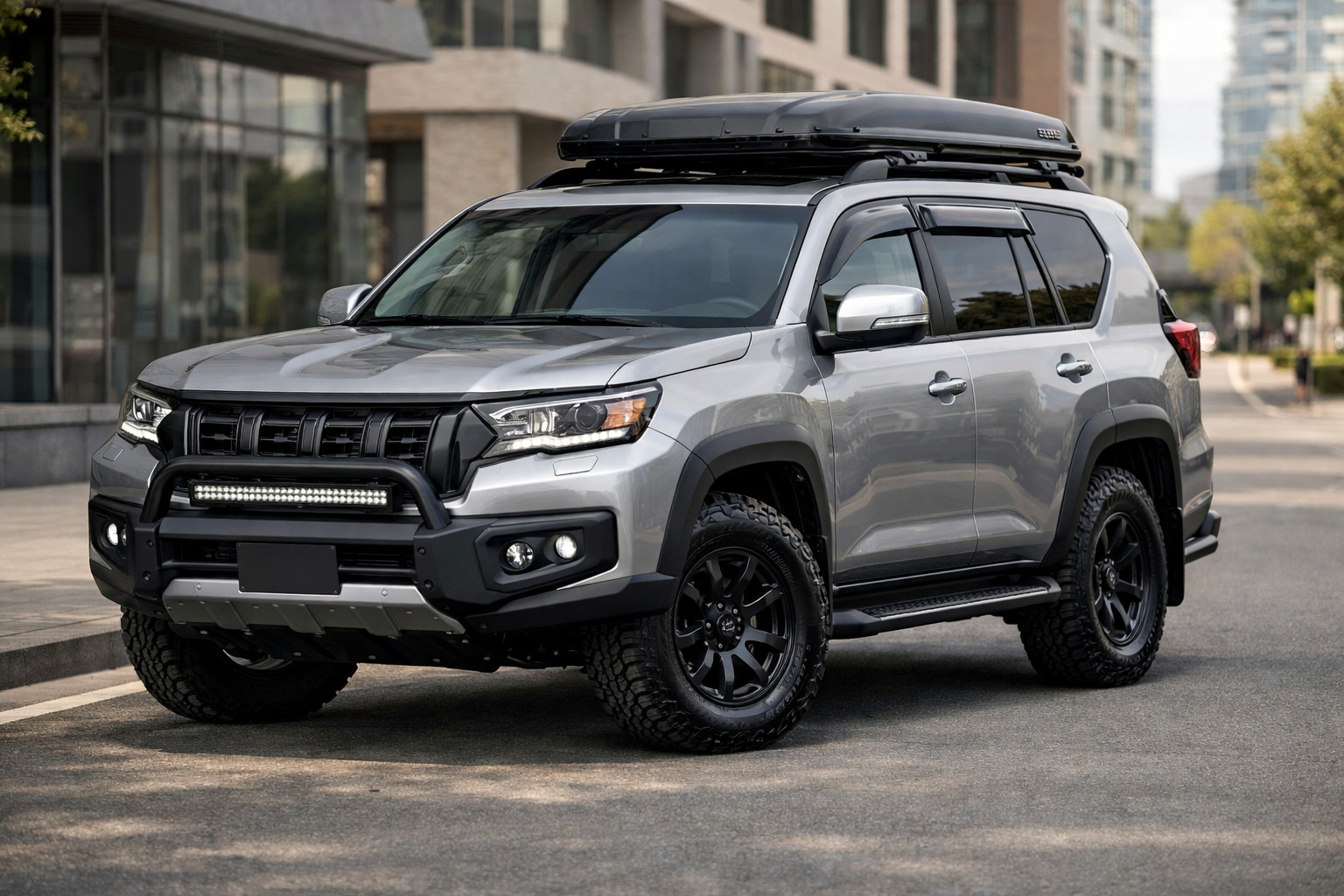
For Prado 250, the best tuning is the kind that strengthens not “looks,” but practical safety and capability under load: protection, lighting, tires/wheels, mud preparation, and travel convenience. If you’re planning an expedition format, start with radiator/critical-area protection and the right tires for your roads and season.
When it comes to “what to add” in a tuning sense, it’s appropriate to consider ready-made approaches for the specific model: in particular, check out the piece on tuning Toyota Land Cruiser Prado 250—it focuses on upgrade logic for real use rather than random small items.
Typical tuning directions that make sense specifically for the Prado 250:
- Bumper/component protection (including bull bar-type solutions depending on your scenario and compatibility with the stock geometry).
- Lighting and electrics for long trips and off-road (important to coordinate with wiring and protection).
- Tires (choose size and type for your roads; geometry and clearance provide capability, but the wrong rubber will hurt handling and noise).
- Cargo organization: straps, organizers, solutions for carrying gear so that 556 L (to the cover) actually works instead of turning into a “chaos stash.”
It’s important to account for the 48-volt side: it can affect engine-bay packaging, so when installing additional components (especially electrics/modules), it’s better to focus on compatible solutions for the specific platform and trim.
Conclusion
Buying a Toyota Land Cruiser Prado 250 2023+ (J250) makes sense for those who need an “all-rounder for work and family” that isn’t afraid of loads and has strong potential for off-road scenarios: stated clearance up to 215.3 mm, wading up to 700 mm, practical cargo volumes, and a strong emphasis on handling/control.
If, however, your decisive priorities are maximum cabin quietness, a soft ride on poor roads, and a “noticeable” fuel-saving effect from the mild-hybrid, the new Prado may not fully meet expectations. The practical verdict: the new-generation Prado 250 is a rational choice for those who genuinely drive a lot, carry loads, and periodically leave the asphalt; for “urban comfort as priority #1,” it makes sense to look at other classes or consistently test-drive the specific version.
Pros and cons
The modern GA-F ladder frame platform and revised off-road systems logic provide more composed handling and better control on different surfaces.
Practical towing capabilities: the materials highlight an increased towing limit of up to 3500 kg (depending on version/market), as well as the flexibility of the 2.8 diesel (205 hp, 500 Nm).
Off-road figures are not just for show: the claimed ground clearance of up to 215.3 mm, fording depth of up to 700 mm, and approach/departure/ramp angles are supported by driving modes.
A salon layout that is convenient for everyday use: 5- and 7-seat configurations, as well as a spacious trunk (556 l to the cover and up to 1875 l with the rows folded).
Ride comfort can feel a bit stiff and "assertive" over bumps — expectations of softness should be closer to an expedition-style setup.
In long-term reviews, the diesel engine is criticized for its rough/"agricultural" sound character, especially under partial loads at low speeds.
In some reviews, the 48-volt (mild-hybrid) system is seen as not noticeable enough; there may also be questions about its usefulness and impact on the layout.