11.04.2026
282
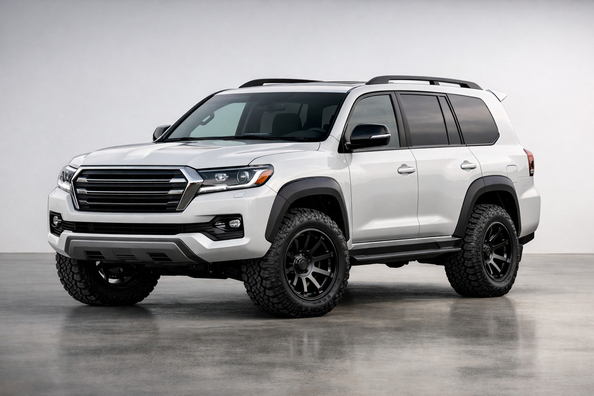

In 2026, the Toyota Land Cruiser 200 still looks like a strong tuning platform: it’s a body-on-frame vehicle with full-time 4WD, a transfer case with low range, and very convenient factory off-road “geometry.” If you look at tuning from a practical angle (tires, expedition gear, more aggressive traction tuning), the 200 Series still gives you a solid starting point.
But in 2026, tuning isn’t only about “what you can bolt on”—it’s also about the ownership budget: fuel consumption, the condition of the specific vehicle, and potentially expensive assemblies (depending on trim). Below is the gist of which generations/years matter, which engines were actually offered, what the dimensions and cargo capacity are, and how to plan upgrades correctly so you don’t ruin longevity.
The Land Cruiser 200 is a “big body-on-frame” SUV that, in most countries, was bought not for efficiency but for platform durability and the ability to regularly go where crossovers typically “tap out.” That’s exactly why it became a popular base for expedition builds, upsizing to larger tires, and engineering upgrades to the drivetrain/cooling.
In 2026, it’s important to understand the market reality: demand for the 200 is supported by the aftermarket (parts and solutions for the 3UR-FE / the LC200 platform architecture), but expectations for condition are also rising. “Buying cheap” only works if you immediately understand what has already been replaced on your vehicle and what you’ll still have to address.
The Land Cruiser 200 is the generation that bridges the history of the “classic” body-on-frame LC and more modern approaches to electronics. During its sales life across regions, powertrains and trims changed, so in 2026 it’s more accurate to compare not “LC200 in general,” but your specific market version (Europe/USA and engine type).
Separately: in the USA, the series effectively ended after the 2021 model year. That doesn’t make it a worse tuning platform, but it does affect the availability and age of donor vehicles/components, and how many “tired” examples may now show up for sale.
For tuning, most people look toward gasoline V8s—specifically the 5.7L (if your market is the USA): the stock potential is backed up by the fact that there are ready-made aftermarket projects for the 3UR-FE (for example, forced-induction kits). For an “expedition + tires + durability” build, what matters even more than a “max number” is having the right traction modes and low gearing.
In the LC200 drivetrain, the key is the combination of full-time 4WD with a transfer case and low range. For the US version, the transfer case is listed with High 1.000:1 and Low 2.618:1 ratios, plus an 8-speed automatic. This works well both for crawling off-road and when you add weight (cargo, winch, heavy wheels) and want to keep traction control manageable.
| Market/fuel type | Engine | Power | Torque |
|---|---|---|---|
| USA, gasoline | 5.7 L V8 (DOHC) | 381 hp | ≈ 543.7 N·m (401 lb-ft) |
| Europe, gasoline | 4.6 L V8 | 318 DIN hp | 460 N·m |
| Europe, diesel | 4.5 L V8 diesel | 248 DIN hp | 650 N·m |
The practical takeaway is simple: if your goal is to “bring out the pull” and do engineering upgrades, the 5.7L gasoline is usually easier to plan because solutions for the 3UR-FE are more widely available. If your goal is longevity and heavy-duty use with less fuel discomfort, the 4.5 V8 diesels make more sense for many expedition scenarios—but tuning specific components must be chosen for your exact version.
On the Land Cruiser 200, the “useful” part for tuning is the body-on-frame construction and the fact that the vehicle was designed from the factory as a heavy off-road tool. On paper it’s large, but that geometry (angles, clearance, wading depth) helps you safely start a project with bigger tires and armor without constantly feeling like you “have to rebuild everything from scratch.”
Another plus is the factory off-road control systems: Multi-Terrain Select, Crawl Control (CRAWL) and maneuver assist, as well as KDSS (Kinetic Dynamic Suspension System). They matter specifically as baseline “control tools,” not as a reason to postpone maintenance.
| Parameter | Value | Note |
|---|---|---|
| Length | ≈ 4950.5 mm | US specification |
| Width | ≈ 1981.2 mm | US specification |
| Height | ≈ 1879.6 mm | US specification |
| Wheelbase | ≈ 2849.9 mm | US specification |
| Ground clearance | ≈ 226.1 mm (8.9 in) | US; for Europe, min 230 mm is stated |
| Wading depth | ≈ 700 mm | stated for US and Europe |
| Cargo (volume) | ≈ 2344.6 / 1172.3 / 455.9 L | to 1st/2nd/3rd row (8-seat configuration) |
For tuning, what matters is this: your “real clearance after a lift” is not the same as the spec sheet numbers. It depends on tires/wheel offset, suspension condition, and whether you have KDSS/active systems. So when planning upgrades, it’s better to factor in tire options and their contact with the fender liners right away, rather than relying only on the factory 226–230 mm.
Inside, the LC200 is a “grown-up” vehicle: comfort isn’t necessarily sporty, but it’s at least stable over long distances. For tuning, this matters indirectly: if you add components (winch, steel bumpers, snorkel, auxiliary power blocks, wiring for cameras/sensors), you’ll need an understanding of the electrical system and reliable installation to avoid error codes and service warnings.
Safety in the 200 isn’t just about “assist systems,” but also the chassis design and mass. In practice, highway stability and predictable behavior after a lift largely depend on whether you haven’t “wrecked” the geometry: correct spacers/bushings, proper alignment settings, and monitoring the condition of the bushings.
In 2026, the LC200 makes sense as a vehicle “for a scenario”: long trips + regular off-pavement driving, or at least one or two tasks per month where a body-on-frame platform is truly justified. If the vehicle is only for city use, fuel consumption and size remain the main drawbacks.
As a fuel reference: for the US V8 5.7, the EPA lists 13 mpg city / 17 mpg highway / 14 mpg combined (≈ 18.09 / 13.84 / 16.80 L/100 km). Tests also show high real-world numbers: observed 14 mpg and on a highway route about 17 mpg. Tuning that adds mass or changes aerodynamics (bull bars, roof rack systems, different tires) usually pushes the numbers even further in the wrong direction.
The LC200’s strength as a base is the combination of an “iron” platform and ready-made off-road solutions. The frame, full-time 4WD, a transfer case with low range, traction modes, and good factory angles/capability parameters allow upgrades without constantly fighting geometry.
The weaknesses for an owner are fuel consumption and potentially expensive assemblies depending on trim (especially if there are active/air elements). Plus, if you’re planning truly “heavy” tuning, you’ll need to budget for supporting the drivetrain, cooling, brakes, and suspension condition.
| Pros | Cons |
|---|---|
| Body-on-frame construction and a “tractor-like” foundation for chassis strength | Fuel consumption: for the US 5.7, around 14 mpg combined (≈16.8 L/100 km) and often higher in real scenarios |
| Full-time 4WD + factory traction modes | Service can be expensive due to complex components (depending on trim) |
| Transfer case with Low range and crawling torque | Large tires/added weight increase load on brakes, cooling, and transmission |
| Factory off-road parameters: ground clearance, angles, wading depth ~700 mm | Careful planning for your market/engine is required, because the LC200 has different configurations |
From an owner’s perspective, the most practical “pros/cons” are these: the plus is the vehicle takes armor and tire upgrades easily, but the minus is any performance increase or added mass almost guaranteed raises fuel and maintenance costs. If you build that into the budget from the start, the LC200 often turns out to be a rational base; if you don’t, it’s easy to burn through both longevity and your financial plan.
The LC200 is tuned in two approaches: “expedition/capability” and “performance.” For the first, suspension/tires/wheels, underbody protection, quality electrics for accessories, and properly set-up traction management matter most. For the second, intake/exhaust, ECU/tuning adjustments, and critically important cooling and fuel compatibility.
If you’re considering forced induction, there’s a clear advantage to a solution for the 3UR-FE (5.7L gasoline): there is a Harrop TVS2650 kit developed specifically for the Land Cruiser 200 with the 5.7-liter V8 and stated compatibility with 2017+ 3UR-FE Land Cruiser 200 series (per the application in the guide). At the same time, you must consider fuel limitations: this kit is not compatible with E85. This is a typical case where you think “I want more—I’ll install anything,” and then you hit the rules of use for a specific kit.
For basic upgrades that usually deliver the biggest result “for the money,” these directions are most often the right fit: the right tire size (so you don’t break geometry and choke drivability), underbody and cooling protection, proper post-lift setup, and rational electrics (wiring for auxiliary lights/winch, fuse protection, OEM-level installation cleanliness).
If you want to move from theory to specifics on which LC200 options are available, use the selection across all products: Toyota Land Cruiser 200.
As an example of the “ready-made solutions for the 3UR-FE” topic, people look to kit guides such as the Harrop TVS2650 documents: a reference point for the Land Cruiser 200 base helps, but exact compatibility is still verified by application for your engine/year/market.
In 2026, the Toyota Land Cruiser 200 remains a strong tuning base if you tune it “according to the platform’s logic”: off-road capability, chassis, tires, protection, traction management, and well-thought-out cooling. The body-on-frame design, full-time 4WD, a transfer case with low-range gearing, and factory off-road parameters provide a solid start without needing to build the vehicle from scratch.
Practical verdict: the LC200 is for those who budget for fuel and service and want “tuning for real life” (expeditions, long mileage, regular off-road use). It’s not worth buying as a universal base for “cheaply make it more powerful”—consumption and component complexity (depending on trim) quickly eat the savings. But if you choose a goal and then select specific components and kits to match it, the 200 Series proves to be a rational and fairly predictable platform for upgrades.
| ✔ | The body-on-frame construction, full-time all-wheel drive, and transfer case with low-range gearing provide a strong foundation for off-road capability and low-speed crawling. |
| ✔ | Factory off-road tools (traction modes, Crawl Control, and KDSS) make it easier to start tuning without constantly fighting the base geometry. |
| ✔ | Factory off-road specs (ground clearance and a stated wading depth of ~700 mm) make it possible to safely plan a move to larger tires and protection. |
| ✔ | For popular versions, there are real aftermarket benchmarks for specific engines; in particular, for the gasoline 5.7 l (3UR-FE), there are solutions such as forced induction kits. |
| ✘ | The budget is constrained by running costs: for the US 5.7 l version, the stated fuel consumption is about 14 mpg combined (≈16.8 l/100 km), and in reality it can be high, while tuning usually makes the numbers worse. |
| ✘ | Technical expenses often arise from servicing expensive components depending on the trim, as well as the need to upgrade cooling, brakes, and transmission when adding weight or loads. |
| ✘ | Tuning is complicated by differences between markets and configurations: without checking your engine/year/version, it is easy to make a mistake with component compatibility and the upgrade plan. |
Shipping to EU
Wholesale and retail
Own warehouse
Опис продукту
Подарунки не надаються при оформленні покупки у кредит під 0,01% або при покупці частинами.