25.02.2026
805
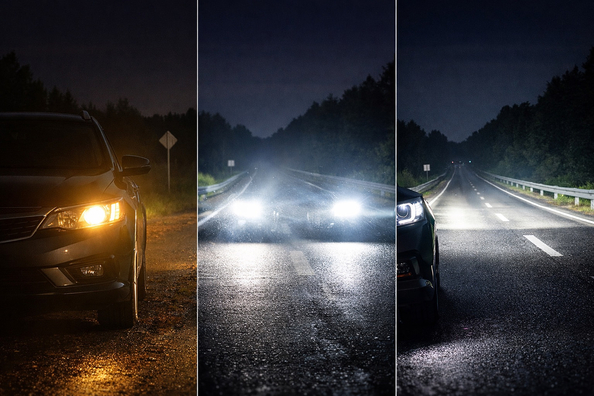
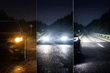
Many standard car headlights are still equipped with halogen bulbs that lack brightness and range. Modern technologies make it possible to significantly improve headlight performance – from a simple switch to LED bulbs to installing more advanced projector modules. Let’s look at the main ways to upgrade your lighting: classic bi-xenon lenses, replacing bulbs with LEDs, and using the latest Bi-LED modules. We’ll analyze how they differ and compare their specifications – brightness, beam angle, color temperature, power consumption, and lifespan. We’ll also provide examples of budget and premium options for each type.
Projector headlights provide a sharply focused beam with a clear cutoff line. Unlike reflector housings that scatter halogen light widely and unevenly, a good projector concentrates the bulb’s light and forms a proper horizontal cutoff. Installing bi-xenon lenses instead of stock reflectors gives brighter and longer-range light without dazzling oncoming drivers.
Most lenses use xenon bulbs (HID), which produce two to three times more light than halogen. Lenses optimize this output: the road surface is illuminated more evenly, the viewing angle is wider (about 120–130° versus ~100° for reflectors), and the focused beam directs light precisely onto the road. Even with powerful bulbs, properly adjusted lenses don’t blind oncoming traffic because the light is cut off horizontally. The color of xenon light in lenses is usually closer to white (≈4300–5000 K), improving nighttime contrast.
Advantages:
Disadvantages:
Example: budget kits with Chinese bi-xenon lenses (Hella or Koito replicas) can be found for ~$50–100, while premium options (original Koito, Morimoto) with quality bulbs and ballasts can cost several hundred dollars. The result, however, is dramatically better night visibility and a modern headlight look.
LED bulbs are a simple way to improve lighting without major modifications. They replace stock halogens and instantly provide brighter, whiter light. The color temperature of LED bulbs is around 6000 K (cool white), which makes road signs and markings reflect light better. LEDs are also more efficient: they consume ~20–25 W compared to 55 W for halogen, reducing load on the alternator and battery. LED lifespan can reach 15–20 thousand hours, dozens of times longer than a halogen filament.
However, it’s not always straightforward. If a headlight is designed for halogen, simply replacing the bulb with an LED doesn’t always yield perfect results. LEDs have a different light source shape, which can cause poor focus in a standard reflector. This may lead to glare for oncoming drivers or dark spots in the beam. Cheap LED bulbs often have exaggerated specs – in practice, their brightness is similar to halogen (about 1500–2000 lm), with risks of overheating and failure due to poor cooling.
Advantages:
Disadvantages:
Example: inexpensive no-name LED bulbs can be found for $10–20, but their effect is limited. Premium bulbs like Osram Night Breaker LED or Philips Ultinon offer better focus and reliability (up to +150% brightness vs. halogen) at around $100 per set. LED upgrades are attractive for their simplicity, but it’s best to choose proven products and always adjust headlights after installation.
Bi-LED lenses are the latest technology combining a projector module and LED source in one unit. Essentially, a Bi-LED module is a bi-xenon lens where the bulb is replaced by a powerful LED chip. These lenses provide both low and high beams (switched by a shutter) and produce an extremely bright, focused beam. Quality Bi-LEDs outperform even xenon: premium models reach 4000–4500 lm, about three times brighter than halogen. The light is pure white (5000–6000 K), making night roads appear daylight-bright and road signs “pop” in the beam.
Key advantages of Bi-LED include minimal power consumption (~30–40 W per module) and a lifespan over 20–30 thousand hours (around 15 years of active use). LED lenses turn on instantly and don’t need warm-up, unlike xenon. They generate less heat, so they don’t “burn” reflectors or headlight plastic. Many modern business-class cars already come with factory LED modules (brands like Koito, Hella supply them for Toyota, BMW, Audi, etc.). Universal Bi-LED retrofit kits are also available – from budget Chinese models to premium ones from Morimoto, Osram, and others.
Advantages:
Disadvantages:
Example: affordable Chinese-made Bi-LED lenses (from ~$150 per set) already outperform stock halogen headlights. Meanwhile, premium modules like Koito Bi-LED Gen2 or Morimoto M LED deliver maximum performance (around 4500 lm, 5700 K) at $400–500. The choice depends on budget: even budget Bi-LEDs offer a huge improvement, while top-tier options bring lighting up to luxury car levels. For original LED bulbs, LED modules for headlights are often sold separately.
| Type | Brightness, lm | Angle, ° | Temperature, K | Power, W | Lifespan, h |
|---|---|---|---|---|---|
| Halogen (stock) | ≈1500 | ~110 | 3200 | 55 | ≈1000 |
| Bi-xenon lens | ≈3000 | ~130 | 4300 | 35 | ≈2500 |
| LED bulb | ≈2000 | ~110 | 6000 | 20 | ≈20000 |
| Bi-LED lens | ≈4000 | ~140 | 5500 | 35 | ≈30000 |
| Category | Budget option | Premium option |
|---|---|---|
| Projector lighting | Chinese bi-xenon lenses (Hella replicas, ~$50–100) | Original Bi-LED modules Koito, Hella (from ~$400) |
| LED bulbs | No-name LED H7 from AliExpress (~$20) | Osram Night Breaker LED H7 (≈$100) |
| Bi-LED lenses | Budget Bi-LED (Alpha, Aozoom, etc., ~$150) | Morimoto M LED, Koito Gen2 (≈$500) |
Conclusion: Today there are several ways to truly improve your car’s headlights. The simplest option is LED bulbs, offering more modern light without complex installation. A more effective route is installing quality xenon lenses, which greatly enhance brightness and safety. The best results come from Bi-LED systems: they bring your lighting up to the level of new cars, though they require higher investment. When choosing an upgrade, consider your budget and needs: for city driving, LED bulbs may suffice; for frequent night highway trips, lenses or Bi-LEDs are worth considering. In any case, after upgrading, make sure to properly adjust your headlights – and enjoy much better nighttime visibility.
Shipping to EU
Wholesale and retail
Own warehouse
Опис продукту
Подарунки не надаються при оформленні покупки у кредит під 0,01% або при покупці частинами.