Why is a winter car kit so important in 2026?
Every year, winter brings unpleasant surprises for drivers – from sudden snowfalls to severe frosts. With the first snow, online forums fill up with questions like: “What should be in a driver’s winter emergency kit?” And for good reason: cold reduces battery efficiency, engine oil circulates harder, and ice appears on the roads. According to auto experts, in severe cold a battery can lose up to half of its capacity, while the engine needs more current to start. It’s no wonder that the number of tow truck calls and jump-starts skyrockets at the peak of the cold. In addition, blizzards can paralyze entire highways: for example, in southern Ukraine one strong snowstorm left 850 cars trapped in snow, and thousands of people needed rescuers’ help. Therefore, a well-equipped winter car kit is not a whim, but a guarantee of your safety and comfort.
A winter emergency kit is a set of tools, accessories, and useful items that help you deal with the most common winter road problems. It’s not just about a standard snow brush or ice scraper. The right kit includes tools for starting the engine with a discharged battery, freeing the car from snowdrifts, keeping passengers warm, improving visibility, and more. Let’s look at **what really saves** a driver in winter, and what you can do without, depending on your driving conditions.
10 essential items in a winter kit that really save
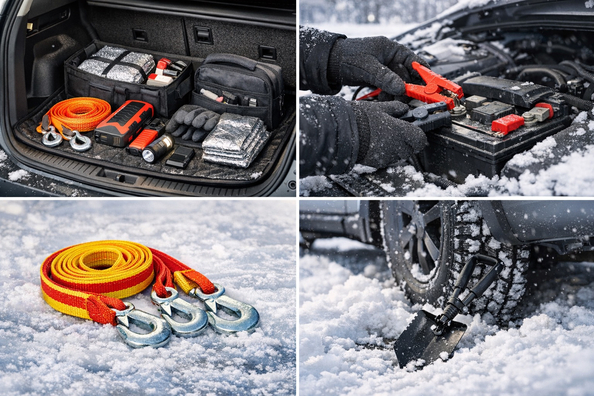
- Jump starter (portable jump starter) – a compact device capable of starting an engine with a discharged battery without another car’s help. In cold weather, the car battery often “dies” at the worst moment. A jump starter will save you in a deserted parking lot or on the highway: just connect it to the battery terminals, and you can start the engine yourself. Modern boosters of 2025–2026 are compact, have built-in reverse polarity protection, and even power bank functions for charging gadgets. This is one of those devices that **really saves** in winter, saving time and nerves. Without a booster or at least a set of “crocodile” cables (jumper cables), you risk being stranded far from civilization.
- Tow rope – a strong rope or strap that can withstand your car’s weight, necessary to pull the car out of a snowdrift or tow it in case of a breakdown. Even an experienced driver can get stuck on ice or buried in snow. A tow rope allows friends or passersby to pull your car to solid ground or a safe place. Choose a rope with a strength margin (at least 3–5 tons breaking load) and reliable hooks or loops. **What’s unnecessary?** In the city, where towing services are nearby, you may rarely use it. But for highways or trips outside the city, a tow rope is essential. Better to have it in the trunk even if you use it once every few years – at a critical moment this simple thing will save you time and money on roadside assistance.
- Snow shovel – a compact car shovel, preferably folding or telescopic, so it doesn’t take up much space. **A shovel** is a true winter hero: who else will help dig out your “iron horse” if a snowstorm turns it into a snow block? Situations where you have to clear snow yourself happen often: you may get stuck in deep snow on the roadside or the snowfall may block your garage or parking entrance. Having a shovel, you can quickly clear space in front of the wheels, make a “path” for acceleration, or free the exhaust pipe from snow. When choosing, pay attention to material strength (metal or reinforced plastic scoop) and handle length – telescopic handles are more convenient. This tool is often underestimated until it’s really needed. But even a small shovel must be in your winter kit, especially if you don’t park in a warm garage.
- Flashlight (emergency torch) – a powerful LED flashlight helps during dark winter hours. In winter, daylight is short, so breakdowns or incidents often happen at dusk or night. A flashlight is necessary to inspect the engine bay, change a flat tire in the dark, or signal other drivers. It’s recommended to have a flashlight with batteries that withstand low temperatures, or a dynamo flashlight (with a built-in hand generator) – it works even when batteries are dead. Many modern car flashlights have magnets or straps for mounting, which is convenient for repairs. Don’t forget to check the battery charge before a trip. A flashlight is **never unnecessary** – it’s useful in winter and summer, and in emergencies it can literally save your life by making you visible to others.
- Warm clothing and thermal blanket – items often mentioned by experienced truckers but useful for everyone. **Gloves**, a hat, a spare sweater or jacket don’t take much space, but if you have to change a tire at -15°C or push the car, you won’t freeze your hands or get hypothermia. Leather or special automotive gloves are handy for working with cold tools or tire chains. A **thermal blanket** is a lightweight insulating blanket (often foil-coated) that retains body heat if you have to wait for help in a cold car. In case of a long traffic jam or breakdown far from town, a thermal blanket can literally save you from hypothermia. Take enough blankets for all passengers. Also useful: a regular plaid or sleeping bag, plus a small supply of food and water (nuts, bars, a thermos with hot tea) – not a classic “kit” item, but invaluable in harsh conditions.
- Ice scraper and snow brush – you can’t go without this accessory in winter. In the morning, the car is often covered with ice and frost, and after snowfall it can be buried up to the headlights. To quickly clean the windshield, side windows, headlights, and mirrors, you need a quality **scraper**. Choose a sturdy plastic scraper that fits comfortably in your hand and won’t scratch the glass. A **brush** is often attached for sweeping snow off the body and roof – combined models with long handles are especially convenient for tall cars or vans. Don’t be lazy to clear snow completely: it’s a matter of safety for you (so snow doesn’t slide onto the windshield when braking) and for others (so chunks don’t fly off your roof). A scraper and brush are cheap and essential – keep them handy all winter.
- Anti-fog glass treatment – a special product that prevents fogging and icing of the inner window surface. Moist air inside the cabin and temperature differences cause condensation, which can freeze in frost. Driving with a “blind” windshield is extremely dangerous. **Anti-fog** comes as a spray or wipes: apply it to clean, dry glass inside – and it will fog up less. Regular cabin filter cleaning and using the A/C to dehumidify air also help, but the chemical product adds protection. This small item greatly improves comfort and safety in winter driving. Also keep a spare canister of winter windshield washer fluid and lock de-icer so doors and trunk don’t freeze shut in severe frost.
- Car compressor – a portable tire pump powered by the cigarette lighter or its own battery. In winter, it’s especially important to monitor tire pressure: cold lowers it, and underinflated tires have worse grip. A compressor lets you inflate tires to the right level on the spot. If you puncture a tire far from a service station, it helps inflate the spare or temporarily refill the punctured one (with sealant) to reach a workshop. In snowdrifts, deflating tires can help you get out (increasing contact area), but don’t forget to reinflate later. A good compressor has a pressure gauge, various nozzles, and a long power cord. A small pump is never useless – even in summer it’s handy for mattresses or balls.
- Winter radiator covers – special panels or covers that block the front grille in cold weather. They reduce cold airflow to the radiator and engine bay. Why is this needed? First, **winter covers** help the engine warm up faster and maintain operating temperature longer – especially useful for diesel engines and older cars that cool quickly at idle. Second, the cover protects the radiator from snow, ice, and dirt, reducing the risk of mechanical damage. Using a cover is justified in severe frost (below -10…-20°C), on long highway trips, and in mountain areas where it’s colder and snow sticks easily. In the city, with mild frost, fully covering the grille can be **unnecessary**, and at above-zero temperatures it can even harm cooling. So use radiator protection wisely: install it, but don’t forget to remove or open vents when it warms up. Properly used winter covers really help your car “survive” the cold with less wear.
- Trunk organizer – while this accessory doesn’t directly save lives, it makes using your winter kit more convenient and safer. An organizer is a bag or container with compartments for storing small items: rope, first aid kit, gloves, flashlight, tools, etc. Instead of these items rolling around the trunk, the organizer keeps them in place. This prevents noise and, more importantly, in an emergency nothing will fly forward. Choose one with a non-slip bottom or Velcro fasteners to secure it. Some have insulated compartments for a thermos or food, preventing freezing. Overall, order in the trunk also contributes to safety: in a critical moment you’ll quickly find what you need. Many manufacturers sell ready-made “winter kits” in a bag or box – convenient as a starter option, but check and customize the contents for your needs.
Kits for different conditions: city, highway, or mountains
Not all drivers need the same extensive winter kit – it depends on where you usually drive. We can roughly distinguish three levels:
| Item | City | Highway (out-of-town trips) | Mountains, off-road |
|---|
| Jump starter / cables | ✔️ | ✔️ | ✔️ |
| Tow rope | Optional | ✔️ | ✔️ (preferably 2 pcs) |
| Snow shovel | Small folding | ✔️ | ✔️ (large sturdy) |
| Flashlight, warning triangle | ✔️ | ✔️ + reflective vest | ✔️ + spare batteries |
| Warm clothes, blanket | Gloves, hat | ✔️ (blanket, plaid) | ✔️ (several blankets) |
| Scraper and brush | ✔️ | ✔️ | ✔️ |
| Anti-fog, de-icer | ✔️ | ✔️ | ✔️ |
| Compressor, pumps | Optional | ✔️ | ✔️ + precise gauge |
| Winter radiator cover | No (only severe frost) | Optional | ✔️ |
| Anti-skid chains | No | Optional | ✔️ (or traction straps) |
| Organizer, tools | Basic tools | ✔️ (jack, wrenches) | ✔️ (extended set) |
✔️ — recommended; Optional — take if needed; No — usually not required for these conditions.
City kit
For city driving, the list of essentials is relatively short. If you drive daily in the city and don’t go far from civilization, a basic kit is enough: brush-scraper, small shovel, flashlight, warm gloves, jumper cables or compact booster, anti-fog for glass. In the city, you can always find warmth or ask for help, so carrying two blankets or a can of fuel makes little sense. A tow rope is optional in the city: it’s rarely used since calling a tow truck is easier. However, many drivers keep one “just in case” – if you have space, it won’t hurt. What’s absolutely necessary even for city drivers is a phone charger (to stay connected) and a car charger or power bank. Don’t forget the standard items **required** by law: a working fire extinguisher, first aid kit, and warning triangle. They’re as relevant in winter as in summer. Your goal in the city is to ensure visibility (clean glass), reliable engine start, and comfort while waiting for help. Everything else can be solved quickly within city limits.
Highway kit
If you often drive outside the city, travel on highways, or between towns, your winter kit should be extended. Add to the basics: tow rope, full-size shovel (stronger than folding), warm blanket or sleeping bag, water and snacks. On the highway, you might get stuck for hours, so be ready to survive a night jam or breakdown. Always keep a tire compressor – far from service stations it’s a real lifesaver for a flat tire. Also useful: a canister of winter washer fluid, since road grime quickly empties the tank at high speed. **Anti-fog** and **lock de-icer** are also handy, as a short stop “for coffee” can turn into a frozen lock or windshield covered with ice inside. Ensure visibility: get a reflective vest so other drivers see you at night – in some EU countries it’s mandatory. Another tip – a paper map or offline maps on your phone: in remote areas you might lose internet, so a traditional map helps find your way or the nearest village. On the highway, **there are almost no unnecessary items** – better to have extra than regret later. But secure all cargo in the trunk so heavy objects don’t become dangerous during sudden braking.
Mountain and extreme kit
For trips to the mountains, ski resorts, or regions with harsh winters, prepare especially carefully. The **mountain kit** includes everything from the highway kit plus additional specialized gear. Always take anti-skid chains or special wheel straps – in the mountains there’s often ice and steep slopes where even good winter tires may fail. Make sure the chains fit your tire size and practice putting them on in advance (it’s hard to do in a blizzard without experience). A **second shovel** won’t hurt, or at least a spare scoop if you use the first one heavily. Have the strongest and longest tow rope, or even two – in mountains you may need double length or parallel towing. **Traction mats** (plastic or rubber grids placed under wheels) are also useful – they create improvised “snowshoes” to get out of deep snow or mud. Don’t forget small things: a flashlight with spare batteries, a fully charged phone + power bank, and always keep enough fuel (to heat the car and avoid being stranded). **Winter radiator covers** are very useful here: in mountain conditions, frost and cold headwinds can prevent the engine from warming up, keeping the cabin cold – the cover solves this by preserving heat. In the mountains, almost nothing is redundant, as weather is unpredictable. Just make sure you have enough space and the load is safely distributed. And one last tip – always inform someone of your route in mountainous areas; that’s also part of safety.
Conclusions: prepare for winter in advance
Winter driving is a challenge, but a well-prepared driver feels much more confident. A **winter car kit** is your personal rescue set that can come in handy anytime. To sum up: make sure your trunk has at least the basics (scraper, brush, shovel, rope, booster or cables, blanket, flashlight, gloves). Add more depending on your needs: trip distance, region, car condition. It’s wise to check your kit at the start of each season: does the flashlight work, is the booster charged, is the first aid kit up to date? In severe frost, always keep the fuel tank at least half full and your phone charged.
Remember, most winter troubles can be solved if you have the right tools at hand. It’s better to prepare an **emergency kit** and never use it than to be helpless on a snowy roadside. Driver and passenger safety comes first, so invest time and a bit of money in winter preparation. Visit our online store DD Tuning – here you’ll easily find all the necessary accessories for your winter car kit: from shovels and tow ropes to modern jump starters and winter radiator covers for various car brands. May this winter be safe for you, and may any road troubles be resolved quickly and successfully. Safe winter travels!