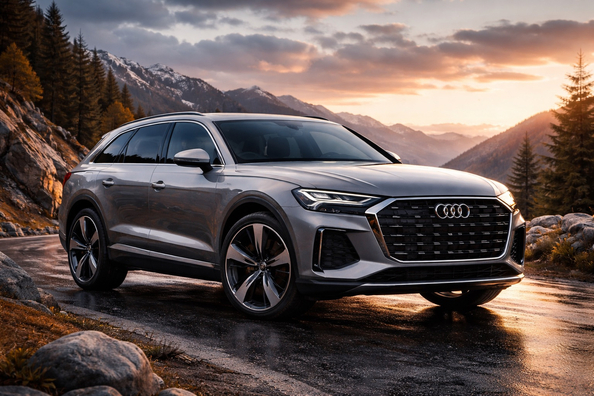
Audi Q9 — the new flagship: how I see it (and why it could “shake up” the large SUV class)
Important: below is my vision of the Audi Q9 as a flagship SUV (a concept combining market expectations + logical solutions for the segment). Where I provide “reference” figures for competitors and current models — that’s for context, while the “target parameters for Q9” are marked as forecasts/ideal formulas.
In short: Audi has long needed a truly large three-row SUV above the Q7 — not “7 seats for show,” but a full-fledged flagship that competes with the BMW X7, Mercedes-Benz GLS, and Range Rover, while still feeling like an Audi: quiet, high-tech, precise handling, and understated premium character.
Contents
- 1. Why the market needs the Audi Q9
- 2. Positioning: where the Q9 stands relative to the Q7 and competitors
- 3. Flagship DNA: the “formula” of the Audi Q9
- 4. Exterior design: proportions, lighting, aerodynamics
- 5. Platform and technology: what makes sense as a base
- 6. Dimensions, cabin, and trunk: figures and practicality
- 7. Interior: 3 rows without compromise
- 8. Technology: the flagship “digital cockpit”
- 9. Safety and driver assists
- 10. Engine/hybrid lineup: what it should look like
- 11. Suspension and driving character
- 12. Towing, winter, long trips
- 13. Trims: simple and clear
- 14. Audi Q9 pricing logic
- 15. When to expect it and what comes in the “first wave”
- 16. How to choose your Q9: buyer’s checklist
- 17. What to buy right away: accessories and tuning (to make the car “yours”)
- 18. FAQ: most common questions about the Audi Q9
1) Why the market needs the Audi Q9
- Buyers have outgrown “compact 7-seaters.” For families, travel, strollers, luggage, and sports gear, a third row that’s truly comfortable — not “for 20 minutes” — is essential.
- The premium segment already has big players. BMW and Mercedes have long made full-size three-row SUVs the segment standard, while Range Rover is the luxury benchmark. It’s logical for Audi to fill that gap.
- A flagship is more than size. It’s about status, uncompromising equipment, technology, and the feeling that you’ve bought the brand’s “top shelf.”
2) Positioning: where the Q9 stands relative to the Q7 and competitors
I see the Audi Q9 as a model half a step larger than the BMW X7 / Mercedes GLS in terms of third-row space, but with European-level composure in handling and cabin acoustics (where Audi has always excelled).
2.1. Reference dimensions of competitors (for context)
| Model | Length, mm | Wheelbase, mm | Comment |
|---|
| Audi Q7 | ~5072 | ~2995 | Three-row, but the 3rd row is often tight for adults |
| BMW X7 | ~5181 | ~3105 | The benchmark for “European” large SUVs |
| Mercedes-Benz GLS | ~5215 | ~3135 | Focus on comfort and smoothness |
| Range Rover (LWB) | ~5252 | ~3197 | Luxury “cruiser,” strong image |
| Cadillac Escalade | ~5383 | ~3071 | Maximum “presence” and size (American school) |
Positioning conclusion: for the Audi Q9 to be a true flagship, it should be closer to the “Range Rover LWB in space,” but closer to the “BMW X7 in composure.”
3) Flagship DNA: the “formula” of the Audi Q9
If I were drafting the technical brief for the Q9, it would sound like this:
- Base — 6 seats (2+2+2) with “captain’s” chairs in the second row and a walk-through to the back.
- Option — 7 seats (2+3+2) for those who prioritize capacity over “business lounge.”
- Silence: double glazing, active noise cancellation, wheel arch and floor insulation at A8 level.
- Comfort packages: ventilation/massage at least for rows 1–2, heating for all rows, 4-zone climate as standard.
- Durability for travel: suspension that “swallows” bumps, brakes that don’t fade in the mountains, proper towing ability.
4) Exterior design: proportions, lighting, aerodynamics
4.1. Proportions
- Long hood + cabin set back — to make the car look “expensive” and not like a van.
- Wide shoulders (arches, rear pillar) — visual mass that a flagship needs.
- Flat roofline to the 3rd row — no “coupe drop,” because the Q9 is about space.
4.2. Lighting as a “signature”
- Front: split headlights (DRLs + main modules) with a very recognizable “signature” graphic.
- Rear: wide light “bar” + adaptive scenarios (animations, indicators) — but without kitsch.
4.3. Aerodynamics of a large SUV (and why it matters)
Even for petrol/hybrid, aerodynamics mean quietness, efficiency, and stability. I’d include: active shutters, flat underbody protection, “clean” sills, optimized mirrors/cameras (where allowed).
5) Platform and technology: what makes sense as a base
For a flagship “here and now,” the most pragmatic path is a modern platform for ICE/hybrids, with 48-volt architecture and plug-in hybrid capability. That way you get power, range, and reasonable consumption.
5.1. 48V mild-hybrid as a “must-have”
- Smooth start/stop in the city
- Torque support at low revs
- Fuel savings without the complexity of a PHEV
5.2. PHEV (plug-in) as “smart premium”
For Europe and city driving, a PHEV allows covering 30–60 km of daily routes on electricity (ideally), while on highways it drives like a regular powerful SUV.
6) Dimensions, cabin, and trunk: figures and practicality
6.1. “Target” dimensions for the Q9 in my vision
| Parameter | My target (Q9) | Why it’s needed |
|---|
| Length | 5200–5300 mm | Real 3rd-row space + trunk |
| Wheelbase | 3120–3200 mm | Ride comfort, legroom, stability |
| Width | 2000–2050 mm (without mirrors) | Shoulder room and “premium seating” feel |
| Ground clearance | 200–230 mm (with air suspension) | Winter, curbs, rough roads |
| Wheels | 20–22" (23" optional, but wisely) | Balance of looks and comfort |
6.2. Trunk: “honest” scenarios
- 7 seats: should fit at least 3–4 cabin-size suitcases or a large stroller.
- 5 seats: flat floor + wide opening — for loading boxes/wheels/gear without “Tetris.”
- 2 seats: long flat area for trips/transport, without awkward “steps.”
7) Interior: 3 rows without compromise
7.1. Seating and layout
- First row: as “A8-like” as possible, 8–10 massage programs, ventilation, soft headrests.
- Second row (captain’s): individual seats with armrests, heating/ventilation, electric adjustment, optional tables.
- Third row: proper backrests/cushions, good knee angle, cupholders, USB-C, climate vents.
7.2. Materials (and how not to make it “too flashy”)
- Natural textures: wood/aluminum/carbon (as packages)
- Minimal “piano black” — it wears quickly and scratches easily
- Premium acoustics as part of the “silence,” not just marketing
8) Technology: the flagship “digital cockpit”
Audi has strong DNA in interfaces. In the Q9, I’d prefer not “more screens,” but better logic.
8.1. What should be standard
- Large navigation + augmented reality (AR) projection, so you don’t take your eyes off the road
- Separate physical panel for “critical” functions: temperature, airflow, heating
- Voice + scenarios: “Long trip,” “Winter,” “Kids sleeping,” “Car wash”
8.2. Passenger tech
- Rear screens/holders — optional, but with proper mounts and power
- High-power USB-C in rows 2–3
- Strong Wi-Fi/5G module (where available)
9) Safety and driver assists
A flagship must feel “calm” in any conditions: snow, rain, night, highway.
- Adaptive cruise with lane keeping and smooth operation (no “nervous steering”)
- Night vision / thermal camera (where allowed and useful)
- 360 cameras with high quality + “transparent hood” for parking
- Smart lighting (matrix headlights) — key safety feature at night
10) Engine/hybrid lineup: what it should look like
Below is not a “leak” or promise, but a logical model range I’d propose for the Q9. The goal: cover 80% of buyers with 3–4 clear versions.
| Version | Type | Power (target) | 0–100 km/h (target) | For whom |
|---|
| Q9 55 TFSI MHEV | Petrol + 48V | 320–380 hp | ~5.8–6.5 s | Universal “best balance” |
| Q9 60 TFSI e (PHEV) | PHEV | 400–500 hp | ~5.0–5.8 s | City + highway, for those who like saving in town |
| SQ9 | Powerful petrol + 48V / PHEV | 500–600 hp | ~4.2–4.8 s | For those who want “flagship and drive” |
| Q9 TDI (market-dependent) | Diesel + 48V | 280–350 hp | ~6.2–7.0 s | Lots of highway, towing, long trips |
Key idea: in 2026+, a flagship SUV buyer wants either a “quiet powerful petrol/hybrid” or a “PHEV for the city.” Everything else is niche.
11) Suspension and driving character
11.1. Suspension
- Air suspension as standard or “must-have” package: variable heights, comfort on bumps, stability at speed.
- Active stabilizers (optional): less roll without losing comfort.
11.2. Steering feel
- Light “city” maneuverability + highway stability
- Rear-wheel steering (optional) — highly desirable for 5.2–5.3 m length
11.3. Brakes
For a flagship, consistency after repeated braking in the mountains matters more than “peak” stopping power. So: large discs, proper cooling, quality pads.
12) Towing, winter, long trips
12.1. Towing
In the flagship class, around 3.5 tons is the norm — and the Q9 should reach that in the right configurations.
12.2. Winter package “as flagship standard”
- Heated windshield (wiper zone) + heated steering wheel
- Heated 2nd and 3rd rows
- Powerful heater + quick cabin warm-up
- Headlight washers and heated/cleaning camera
12.3. Long trips
- Large tank / efficient hybrid
- Comfortable seating, adaptive seats
- Sound insulation as the key “feature” of the Q9
13) Trims: simple and clear
I’d make three lines so the buyer doesn’t drown in configurators:
- Q9 Premium — “everything essential included”:
- air suspension, 4-zone climate, heated features
- 360 camera, basic top lighting
- 6 seats (captain’s) as the model’s highlight
- Q9 Luxury — for those who want “business jet” comfort:
- massage/ventilation for rows 1–2, extended leather package
- premium acoustics, double glazing
- silence package + maximum comfort
- SQ9 / Sport — flagship with character:
- active stabilizers, upgraded brakes
- sport tuning, unique design packages
- engine/hybrid with extra power
14) Audi Q9 pricing logic
For the Q9 to be perceived as a flagship but not “the most expensive just because,” pricing should sit between the X7/GLS and top Range Rover versions. My forecast (depending on market and taxes): starting around X7/GLS level, with “Luxury/SQ” higher.
- Q9 Premium: roughly “X7/GLS entry zone”
- Q9 Luxury: +10–20% for interior and silence
- SQ9: higher still, but with real tech (suspension/brakes/powertrain)
15) When to expect it and what comes in the “first wave”
The rollout logic for such a car is usually: first the most in-demand (but expensive) trims, then lineup expansion and market localization.
- First wave: 6-seat Q9 with rich packages (easiest way to “enter” the segment).
- Second wave: 7-seat configurations, additional engines/hybrids.
- Third wave: SQ version (once demand and pricing are clear).
16) How to choose your Q9: buyer’s checklist
16.1. Questions to ask the dealer
- Exact seat configuration: 6 or 7 seats? Is the 2nd row adjustable?
- Is there air suspension? What height modes? “Lift” mode for rough roads?
- Real trunk capacity with 3rd row up?
- Which winter options are standard vs. in a package?
- What wheels come “from factory” and how’s comfort on 22"?
16.2. What to test on a test drive
- Access to/from the 3rd row (passage, comfort, knees/feet)
- Noise at 100–120 km/h (arches, mirrors, roof)
- Brakes after 3–4 hard stops
- Parking: cameras/view/maneuverability
17) What to buy right away: accessories and tuning (to make the car “yours”)
A flagship SUV is almost always personalized. Here’s a set of items that truly add comfort and preserve the car:
17.1. Protection and practicality
- Floor and trunk mats (especially if kids/snow/pets)
- Protective film (PPF) on stone-impact zones: hood, roof edge, mirrors, sills
- Winter kit: flashlight, tow rope, gloves, thermal blanket, booster (jump starter)
17.2. Travel comfort
- Roof box (for skis/luggage) or trunk organizers
- Nets/dividers in the trunk to secure items
- Holders/chargers for passengers’ gadgets
17.3. Exterior style (subtle, premium)
- Black package (dechrome) — if done properly
- Aerodynamic elements without “overdoing” (small trims, S-line-style diffuser)
- Wheels — but prioritize comfort (sometimes 21" is better than 22")
18) FAQ: most common questions about the Audi Q9
- Q: Will the Audi Q9 be larger than the Q7?
- A: In segment logic — yes: the Q9 should meet the need for a more spacious 3rd row and trunk.
- Q: 6 or 7 seats — which is better?
- A: 6 seats — for comfort and “walk-through” access. 7 seats — for capacity when traveling with a large family or group.
- Q: Which engine is the “no-stress” choice?
- A: Most often — 48V petrol or PHEV, depending on your city mileage and charging options.
- Q: Are 22" wheels necessary?
- A: For looks — yes. For daily comfort and our roads — often 20–21" are smarter.
Final thought
I see the Audi Q9 as a flagship that finally gives Audi a true three-row “large premium” SUV — no compromises on the 3rd row, with proper comfort, silence, and modern hybrid logic. If Audi builds the Q9 this way, it will be a very strong choice for those who want a “premium family cruiser” without the American “barge” feel.