 Author: Radomskyi Maksym Vasyliovych
If you boil the choice down to practice, for a roof rack on roof rails only three things are truly essential: compatible feet, the right crossbars, and a fixing kit for your roof type. Everything else—locks, T-slot accessories, box/bike/ski adapters—isn’t needed by everyone and not right away.
Most often, people overpay not for quality, but for unnecessary parts or for a system that doesn’t match their use case. For city driving, highways, and a few trips a year, a decent aerodynamic base is usually enough. For heavy loads, frequent long routes, bad roads, or an expedition-style platform, the requirements are different.
What the choice is really about
The main question isn’t which brand is louder or more expensive, but what exactly you’ll carry and how often. If you need a base for a roof box, skis, or a bike carrier, compatibility of the feet with the rails, crossbar length, and profile type are critical. If you’re planning heavy cargo, a rooftop tent, or regular driving on rough roads, you need to look not only at the crossbars, but at the strength reserve of the entire system.
In practice, the market splits into three logical options: basic steel crossbars, aerodynamic crossbars, and heavy-duty systems or platforms. The first are cheaper, but noisier. The second are better for everyday use. The third only make sense when the load and operating conditions are genuinely demanding.
Which criteria to compare
Installation. You need to know your exact rail type: raised, flush/integrated, or no rails at all. This is where most mistakes happen, because there is no universal kit. Integrated rails often require separate clips or a vehicle-specific kit; raised rails use different feet.
Noise. Round bars and many simple steel crossbars almost always make more noise. An aero profile is usually quieter, but even it can whistle at certain speeds if positioned poorly or if extra accessories are fitted.
Lifespan and strength. What matters here is not only the crossbar material, but also the quality of the feet, how they sit on the roof, and the real load limit. The system is always limited by the weakest link: the car roof, the feet, or the crossbars themselves.
Practicality. If you’re planning a box, bike mounts, or ski holders, a T-slot makes life much easier. If you won’t use any of that, paying for it sometimes makes no sense. Same with locks: for parking in a yard or on the street it’s a useful option; for occasional use with garage storage it’s not always mandatory.
Price. The real budget is almost always higher than the price of the crossbars alone. Feet, clips, locks, and mounts for a specific accessory are often added separately.
Quick comparison of options (table)
| Option | Strengths | Weaknesses | Who it’s for |
|---|---|---|---|
| Basic steel crossbars | Lower price, simple design, sufficient for occasional use | More noise, worse aerodynamics, less comfort on the highway | Those who install a rack a few times a year and don’t want to overpay |
| Aerodynamic crossbars | Quieter, more comfortable for daily driving, often have a T-slot for accessories | More expensive, sometimes require more careful selection of length and compatibility | Those who often drive on the highway, plan a roof box, or want a good balance of price and comfort |
| Heavy-duty crossbars or platform | Better durability under heavy loads, more tie-down options, makes sense for expedition use | Higher price, more weight, worse efficiency, and only sensible for specific tasks | Those who carry heavy loads, drive bad roads, or are building a system for a tent or work use |
Detailed breakdown of each option
Basic steel crossbars
This is the working minimum if you simply need a base for straightforward tasks. They handle occasional transport of light loads just fine, but on a daily driver they quickly become noticeable because of noise and aerodynamic drag. If the car often runs on the highway, the upfront savings aren’t always justified.
Aerodynamic crossbars
The most rational format for most owners. These crossbars are usually quieter, behave better at speed, and make accessory installation easier thanks to the T-slot. This option best covers city use, travel, roof boxes, skis, and bikes without the feeling of a rough cargo construction on the roof.
Heavy-duty crossbars or platform
Here it’s not about trends, but about the scenario. If you’re carrying heavy gear, driving on bad roads, or need a large surface for mounting, a reinforced system or platform is justified. But for a regular family car without frequent load duty, it’s often extra weight, extra noise, and extra money.
DD Tuning expert comment: the most common mistake is to buy crossbars first and only then find out the feet don’t fit the specific rail type or that a vehicle-specific kit is missing. The second mistake is to focus only on the crossbars’ load rating without checking the car roof’s own limit. If the car is driven daily, it’s better to choose a quieter aero system right away than to put up with whistling and remove it a week later.
Which option is better for different scenarios
For city and highway driving, aerodynamic crossbars most often win. They create less noise, work better with roof boxes and other accessories, and are less annoying in daily use.
For the cottage, a few trips per season, or rare use, you can live with simpler steel crossbars if noise isn’t critical. It’s a solid option when the budget is tight and the system isn’t on the car permanently.
For construction tools, long items, heavy camping gear, or trips beyond good asphalt, you should look at heavy-duty solutions. In this mode, you’re paying not for looks, but for strength reserve and stability.
Use case and what to choose (table)
| Scenario | Best choice | Why |
|---|---|---|
| Daily car, highway, occasional roof box | Aerodynamic crossbars | Less noise, better aerodynamics, easier accessory fitting |
| Rare trips, minimal budget | Basic steel crossbars | Cheaper entry without paying for features that won’t be used постоянно |
| Bikes, skis, several different accessories | Aerodynamic crossbars with T-slot | Faster installation and less hassle with adapters |
| Heavy cargo, work use, bad roads | Heavy-duty system or platform | Handles load better and offers more freedom to secure cargo |
| Rooftop tent or large touring gear | Heavy-duty system after checking the car roof limit | Here it’s critical not only the crossbar, but full-system compatibility and load headroom |
Common mistakes when choosing
- Buying only crossbars without checking which feet and mounting hardware are needed for your rail type.
- Confusing raised and integrated rails. They look similar, but the mounting kits are often different.
- Judging the system only by the maximum load number without considering the car roof’s limitations.
- Choosing a heavy platform “just in case” when in reality you only need a roof box a few times a year.
- Ignoring noise. If the rack will stay on permanently, the difference between a basic and an aerodynamic system is felt every day.
- Not budgeting for locks and mounts for a specific accessory, then discovering the base kit still isn’t ready to use.
When a more expensive solution makes sense
A more expensive system is justified when the car regularly runs with a rack, when low noise matters, or when you plan several different accessories. In that case, aero crossbars are more convenient than basic ones in almost everything—from highway comfort to how easily you can mount a box or bike carrier.
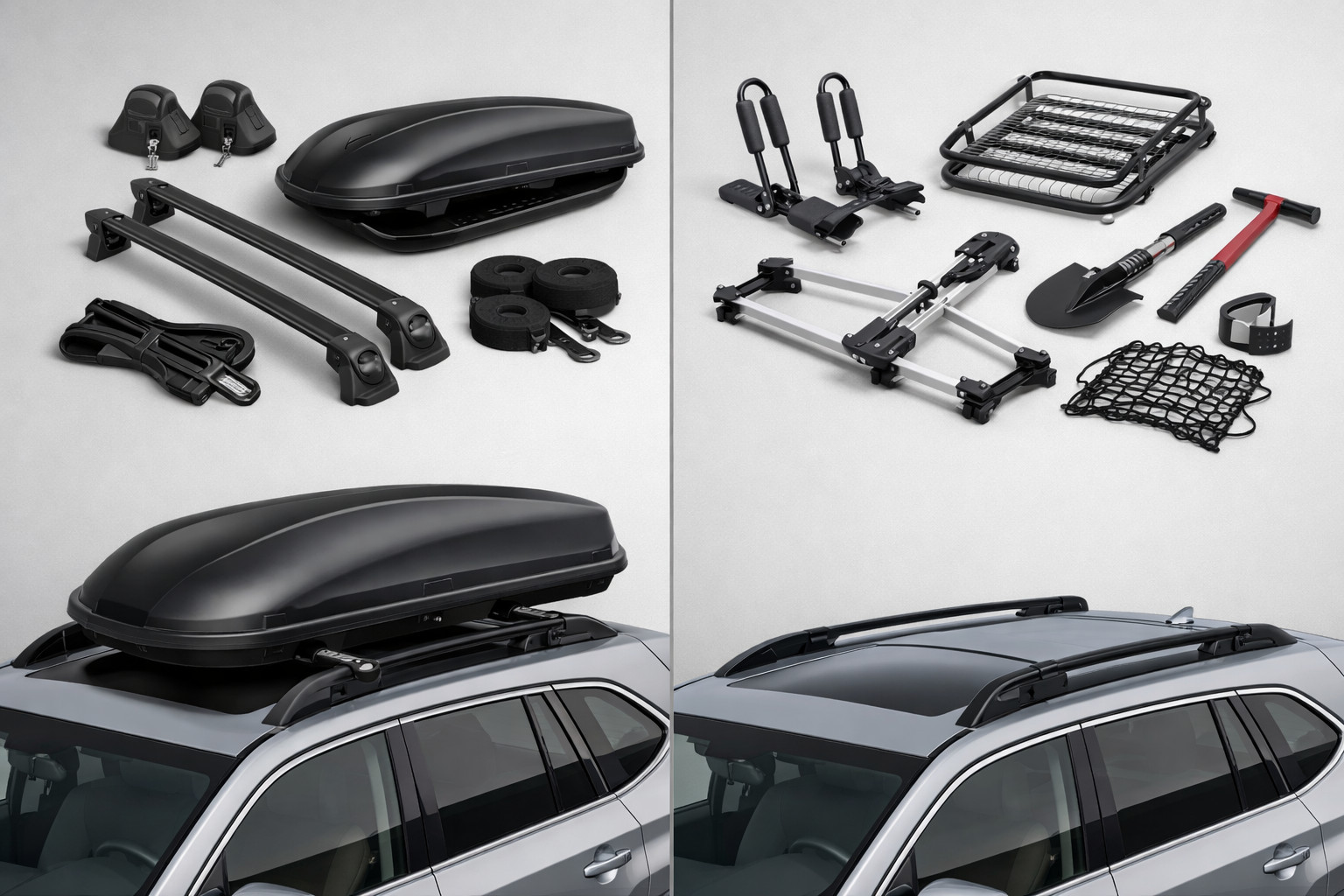
If the task is closer to heavy gear or expedition use, it makes sense to look not only at crossbars but at the complete system: components for roof rails, roof racks for standard roof rails and roof boxes. In these scenarios, the higher price pays off not in status, but in not having to rebuild the system after the very first trip.
Separately, a more expensive solution makes sense if you don’t want compromises in longevity. Quality feet, precise fitment, and proper hardware usually last longer and are less irritating in small ways like play, misalignment, or difficult installation.
From a customer’s experience: a crossover owner initially wanted the cheapest crossbars only for a summer roof box. During selection it turned out the rack would stay on the car almost the entire season, and skis were also planned for winter. In the end, they chose an aerodynamic T-slot system: it cost more upfront, but they didn’t have to replace the crossbars after the first long trip due to noise and inconvenient accessory mounting.
Conclusion
In most cases, a simple logic works without unnecessary spending: you need the right feet, compatible crossbars, and the correct fixing kit for your roof. Locks, a T-slot, and separate mounts for a box or bike are worth buying when there’s a real task for them, not “just to have it.”
If the car is used daily, the healthiest choice is an aerodynamic system. If the load is rare and the budget is strict, you can live with basic steel solutions. If the scenario is heavy, with bad roads or large gear, then a reinforced system or platform is justified. This material is based on real selection experience, practice, and real use cases—not abstract numbers from a product card.
How it works
- Define your usage scenario First, figure out exactly what you’ll be carrying: a roof box, bikes, skis, light luggage, or heavy gear. This will determine whether a basic setup is enough or if a reinforced system is already needed.
- Check the rail type and mount compatibility Find out whether you have raised rails, integrated rails, or a roof without rails. Each type requires its own feet, clips, or vehicle-specific kit — there is no universal solution here.
- Choose crossbars based on trip frequency For occasional use and a minimal budget, basic steel crossbars will do. If the car is driven daily or often on highways, aerodynamic ones are better: they are quieter and more convenient in use.
- Assess whether extra options are needed Buy locks, T-slot, and mounts for a box, bike, or skis only when they are truly needed. If the system will stay installed all the time or the car is stored outdoors, locks and T-slot can be practical; for occasional use, this is not necessary.
- Check the load limit and plan for the full budget Do not rely only on the crossbars’ load capacity figure: take into account the car roof’s limitations and the weakest link in the system. Also include the feet, mounts, and needed accessories in your budget right away, because the real price of the set is often higher than the cost of the crossbars alone.
Pros and cons
For regular use, the author clearly identifies the minimum required set: compatible feet, the right crossbars, and a mounting kit for the roof type. This helps avoid buying unnecessary items at the start.
Aerodynamic crossbars are described as the most practical option for the city and the highway: they are quieter, perform better at speed, and are more convenient for everyday driving.
The article clearly distinguishes between use cases: occasional trips, a daily car, or heavy cargo require different solutions. This makes choosing easier without focusing only on the brand or price.
It explains when the T-slot is actually useful and when there is no point in paying extra for it. This is practical for those who do not plan to use many accessories.
There is a useful warning about the system’s overall limit: not only the crossbars matter, but also the car roof and the feet. This reduces the risk of buying the wrong load rating.
The article acknowledges that the real budget is often higher than expected, because feet, clips, locks, and special mounts are often bought separately. In practice, this makes it harder to calculate costs accurately.
Integrated and raised roof rails require different kits, and there is no universal solution. Because of this, it is easy to make a mistake already at the selection stage.
Basic steel crossbars are cheaper, but they are noticeably noisier and perform worse on the highway. For everyday use, this can quickly become inconvenient.
A reinforced system or platform makes sense only for specific tasks, and for an ordinary family car it is often extra weight and extra cost. In other words, the extra spend without a clear use case is unlikely to pay off.