
Which car vacuum is better? Guide to choosing the right one

The car interior gets dirty fast: crumbs, sand, pet hair, and dust build up in just a few weeks. A regular household vacuum isn’t always convenient to take into the car, so a compact car vacuum becomes a real lifesaver. But how do you avoid making the wrong choice among hundreds of models on the market? Let’s break down which option might be the best. If you like, you can also upgrade your car’s interior with various tuning accessories that help make the cabin even more comfortable and well-kept.
Types of car vacuums
Modern car vacuums fall into three main groups:
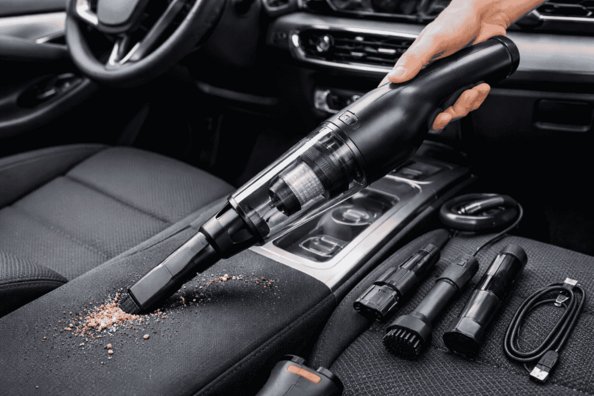
- Cordless handheld models — the most convenient for quick cleanups. Lightweight, no cords, battery-powered.
- 12 V cigarette lighter vacuums — more powerful, run from the car’s electrical system, but limited by the cable.
- Hybrid models — combine battery and wired power, the most versatile, though more expensive.
What to look for when choosing
Here are the key specs that define quality:
- Power — 80–150 W (consumption) for effective cleaning.
- Dust container capacity — 0.3–0.5 liters is enough for a passenger car. A larger capacity is handy for bigger cabins or SUVs.
- Filter type — ideally a HEPA filter or a high-quality equivalent.
- Included accessories — a crevice tool, upholstery brush, and a nozzle for floor mats should be included.
- Battery runtime — at least 20–25 minutes of continuous operation.
- Noise level — preferably up to 75–80 dB so it doesn’t get annoying while cleaning.
Top recommendations for 2026
- For most drivers: battery models with Li-ion 2000–4000 mAh.
- For families with kids and pets: powerful hybrid vacuums with a large dust container, turbo brush, and HEPA filter.
- Budget option: cigarette lighter vacuums with a good accessory set.
Helpful tip: Before buying, read reviews specifically about performance with pet hair and fine dust. It’s better to spend a bit more on a quality model than to buy a new cheap vacuum every month.