08.05.2026
388
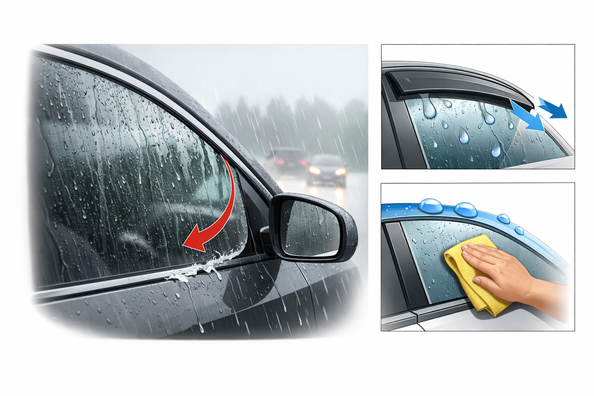
In the rain, side windows get dirty not so much from the precipitation itself as from airflow and road spray. The worst area is almost always the same: the front part of the side glass near the A-pillar and the mirror—exactly where the driver looks when changing lanes.
You can reduce it, but rarely with a single trick. A deflector on its own, a hydrophobic product on its own, or just frequent washing only give a partial effect. What works consistently is a combination: clean, degreased glass, a properly applied water-repellent layer, good wipers, and normal aerodynamics around the mirror.
The front side window sits in a complex airflow zone. Air traveling along the windshield hits the A-pillar, the mirror, and the door edge, and part of the flow starts to swirl. In this area, water isn’t simply blown away—it mixes with fine dirt and settles as a streak.
That’s why in the rain the glass often doesn’t get dirty evenly; it’s specifically the section near the mirror. On the highway the effect is stronger due to speed; in slush it’s worse because of salty and dirty mist thrown up by your tires and vehicles ahead. On cars with large mirrors, a tall body, or a pronounced pillar shape, the problem is usually more noticeable.
In most cases it’s not a single cause, but two or three at once. That’s why a cheap, one-point fix often doesn’t deliver a noticeable result.
Start with a simple test: wash and degrease the side glass, then drive for 10–15 minutes in light rain without using the washer. If a narrow stripe near the mirror and the front corner of the glass appears first, the cause is mostly aerodynamics rather than poor washing.
If the glass suddenly gets wet right after using the windshield washer, the source is partly in the nozzles, the wipers, or how the airflow blows fluid off the windshield. If dirt rises from bottom to top along the full height of the door, the main culprit is road spray. If even after washing the water sits as a continuous film and leaves spots, the problem is the condition of the glass surface or an incorrectly applied coating.
Another indicator is speed. In the city the problem may be tolerable, but on the highway it can intensify sharply. This almost always means the key role is played by the airflow near the pillar, not just the car being generally dirty.
DD Tuning expert comment: the most common mistake is to install any deflector on dirty glass and expect an instant result. The second typical mistake is applying a hydrophobic product without proper degreasing, or wiping it off too early. In practice, what works best isn’t a single accessory, but a bundle: correct glass prep and checking exactly where the dirt is coming from—top, side, or bottom.
| Symptom | Likely cause | What to do |
|---|---|---|
| Dirty streak near the mirror and the front edge of the glass | Vortex near the A-pillar and mirror housing | Check repeatability after washing; if the zone is always the same, work with a deflector and the condition of the glass surface |
| The glass gets wet immediately after using the washer | Fluid from the windshield is blown sideways | Inspect the wipers, the washer nozzle spray pattern; don’t use the washer at speed unless necessary |
| Dirt rises from bottom to top along the door and side glass | Road spray from the tires and airflow from under the car | Rinse off salt film more often; don’t expect an upper deflector to fully eliminate this type of contamination |
| Water stays as a continuous film instead of beading off | The glass is greasy, polished by road film, or the coating was applied incorrectly | Deep-clean and degrease, and only then apply protection evenly all the way to the edges |
| On the highway it gets much dirtier than in the city | The issue depends on speed and airflow shape | Evaluate accessory effectiveness only after driving at speed, not after a short city trip |
First: proper glass preparation. Side glass needs more than just a wash—you must remove road film, old chemical residues, and grease. Without this, even a good water-repellent product works in patches and weakens quickly.
Second: a hydrophobic coating applied to dry, clean glass evenly over the entire area, including the corners. It doesn’t eliminate the source of dirt, but it reduces water film adhesion and makes the glass easier to maintain.
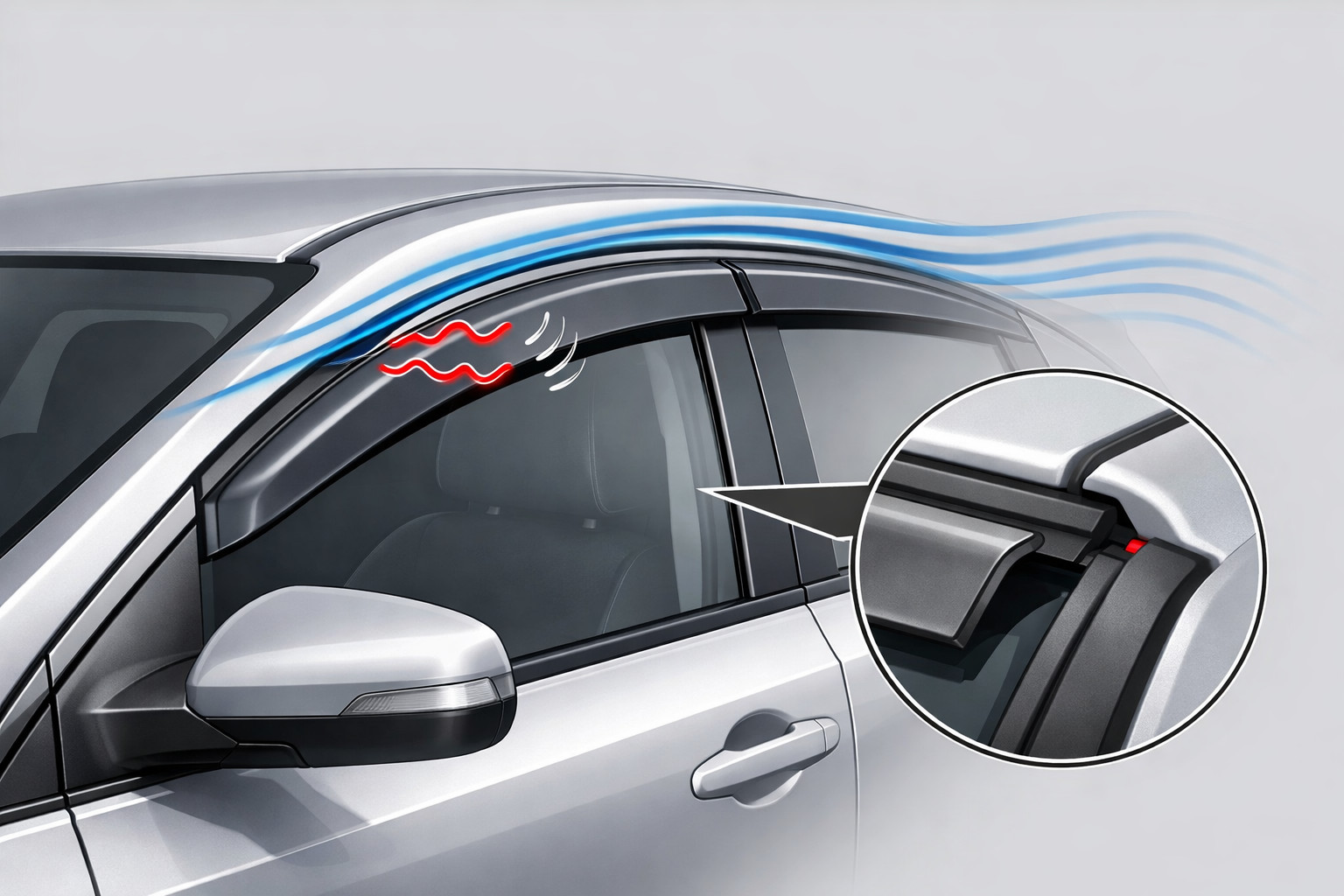
Third: a correctly selected deflector. It’s most useful when water comes from above and from the front, not only from below. On some cars the effect will be noticeable; on others moderate, because the shape of the pillar and mirror differs across models.
Fourth: control of the washer system and wipers. Worn blades, a poor nozzle spray pattern, and overusing the washer at speed often throw dirt into that same corner of the side glass. In slush, a simple habit also helps: keep a clean cloth in the cabin to quickly wipe the glass and mirrors during a stop.
A cheap product applied to unprepared glass usually gives a short, uneven effect. At first it seems like water runs off, but after a few trips spots appear and dirt sticks just as quickly.
A universal deflector without an exact fit is also a questionable solution. It may slightly change the upper airflow, but it can also add noise and barely affect the dirt that flies up from the wheels.
You also shouldn’t expect that one wash will solve the problem for the whole season. In winter slush and on wet highways, the contamination source is constant, so without regular care the effect of any product will be limited.
The logic is simple: an accessory should be chosen for a specific scenario, not “just in case.” If the dirt is coming from below, a deflector alone won’t solve it for the whole car.
| Solution | When it works | When it’s not worth spending money |
|---|---|---|
| Deep cleaning and degreasing of the glass | Almost always, especially before applying any protection | There’s no point skipping this step and immediately buying accessories |
| Hydrophobic coating | When the glass is clean and dry and the product is applied evenly over the entire area | If you expect a long-lasting effect from a one-time application on dirty or cold glass |
| Model-specific deflector | When water comes from above and the front, and the problem gets worse at speed | If the main dirt flies up from the road below, or if you choose a universal part without an exact fit |
| New wipers and checking the nozzles | When the side glass gets dirty after using the windshield washer | If the problem appears even without using the washer |
| Repair or replacement of a damaged mirror | When the dirty zone is tightly tied to the mirror housing and there’s an obvious defect | If the mirror is fine and the cause is typically aerodynamic for the whole model |
| Simply washing the car more often | Helps as maintenance during the slush season | As the main solution, because the airflow and spray cause doesn’t go away |
From a customer’s experience: a driver complained that in the rain, after 15–20 minutes on the highway, visibility in the left mirror disappeared—a dirty streak appeared every time in the same spot near the front corner of the glass. After proper glass cleaning, applying a hydrophobic coating, and installing model-specific deflectors, the problem didn’t disappear completely, but the time until it got dirty became noticeably longer, and the glass itself became easier to clean even on the road. The most important thing for him was that the sector near the mirror stopped gumming up quickly, rather than the entire glass at once.
Fast side-window contamination in the rain is almost always a combination of two things: road spray and unfavorable airflow near the A-pillar and mirror. That’s why the solution should be layered: clean and degreased glass, properly applied protection, good wipers—and only then accessories that match your specific scenario.
Don’t spend money on random universal little add-ons if you still haven’t identified the source of the dirt. This material is based on real selection experience, hands-on practice, and real-world driving scenarios in rain, on the highway, and during seasonal slush—so the main advice is simple: diagnose by symptoms first, then apply a targeted fix, not the other way around.
Shipping to EU
Wholesale and retail
Own warehouse
Опис продукту
Подарунки не надаються при оформленні покупки у кредит під 0,01% або при покупці частинами.