01.04.2026
552
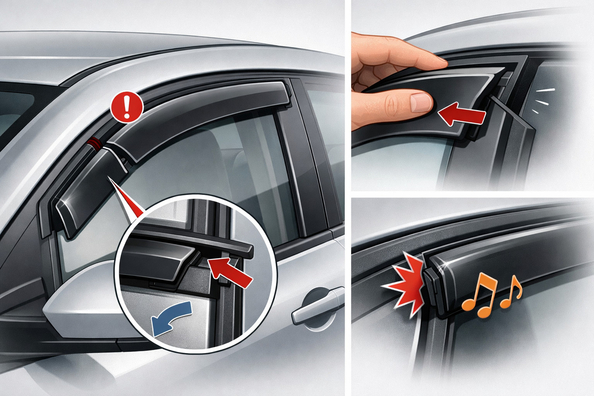
If in-channel window deflectors fall out, squeak, or make the glass bounce back down, the problem is usually not with the accessory concept itself but with how it sits in the window channel. A bit of dirt or moisture in the groove, a misaligned front or rear edge, a folded seal, or swapped left/right pieces is enough for the glass to start rubbing and the deflector to lose tension.
Symptoms often get worse with temperature. In the cold, the material and the seal settle more slowly, so the deflector takes longer to “seat” in place. In the heat, the part may expand slightly, increasing resistance for the glass or triggering the window regulator’s protection. That’s why the first thing to do is not to glue everything in sight, but to check the fit along the edges and the condition of the channel.
An in-channel deflector is held not only by the plastic shape but also by precise tension in the window frame. If the part sits even slightly crooked, it either presses on the glass or, наоборот, holds too loosely. This leads to two extremes: squeaking and tight closing, or play and falling out at speed.
Sensitive auto-up systems are another factor. For them, even a small extra resistance near the top of the travel already looks like an obstacle. So the glass doesn’t reach the end and automatically drops back down, even though the window regulator itself may be fine.
DD Tuning expert comment: most often users try to “fix” squeaks with lubricant or double-sided tape without checking whether both edges are seated correctly. A second typical mistake is installing in the cold and immediately using the windows активно. If the part didn’t sit evenly from the start, no “quick life hack” gives a stable result.
| Symptom | Likely cause | What to do |
|---|---|---|
| The glass doesn’t close all the way | The front or rear edge is seated crooked, the seal is folded | Remove the deflector, level the fitment, return the seal to the correct position |
| The glass goes up and bounces back down | Excess resistance for the pinch protection system | Reinstall the part, do slow cycles, reset auto-up if needed |
| Squeak or chirp while the glass moves | Dirt in the channel, glass rubbing on an edge or the seal | Clean and dry the groove, check contact marks, correct the fitment |
| The deflector has play when pushed by hand | Weak tension, wrong side, or missing clips | Check part markings, install OEM-style retainers if they’re предусмотрены |
| One edge comes out of the channel after a few days | Insufficient settling or the wrong kit | Reinstall in a warm place and don’t open the window for the recommended time; if it doesn’t help, replace the kit |
| The issue is worse in heat or мороз | Temperature-related change in material and seal stiffness | Evaluate fitment after temperature stabilizes, don’t rush installation in the cold |
The best results come not from taping, but from reinstalling from scratch. The channel and the glass edge must be clean and dry. The front edge must be placed on the correct support point; the rear edge must be tucked behind the seal without folding it. After that, it’s better not to lower the window for as long as the specific kit requires: often 12–48 hours, sometimes longer.
If the set has clips or other OEM-style retainers, they must be installed обязательно. On some vehicles they are exactly what removes play in the upper part of the frame. Installation in a warm room also helps: at temperatures below about 16 °C the deflector may take longer to seat.
For windows with auto-close/auto-up, after installation it’s useful to raise and lower the glass a few times slowly without automatic mode. This helps you see the real binding point instead of only catching the symptom after a drive.
Just spraying silicone into the groove is a weak solution. Sometimes the noise decreases for a day or two, but the root cause remains: the deflector is still seated crooked or the seal is folded. Plus, lubricant attracts dirt, and the rubbing can return even faster.
Double-sided tape as the main retention method for in-channel systems also rarely saves the day. If the geometry doesn’t match or tension is weak, the tape only masks the problem, and then the edge comes out of the channel again. Randomly trimming the plastic doesn’t help much either: it’s easy to ruin the part and still not eliminate the misalignment.
The worst option is forcing the glass up repeatedly. That can overload the mechanism, and the deflector still won’t seat properly because of it.
If the deflector is already cracked, has lost its shape, or consistently comes out of the channel after a proper reinstall, it makes sense not to waste time experimenting but to choose new window deflectors for the exact vehicle modification. When the issue isn’t the part itself but the fixing method, it’s worth looking at deflector mounts and compatible installation hardware.
If you’re unsure where the mistake was, it’s useful to cross-check the procedure via step-by-step installation. This is especially relevant for cars with sensitive auto-up, where even a small misalignment immediately causes the glass to bounce back.
Replacing the seal makes sense when it’s already hard, torn, or деформированный and works poorly even without the deflector. But if before installation the glass moved quietly and easily, and the problem appeared right after fitting, the seal is usually not to blame—the fitment is.
| Solution | When it works | When it’s not worth spending money |
|---|---|---|
| Full reinstall with cleaning and drying the channel | When the cause is dirt, moisture, edge misalignment, or a folded seal | If the part physically doesn’t fit the shape or is already deformed |
| Let it settle for 12–48 hours in warm conditions | When the kit is new and the glass is only slightly tight after installation | If the edge is already popping out of the channel or the glass binds very hard |
| OEM clips or an auxiliary retainer from the kit | When the manufacturer explicitly предусмотрел this fixing method | If you’re trying to compensate with them for an incorrect or чужой kit |
| Resetting auto-up | After the mechanical cause has been fixed, but the automation still makes the glass bounce back | If the deflector still clearly creates an obstacle in the channel |
| Replacing the seal | When it’s old, torn, or deformed on its own | If the glass worked normally before installing the deflector |
| Re-taping, lots of tape, “blind” lubrication | Almost never as a long-term solution | When you need to remove the cause rather than mask noise or play |
| Replacing the kit with an exactly compatible one | When a selection mistake is confirmed or the geometry clearly doesn’t match | If the current kit was simply installed incorrectly and that hasn’t been checked yet |
From a customer’s experience: after DIY installation, the front door glass started bouncing back down, and a squeak appeared at the rear. After reinstalling in a warm bay with the channel cleaned, it turned out that one deflector was on the wrong side, and the seal was folded on the other. After correct seating and a pause without opening the windows, the problem disappeared without replacing the window regulator.
When in-channel deflectors fall out or squeak, in most cases the cause comes down to three things: incorrect fitment, a dirty or wet channel, or an inaccurate kit selection. So the repair logic is simple: first check the edges, seal, and tension, and only then think about replacing parts.
If after proper reinstallation, settling, and checking the glass the issue remains, spending money on random “reinforcements” makes little sense—it’s better to replace the kit or worn elements. This material is based on real selection experience, practice, and real use scenarios, so the main advice here is one: don’t treat symptoms until the exact cause is found.
Shipping to EU
Wholesale and retail
Own warehouse
Опис продукту
Подарунки не надаються при оформленні покупки у кредит під 0,01% або при покупці частинами.