
































































 Author: Radomskyi Maksym Vasyliovych
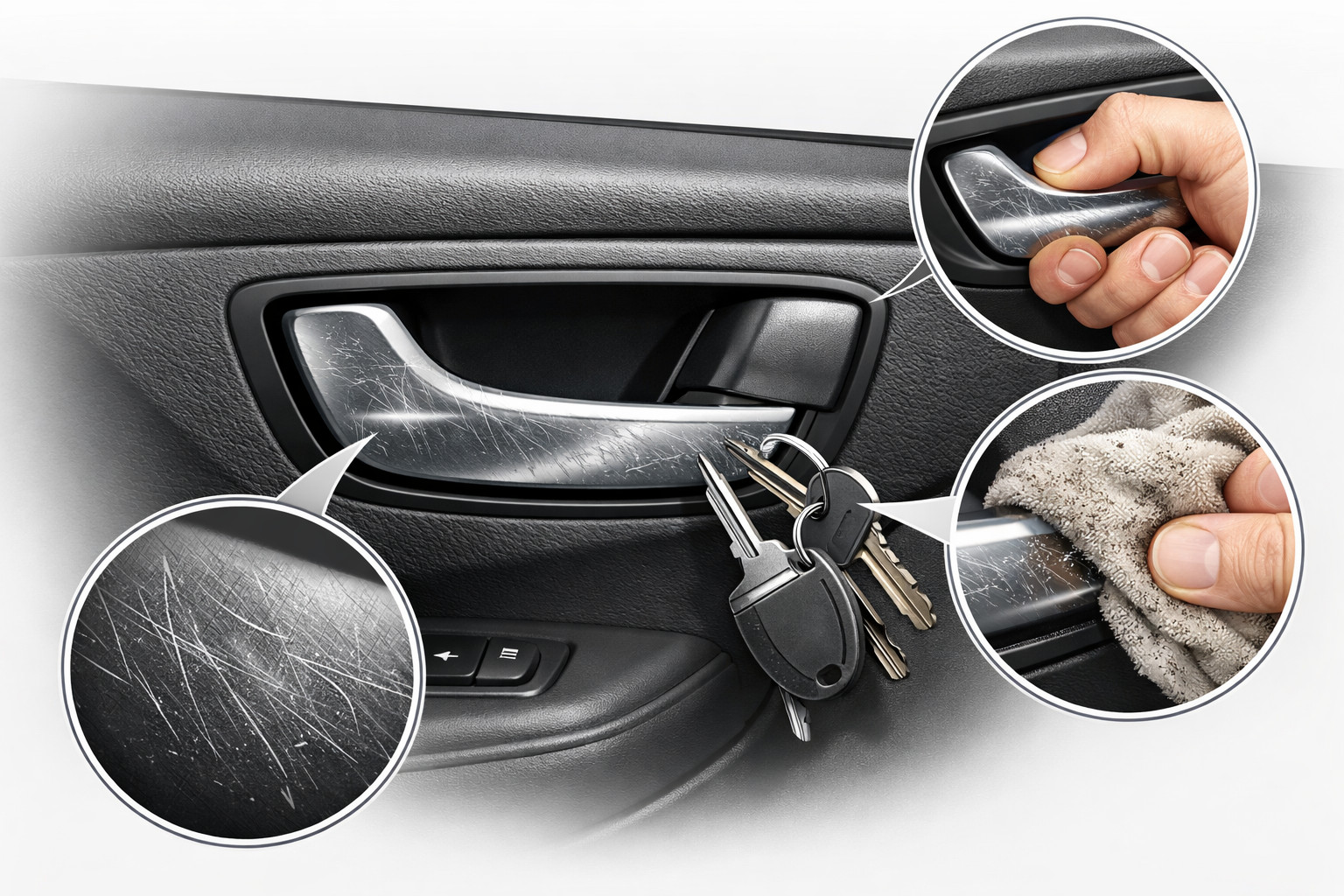
Interior door handles in the cabin often get scratched and go dull not because of poor care, but because of the material itself. On many cars there’s a thin soft rubberized coating there, which constantly takes abuse from fingers, nails, dust, hand cosmetics, and summer heat inside the cabin.
The key here is to distinguish dirt and greasy buildup from real coating wear. If, after gentle cleaning, the surface still feels tacky, shines in blotches, or looks like it’s rubbing off in places, the issue is no longer maintenance—it’s the top layer breaking down.
Why this problem occurs
The interior handle is one of the most heavily used points in the cabin. It’s touched dozens of times a day, almost always in the exact same spot. If the part has a soft decorative layer only a few dozen microns thick, it wears much faster than hard painted plastic.
Temperature speeds things up. In hot weather the cabin overheats, and the coating ages faster along with it: it loses its even matte look, becomes more sensitive to chemicals, and starts to handle mechanical stress worse. That’s why on cars that often sit in the sun, the handles age noticeably faster.
Main causes
- Material aging. Over time, the soft rubberized coating dries out, loses stability, and starts to dull or become sticky.
- Mechanical abrasion. Nails, rings, keys in your hand, and constant rubbing in one spot quickly polish a matte surface into a shiny one.
- Dust and dry rough wiping. Fine dust acts like an abrasive, especially if the handle is often wiped without pre-wetting.
- Chemicals from hands. Hand sanitizer, cream, sunscreen, perfume, and even in-cabin air fresheners can leave marks or accelerate layer breakdown.
- Poor care choices. Alcohol-based cleaners, solvents, stiff brushes, abrasive pastes, and overly aggressive polishing don’t restore the coating—they remove it even faster.
How to understand the cause in your case
Start with a simple test: remove dust, dampen a microfiber with a neutral cleaner, and wipe the entire handle area evenly. It’s important to apply the product to the cloth, not pour it directly on the part. After it dries, see what changed.
If the surface becomes even and matte, the problem was residue. If the spot remains but is simply shiny and smooth, that’s mechanical wear in the grip area. But if there’s tackiness, uneven shine, a dark mark on the cloth, or a feeling that the top layer is smearing, that’s coating failure.
Another check is to compare the driver’s handle with the passenger’s. If almost only the driver’s side suffers, the cause is mostly daily contact. If you see a similar pattern on several doors at once, suspect material aging and cabin overheating more strongly.
DD Tuning expert comment: The most common mistake is trying to bring back a matte finish with plastic polish when the layer is already damaged. If the handle is sticky or the shine is blotchy, a cosmetic product will only mask the issue temporarily. First you need to understand whether the surface is still intact, and only then choose between protection, covering, or replacement.
Symptoms, causes, and what to do (table)
| Symptom | Likely cause | What to do |
|---|---|---|
| The handle was simply dirty, but after cleaning the matte finish returned | Grease, dust, fingerprints | Regular gentle cleaning with microfiber and a neutral cleaner |
| A localized glossy spot exactly where you grip | Mechanical wear of the top layer | Protect the area with film, or prepare for replacement if the look is already annoying |
| The surface feels sticky or oily to the touch | Degradation of the soft coating | Don’t rub aggressively, don’t use solvents; consider replacement or covering with a harder material |
| Small scratches in an arc or dots | Nails, rings, keys, dust acting as an abrasive | Light cleaning, then add a protective layer on the contact area |
| Different-gloss patches after “cleaning” | Overly aggressive local rubbing or an unsuitable product | Clean the whole area evenly; if contrast remains, the layer is already partially worn through |
| The passenger handle is fine, the driver handle is worn | Repeated daily load | Local protection can help, but it won’t restore an old, damaged layer |
What actually helps
- Gentle cleaning as the first step. It doesn’t fix wear, but it clearly shows whether it’s dirt or already damaged material.
- Even cleaning of the entire area. This reduces the risk of patches with different gloss levels.
- Protective film over the whole grip area. Works as a sacrificial layer if the base isn’t flaking and isn’t sticky.
- Replacing the part. The most sensible solution when the top layer is already breaking down and the handle is used daily.
- Switching to a harder cover/overlay. Makes sense where you don’t want to restore the old layer, but to solve the issue with a more durable surface.
If the car often sits in the sun, prevention helps too: less overheating, less dry dust on the handles, less contact with aggressive chemicals on your hands. This won’t bring back the old layer, but it will slow down repeat wear after repair or replacement.
What almost doesn’t work or only helps briefly
- Alcohol, solvents, strong degreasers. They may remove dirt, but often finish off the coating itself.
- Abrasive polishing. On hard plastic it can sometimes mask a mark; on soft coatings it usually makes things worse.
- Silicone-based polishes. They temporarily darken the surface, but don’t restore the worn layer and often add uneven shine.
- Local “touch-up” only on the spot. You can almost always see the difference in texture and gloss.
- Hard brushing. A quick way to turn a matte handle into a blotchy glossy one.
When accessories or part replacement makes sense
If the coating is still intact but you want to stop new scratches in the grip area, a logical option is carbon film as a consumable protective layer. It doesn’t restore the material, but it takes the abrasion instead. The downside is obvious: the look and texture change.
When the wear is already visible but the base is hard and not sticky, interior trim overlays sometimes help. This is a way to cover a cosmetic defect, not to heal the surface. If the handle is already crumbling or sticking to your fingers, an overlay won’t solve the touch/feel problem.
If it’s not only about the interior handle but about worn grip areas in general, you can also look at handle covers. But spending money only makes sense if the accessory fits the geometry precisely and covers your exact issue. With deep wear of the inner part, the longest-lasting path still leads to replacing the element.
Solutions: when they work and when it’s not worth spending money (table)
| Solution | When it works | When it’s not worth spending money |
|---|---|---|
| Microfiber and a neutral cleaner | There’s residue, grease, dust, fresh fingerprints | When the surface is already sticky, rubbing off, or has persistent blotchy shine |
| Light manual refinement with microfiber | On hard plastic with very fine marks | On a soft rubberized layer with real wear |
| Protective film | The base is intact and you need to stop new scratches | If the coating is already peeling, sticky, or has a loose/chalky surface |
| Decorative overlay | You need to cover a cosmetic defect on a rigid, even base | When the issue isn’t appearance, but the material breaking down under your fingers |
| Replacing the handle or element | The layer has degraded, is sticky, wears off, and the defect keeps coming back | When cleaning made it clear it was only dirt |
From a customer’s experience: someone was looking for a way to remove wear on the driver’s handle without repainting the entire element. After proper cleaning it became clear the issue wasn’t dirt: the grip area was shiny, and the edge of the coating had already started to feel sticky. In the end they avoided quick chemical fixes, replaced the handle itself, and applied a protective layer nearby so the new part wouldn’t get scratched as quickly.
Conclusion
Quick scratching and dulling of interior handles is mostly a result of design and materials, not just care. In short: dirt cleans off, localized wear is hard to hide, and a destroyed soft-touch coating can’t be properly restored. So the right sequence is: first a gentle cleaning check, then protection, covering, or replacement—depending on the part’s condition. This material is based on real selection experience, practical work, and real usage scenarios, not myths about “magic” interior products.
How it works
- Assess whether it is dirt or wear First, remove the dust and wipe the handle with a microfiber cloth and a neutral cleaner, applying it to the cloth rather than directly to the part. If, after drying, the surface looks even, it was residue; if gloss, stickiness, or spots remain, the coating is already wearing out.
- Compare with the neighboring handles Look at the driver’s and passenger’s sides. If only one handle is more heavily worn, the cause is usually everyday rubbing; if a similar pattern is present on several doors, material aging and cabin overheating are likely.
- Do not use aggressive products Alcohol, solvents, strong degreasers, abrasive pastes, and stiff brushes often do not restore the surface, but instead finish off the soft coating. If the layer is already sticky or rubbing off, aggressive friction will only make it worse.
- If the base is still intact, protect the grip area When the coating is not breaking down, but there are already fine scratches, you can apply a protective film to the grip area. It works as a consumable layer and takes the main friction on itself.
- With heavy wear, be prepared for replacement or covering If the handle is sticky, has patchy gloss, or the top layer is clearly worn away, cosmetic products will no longer help. In that case, it makes more sense to replace the part or cover the problem with a hard overlay, if it matches the geometry.