31.08.2026
62
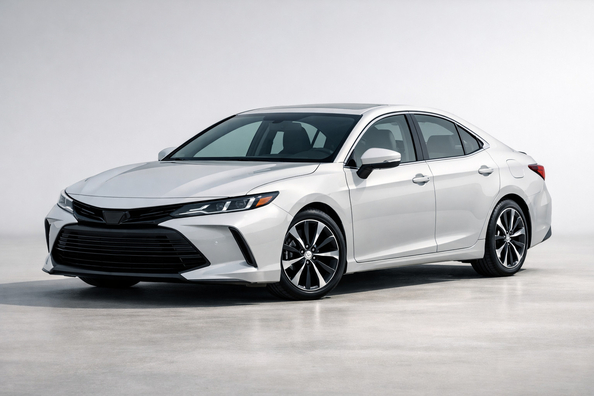
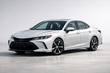
Toyota Camry XV80 is the ninth generation of the large Camry sedan, focusing not on flashiness but on clear everyday value: a spacious body, a hybrid powertrain, quiet ride quality, and predictable ownership. The model’s core idea is simple: if you don’t need a crossover, but want a large, efficient sedan for the city, highways, and long daily mileage, Camry once again hits the same sweet spot.
At the same time, XV80 shouldn’t be seen as a radically new car built from scratch. It’s more of a deep evolution of the XV70 idea: refreshed design, a new interior, more up-to-date driver assistance systems, and a hybrid that has become the main—or the only—option for many markets. For the buyer, that’s a good thing: fewer surprises in the way it drives, more straightforward practicality.
Camry XV80 enters a segment where crossovers have long been pulling attention, yet demand for large sedans hasn’t disappeared. Its audience is drivers who value quietness, smoothness, city efficiency, and a proper amount of second-row space. It’s also a logical choice for corporate fleets, daily intercity travel, and for those who don’t want to pay with driving behavior and fuel consumption for a taller body.
Who it doesn’t suit as well: those who often drive on badly broken roads, regularly climb curbs, or want the most versatile cargo area. XV80 is still a sedan with modest ground clearance, not a vehicle for rough dirt roads or hauling lots of bulky items.
XV80 is formally a new, ninth-generation Camry. Its public debut took place at the end of 2023, with market rollouts starting in 2024; in North America it’s a 2025 model year car. The previous XV70 has been produced since 2017 and, in many markets, remains the main reference point in the used-car segment.
An important nuance: XV80 is built on the same TNGA-K architecture, but it has been heavily reworked in terms of body, electronics, interior, and tuning. So for the buyer it’s a new generation, but without breaking away from the proven logic of the previous Camry. That’s why reliability discussions are cautious: Toyota’s hybrid layout has long been known, but there isn’t much long-term статистика for XV80 specifically yet.
For XV80, the key story is the hybrid. The main powertrain is built around a 2.5-liter gasoline engine as part of a full-hybrid system. In the U.S. market, combined output is 225 hp in the front-wheel-drive version and 232 hp in the all-wheel-drive version, where a separate electric motor works on the rear axle. In other markets, the range of versions and power figures may differ slightly.
The transmission here isn’t a classic “automatic,” but a hybrid continuously variable transmission. In everyday driving, that means smooth acceleration, predictable response in traffic, and the absence of familiar gear changes. For those who like the mechanical feel of shifting, it may seem too calm, but for city use it’s one of the model’s strengths.
| Parameter | Toyota Camry XV80 | What matters in real life |
|---|---|---|
| Generation | XV80, ninth | A new generation, but evolutionarily close to XV70 |
| Production years | from 2024; in the U.S. — 2025 model year | Sales launch depends on the market |
| Powertrain | 2.5-liter gasoline engine as part of a hybrid system | In many markets, Camry is now hybrid by default |
| Power | 225 hp front-wheel drive / 232 hp all-wheel drive | Figures are for the U.S. market; other markets may differ |
| Transmission | hybrid continuously variable | Smooth operation without classic shifts |
| Length | 4915 mm | Nearly five-meter body, comfortable on the highway |
| Width | 1840 mm | Confident stability, but tight parking garages require attention |
| Height | 1445 mm | Low silhouette with no crossover-like clearance reserve |
| Wheelbase | 2825 mm | Provides decent second-row space |
| Ground clearance | about 145 mm | Fine for asphalt; curbs require caution |
| Trunk volume | about 427 L | Practical shape, but a sedan is less convenient than a liftback for loading |
In size, XV80 remains a big Camry without surprises: a long wheelbase, a spacious cabin, and a seating position aimed at everyday comfort rather than sporty stiffness. In the city, that means good ride comfort, but also the standard limitations of a large sedan: not every U-turn is easy, and not every parking space feels effortless.
The chassis concept is familiar: MacPherson struts up front and a multi-link rear suspension. The tuning is set for calm, refined driving without nervousness over joints and bumps. A ground clearance of about 145 mm doesn’t make the car helpless, but underbody protection and attention to the front bumper really do matter here.
In XV80, the interior has become more modern in architecture and infotainment, but the key isn’t the screens—it’s the overall ergonomics. Camry is still strong where the owner actually spends time: comfortable seating, intuitive controls, enough space front and rear, and a solid noise-insulation baseline for daily driving.
Safety depends on the market and trim level, but the suite of electronic assistants has grown: collision warning systems, lane keeping, adaptive cruise control, blind-spot monitoring. The important thing is not to chase a trim name, but to check what’s included in the specific vehicle—equipment differs noticeably between markets.
In the city, a hybrid Camry makes the most sense: part of your driving is quieter, smoother, and with noticeably lower fuel consumption than a conventional large gasoline sedan. On the highway it’s logical too—stable, calm, not tiring with noise, and not constantly encouraging you to keep pressing the accelerator.
Practical нюанси for the owner: a low front overhang, the sensitivity of large wheels to potholes, trunk limitations inherent to the sedan format, and the still short ownership history specifically for XV80. If you want a car “for many years without anything exotic,” that’s a plus. If you need a versatile body for the countryside, bikes, and high curbs—then not so much.
| Aspect | Strength | Weakness |
|---|---|---|
| Hybrid system | More efficient in the city and very smooth in daily driving | Acceleration character is calm, without the sharpness of a traditional “automatic” |
| Ride comfort | Well suited for long trips and daily traffic | Not for those expecting sporty steering sharpness |
| Interior | Spacious second row, comfortable seating, clear ergonomics | Equipment depends heavily on trim and market |
| Body | Classic sedan with good aerodynamics and a solid noise-insulation base | Less practical than a crossover or liftback for cargo tasks |
| Ownership | Proven brand logic and predictable behavior that’s easy to get used to | There is still little long-term data for XV80 itself |
| Ground clearance | Enough for smooth asphalt | On bad roads and near curbs, you need to be careful |
For Camry XV80, the most sensible tuning is not decorative, but practical. First on the list are usually items that protect the interior and the car’s underside, as well as small things that reduce everyday wear. Because this generation is new, it’s important to check compatibility specifically with XV80, rather than buying an accessory just because it says “Camry.”
What to consider for this model:
To keep a reference point on the model itself, you can return to /oglyad-toyota-camry-xv80-nadijnij-gibridnij-sedan-novogo-pokolinnya.html, and when choosing accessories, separately verify the generation, body style, and mounting points.
Toyota Camry XV80 is a strong answer for those who need a large, quiet, and efficient sedan without a complicated learning curve. It works well for the city, highways, family and corporate use, but it won’t replace a crossover where you need higher ground clearance and the most flexible cargo space.
The main takeaway is simple: if you want a calm, clear, and practical next-generation hybrid Camry, XV80 looks very convincing. This material is based on real selection experience, практики, and real-life use cases, so the focus here is not on loud promises, but on how the car behaves in an owner’s day-to-day life.
| ✔ | The hybrid powertrain is a great fit for the city: the car drives quietly, smoothly, and is usually more economical than a large gasoline sedan. This is especially noticeable in daily traffic jams and short trips. |
| ✔ | The cabin retains Camry’s strong points — comfortable seating, intuitive ergonomics, and decent rear-seat space. For everyday use and longer trips, this is more practical than a flashy but tighter interior. |
| ✔ | The nearly five-meter body and 2825 mm wheelbase provide good stability on the highway and comfort over long distances. The car is not nervous over joints and does not tire you out in routine driving. |
| ✔ | The safety system package has become broader: there is collision warning, lane keeping, adaptive cruise control, and blind-spot monitoring. This is useful not just as a “paper advantage,” but in everyday city driving and on the highway. |
| ✔ | For a sedan, the Camry has a perfectly normal trunk and a practical body shape, and in daily use, available accessories such as floor mats and an engine undertray protection help. This reduces small maintenance and protection costs for the car. |
| ✘ | The ground clearance of around 145 mm limits freedom on rough roads, high curbs, and ruts. It is enough for asphalt, but as a universal car for problematic surfaces, the Camry is not suitable. |
| ✘ | The 427-liter trunk is normal for a sedan, but in terms of loading convenience it is inferior to a liftback or crossover. For large items, trips to the dacha, or bulky luggage, this is a noticeable drawback. |
| ✘ | The hybrid transmission works very smoothly, but it does not give the familiar sense of shifting and sharp response that not all drivers like. For those expecting a more “lively” drive, the Camry’s character may seem too calm. |
| ✘ | Equipment depends noticeably on the market and trim level, so one and the same Camry can have a completely different set of assistants and options. When buying, you need to carefully check the specific car, not rely only on the model name. |
| ✘ | There is still little long-term operating data on the XV80, so it is too early to judge the reliability of this generation specifically. Toyota’s hybrid setup is familiar, but the new generation itself has not yet had time to prove everything over time. |
Shipping to EU
Wholesale and retail
Own warehouse
Опис продукту
Подарунки не надаються при оформленні покупки у кредит під 0,01% або при покупці частинами.