18.08.2026
143
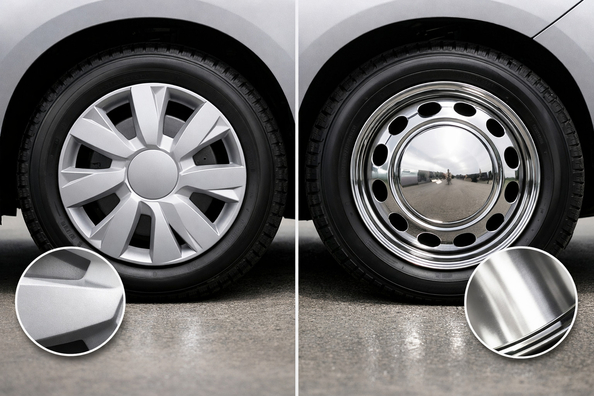
If you need wheel covers for a daily passenger car, in most cases quality ABS or ABS+PC plastic wins: it’s lighter, cheaper, and usually easier to install. Stainless steel makes sense where longer service life, resistance to salt and moisture, and a consistently neat appearance matter—but you pay for that with extra weight, a higher price, and stricter fitment requirements.
The biggest mistake in this topic is reducing everything to the material. In practice, noise, play, and even losing a cover are more often related not to whether it’s plastic or metal, but to fitment accuracy, clip condition, the presence of a retaining ring, and correct installation on a specific steel wheel.
The choice here isn’t between “cheap” and “expensive,” but between two different usage scenarios. A plastic cover works better as a practical consumable: it’s easier to fit, cheaper to replace after a curb hit or crack, and it doesn’t add unnecessary mass. For a city car, this is often the most sensible option.
A stainless cover is strong in a different way. It handles salt, dirt, frequent washing, and long, intensive use better. But it’s important to understand: under the name “stainless” you can also find mixed designs where not the entire part is metal, so you should look not only at the description but also at the actual mounting design.
Installation. For wheel covers, not only inches matter, but also the shape of the steel wheel, the seating profile, the retaining ring, and alignment with the valve stem. Plastic is usually more forgiving of small inaccuracies, while stiffer stainless options require a more precise fit.
Noise. The material itself isn’t the main factor. If a cover rattles, the cause is usually play, worn clips, a missing ring, or a ring installed incorrectly. Rigid metal elements can sound sharper once a gap appears.
Service life. Plastic is weaker against UV, cold, and impacts. Stainless steel tolerates salt and moisture better, but that doesn’t eliminate wear of the mounting hardware. The lifespan of the finished product depends not only on the material, but also on thickness, reinforcing ribs, and the quality of fixation.
Practicality and price. Plastic wins as a budget and backup option. Stainless costs more, but keeps a tidy look longer in harsh conditions and is easier to wash off winter buildup.
| Option | Strengths | Weaknesses | Who it’s for |
|---|---|---|---|
| ABS/ABS+PC plastic wheel covers | Lower weight, lower price, easier installation, cheaper replacement | More sensitive to frost, UV, impacts, and coating peeling | Most passenger cars, city driving, limited budget |
| Stainless steel wheel covers | Better resistance to salt, moisture, and frequent washing; keep a neat appearance longer | Higher price, heavier weight, more demanding selection and installation | Commercial use, winter, long mileage, durability priority |
DD Tuning expert comment: most often customers make two mistakes: they measure only the diameter and don’t check the wheel shape, or they choose a stiffer cover for a wheel with an already tired seat. If you need covers for everyday use, look at compatibility and the condition of the mounting first, and only then at the material. Incorrect fitment is what most often causes noise and lost covers on potholes.
Quality ABS is light and flexible enough for daily use. If you compare the materials themselves, it’s several times lighter than stainless steel, so it puts less load on the mounts and behaves more easily during installation. For a mass-market passenger car, that’s a strong argument.
The weak point of plastic is aging. In the sun the finish can fade, in severe cold the risk of cracking increases, and after curb contact the damage is usually visible right away. But such a cover is inexpensive to replace, and for many drivers that’s more practical than overpaying for a material that doesn’t provide a noticeable advantage in mild conditions.
Stainless steel is much denser and stiffer than plastic, so it holds its shape better and handles aggressive environments more calmly. That’s why it makes sense for vehicles that constantly see de-icing chemicals, highway grime, frequent washes, and high mileage.
But stiffness has a downside. If the fit isn’t ideal, this type of cover doesn’t “forgive” small deviations, and any play becomes more unpleasant. Also, the higher price doesn’t always pay off: on a typical city car without harsh winter conditions, the difference in everyday usefulness may be small.
For most drivers who commute in the city, park near curbs, and simply want to neatly cover steel wheels without extra costs, plastic is the better choice. It doesn’t hurt as much to replace if one cover cracks or gets lost.
For fleet vehicles, vans, cars with intensive winter use, or those where appearance needs to stay good for a long time without constant small refreshes, stainless has the advantage. There, the extra spend works not for “effect,” but for service life and ease of care.
| Scenario | Best choice | Why |
|---|---|---|
| City passenger car, normal annual mileage | ABS/ABS+PC plastic wheel covers | Lighter, cheaper, easier to replace after minor damage |
| Winter driving on salted, wet grime | Stainless steel wheel covers | Handle moisture, chemicals, and frequent washing better |
| Delivery, commercial vehicle, high mileage | Stainless steel wheel covers | It makes sense to pay for durability and a consistently neat look |
| Need a budget set or a backup option | Plastic wheel covers | Lower price and easier selection for everyday tasks |
| Old wheels with less-than-ideal fitment | More often plastic, but only after checking compatibility | A more flexible design sometimes seats better than rigid metal |
Paying extra for stainless steel is justified when the car regularly drives on salted roads, runs in commercial service, or the owner wants the covers to keep a neat look longer without constant replacement. In such conditions, the stiffer, more corrosion-resistant option really delivers a practical difference.
Before buying, it’s worth looking not only at the material, but also checking the mounting and installation method. For that, it’s useful to separately browse stainless steel wheel covers, refresh the basic criteria in how to choose wheel covers, and review wheel cover installation so you don’t end up with play or rattling right after fitting.
From a customer’s experience: a driver was looking for a set for a company vehicle that drives the highway daily and in winter is almost never parked in a garage. At first he wanted standard plastic because of the price, but after two seasons of frequent replacements he switched to a stainless option. He was satisfied not because it was “prettier,” but because the covers are easier to wash and handle salt and constant mileage more calmly.
For most passenger cars, quality ABS or ABS+PC plastic is the better choice: it’s lighter, more affordable, and usually more logical for everyday use. Stainless steel proves itself where durability, corrosion resistance, and a consistently good appearance in harsh conditions come first.
The key to a good result is not arguing about the material in isolation from compatibility, mounting, and driving scenario. This piece is based on real selection experience, practical work, and real usage cases, so the main takeaway is simple: for the city, good plastic is often enough; for salt, moisture, and intensive work, it makes sense to pay for stainless steel.
| ✔ | Plastic ABS/ABS+PC hubcaps are lighter than stainless steel, so they put less load on the fasteners and are easier to install. For a daily city car, this is a practical option without unnecessary weight. |
| ✔ | Plastic is usually cheaper both to buy and to replace after a crack or curb contact. This is convenient if the hubcaps are needed as a budget or spare set. |
| ✔ | Stainless steel hubcaps handle salt, moisture, road chemicals, and frequent washing better. In winter use or on fleet vehicles, this helps them keep a neat appearance longer. |
| ✔ | Stainless steel is stiffer and holds its shape better in harsh conditions. It is suitable for cars with high mileage and intensive use. |
| ✔ | Plastic is more forgiving of small fitment inaccuracies, so it can sometimes fit older wheels more easily. This reduces the risk of installation issues if compatibility is chosen correctly. |
| ✘ | Plastic is less resistant to ultraviolet light, frost, and impacts. In sunlight it can fade, and in cold weather the risk of cracks increases. |
| ✘ | Stainless steel hubcaps are more expensive and heavier than plastic ones. Because of this, the extra cost does not always make sense for normal city driving. |
| ✘ | Stainless steel is more demanding in terms of fitment precision and the condition of the fasteners. If there is play or worn clips, it will show up sooner as noise or unstable mounting. |
| ✘ | Under the name “stainless steel,” mixed constructions may be sold, where not every part is metal. So without checking the mounting scheme, there is a risk of buying something different from what was expected. |
Shipping to EU
Wholesale and retail
Own warehouse
Опис продукту
Подарунки не надаються при оформленні покупки у кредит під 0,01% або при покупці частинами.