 Author: Radomskyi Maksym Vasyliovych
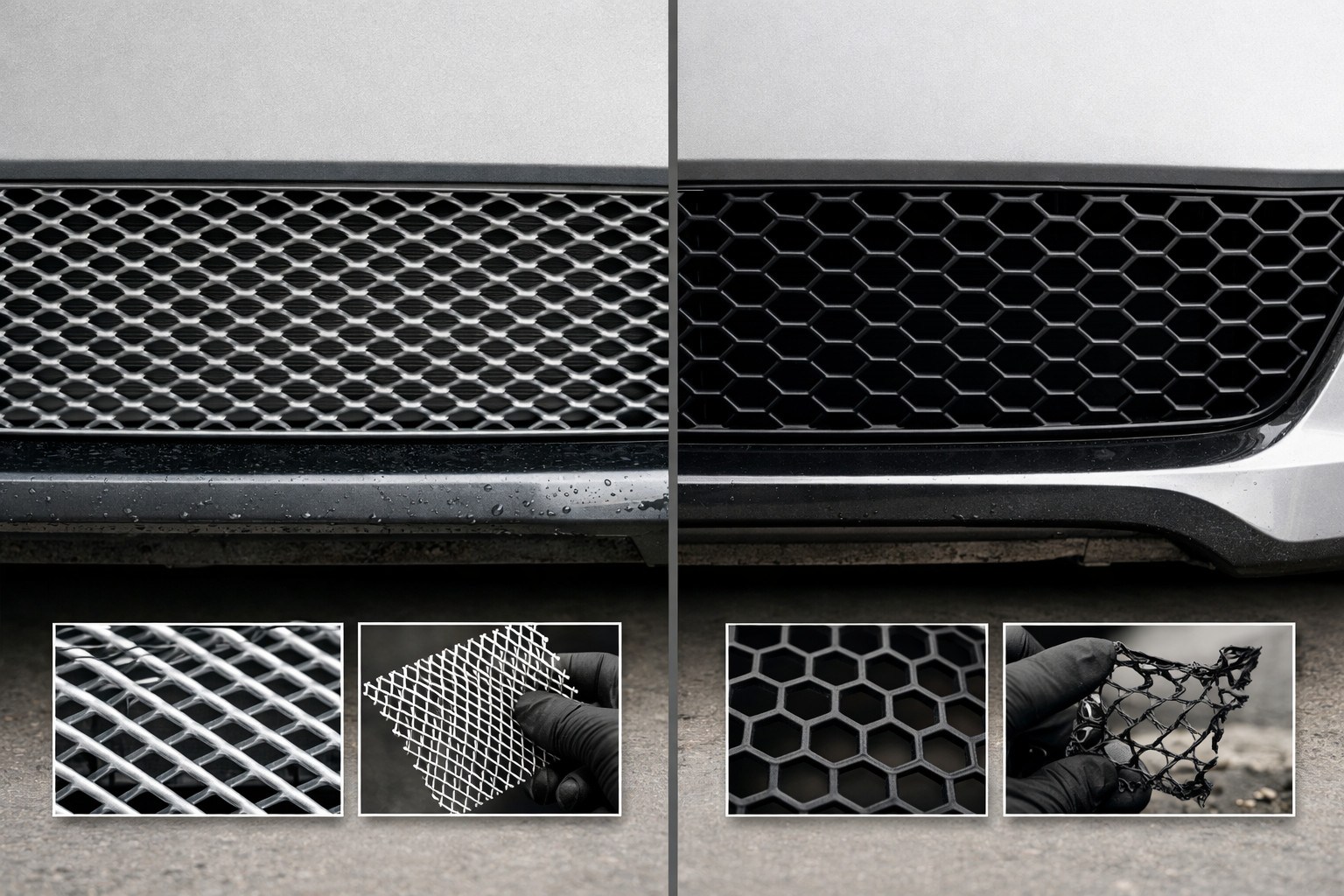
For daily driving, an aluminum mesh more often makes sense: it holds its shape better, tolerates sun, car washes, vibrations, and seasonal use more calmly, so it works as permanent protection against stones, insects, and dirt. A plastic mesh is justified when a lower price, lighter weight, and simpler installation without drilling matter more.
But the choice isn’t only about the material. In practice, cell size, open area, mounting method, and where the car is driven matter just as much: city, highway, winter with road chemicals, or a mild climate. These details determine whether the mesh will actually protect, or become an extra part that rattles, packs with snow, or ages quickly.
What the choice comes down to
The logic is simple: aluminum is chosen for service life and stable shape, plastic—for affordability and easier installation. For a daily car, that means choosing between a solution typically installed for the long term and an option better suited for those who want to solve the problem quickly without complex fitting.
There’s one more important point: an overly fine or dense mesh is a bad idea regardless of material. Yes, it catches small debris better, but in winter it can clog with snow or ice, and in summer it accumulates dirt more intensely. For daily driving, it’s better to look for a balance between protection and airflow, not maximum density.
What criteria to compare by
- Installation. Plastic inserts are more often vehicle-specific or mounted with clips and zip ties without drilling. Aluminum mesh more often needs to be cut to the opening and matched with the right fasteners.
- Noise. The material itself is rarely the main cause of noise. Rattling appears due to weak fastening, incorrect tension, or contact with the factory grille.
- Service life. Aluminum tolerates outdoor conditions better and keeps its shape longer. With plastic, everything strongly depends on quality: a UV-protected option can last well, while standard plastic ages faster in the sun.
- Practicality. Both options reduce the amount of debris on the radiator, but a fine cell will need cleaning more often. This is especially important for highway driving and winter use.
- Price. Plastic is usually cheaper upfront, but if the car is driven daily and not only in the city, paying extra for aluminum is often justified by a longer service life.
Quick comparison of options (table)
| Option | Strengths | Weaknesses | Who it suits |
|---|---|---|---|
| Aluminum mesh | Holds its shape better, usually lasts longer, tolerates washing, vibrations, and seasonal use more calmly, wider choice in open area | More often requires trimming and fitting, sometimes more expensive, in winter also needs cleaning of snow and road chemicals | Those who drive every day, often go on the highway, and want to install it once and not revisit the issue every season |
| Plastic mesh | Lighter, usually cheaper, often easier to install, especially in vehicle-specific kits without drilling | Quality depends heavily on the compound; ordinary plastic ages faster in the sun; in frost it handles rough removal or bending worse | Those who mostly drive in the city, want minimal modifications, and aren’t ready to pay extra for longer service life |
DD Tuning expert comment: Most often, the mistake is looking only at price and cell size. A universal mesh is frequently bought with extra margin and then cut too close to the edge—so it doesn’t hold well or starts to rattle. For a daily car, it’s safer to choose not the finest pattern and immediately think through how the mesh will be cleaned in winter.
Detailed breakdown of each option
Aluminum mesh
Its strong point is rigidity and stability. Even when the sheet is thinner than plastic, metal usually holds its shape better across a large opening and is less prone to waves or sagging. This is especially noticeable on cars where the grille is large and airflow plus debris loads are higher.
For daily driving, it’s a practical option because aluminum more calmly survives sun, temperature swings, and car washes. The downside is that installation is often more hands-on: trimming, test fitting, zip ties or other fastening. Done neatly, it lasts a long time; secured carelessly, it can cause unwanted noise or misalignment.
Plastic mesh
Plastic wins where simplicity is the priority. If it’s a good vehicle-specific kit, it can be installed faster and with less risk of interfering with factory parts. Plastic is also light and often cheaper, which can be enough for a city car with modest mileage.
The issue is different: “plastic” doesn’t automatically mean bad, but cheap material ages faster. If the mesh doesn’t have proper UV protection, it will lose appearance and strength sooner. And in cold weather, a plastic insert is easy to damage during removal or reinstallation if it’s bent aggressively.
Which option is better for different scenarios
For city driving with gentle use, a plastic mesh can fully cover the task: there will be fewer insects, leaves, and small debris on the radiator, and installation is often simpler. If the car is parked outside overnight, washed regularly, and sits in the sun, aluminum looks more reliable in the long run.
For highway use, intercity trips, and rough roads, aluminum has the advantage. Here it’s not only about stones, but also about the insert keeping its shape after a season of vibrations and not looking tired after a year. If the priority is quick installation without disassembling the front end and mileage is moderate, a good plastic kit can also make sense.
For winter use, what matters most is not the material but the mesh density. A cell that’s too fine is equally unsuccessful in metal and plastic because it can accumulate ice and temporarily worsen airflow.
Use case and what to choose (table)
| Scenario | Best choice | Why |
|---|---|---|
| Daily driving: city + highway | Aluminum mesh | Holds its shape better, lasts longer under load, and is better suited as permanent protection |
| City car with low mileage | Plastic mesh | Lower price and often simpler installation without extra modifications |
| Car in a region with intense sun and a long warm season | Aluminum mesh | Less dependent on material aging outdoors |
| Need to install quickly and without complicated fastening | Vehicle-specific plastic insert | More often has a simpler fixing method and requires less fitting |
| Frequent winter trips | Aluminum or plastic, but with a medium cell | The key is not the material, but that the mesh isn’t too dense and doesn’t collect ice |
Common mistakes when choosing
- Choosing the smallest cell. Protection seems better, but maintenance is worse and the risk of clogging with snow and dirt is higher.
- Ignoring the mounting method. Even a good mesh works poorly if it’s fixed with play or at the wrong angle.
- Buying a universal sheet without assessing the grille opening. On one car it will fit neatly; on another it will require a lot of cutting and fitting.
- Saving on plastic quality. If the material is weak, appearance and strength will fade faster than the price difference can pay back.
- Not considering the driving pattern. What works fine in the city may be a poor choice on the highway or in a harsh winter.
When a more expensive solution makes sense
A pricier solution is justified when the car spends a lot of time on the highway, has a large front opening, an expensive radiator pack, or when you don’t want to rework the mounting every season. Here you’re paying not just for material, but for better fitment, proper coating, correct stiffness, and a more predictable result after a year or two of use.
If you’re already leaning toward metal, it makes sense to look at aluminum meshes. To understand whether this kind of protection is justified for your exact scenario, the materials does a mesh save the radiator and how not to ruin airflow are useful. More expensive solutions more often provide a cleaner installation and fewer compromises on service life.
From a customer’s experience: the owner of a daily-driven crossover was looking for protection from stones and poplar fluff but didn’t want to remove the front end every season to redo the setup. After comparing options, he отказался от fine plastic insert and chose an aluminum mesh with a medium cell because the car регулярно drives on the highway. As a result, the radiator pack stayed cleaner, and in winter there’s no need to constantly knock ice out of an overly dense cell.
Conclusion
If you need one answer for daily driving, the aluminum mesh more often wins: it’s more practical over the long term, holds its shape better, and tolerates seasonal load more calmly. A plastic mesh also makes sense when the budget is tighter, you need simple installation, and the car doesn’t live in harsh conditions. The main thing is not to choose an overly dense cell and not to underestimate fastening. This conclusion is based on real selection experience, practical work, and real use scenarios—not on picking a material “blindly.”
How it works
- Assess the operating conditions First, determine where the car is driven most often: city, highway, winter with road salts, or a warm climate. For daily driving, this matters because the usage pattern affects the mesh’s service life, dirt buildup, and resistance to aging.
- Choose the material based on your priorities If you need longer service life, stable shape, and reliable performance under sun and car washes, choose an aluminum mesh. If lower price, lighter weight, and easier installation without drilling matter more, a plastic mesh will do.
- Don’t choose a mesh that is too fine A denser mesh catches debris better, but in winter it can fill with snow and ice, and in summer it can collect dirt more heavily. For a daily car, it is better to look for a balance between protection and airflow rather than maximum density.
- Think through the mounting method Check whether a model-specific insert, clips, ties, or trimming to fit the opening is needed. Even a good mesh can rattle or sit crooked if it is secured with play or the wrong tension.
- Consider the season and maintenance For highway use and winter operation, it is better if the mesh does not lose its shape and is easy to clean from snow and road salts. If the car is often in the sun, pay attention to the plastic quality or prefer aluminum.
- Choose the option for your use case For city driving with low mileage, a plastic mesh may be enough. For daily city + highway driving, as well as for longer service life, aluminum is usually the more practical choice.
Pros and cons
Aluminum mesh holds its shape better and sags less on a large opening. For everyday driving, this matters because the protection does not ‘move around’ after vibrations and seasonal loads.
It handles sun, washing, and temperature changes more calmly. This makes it more suitable for a car that is often parked outside and driven year-round.
Plastic mesh is usually cheaper and lighter. If you need a simple solution for city driving or low mileage, it lets you solve the task without unnecessary costs.
Plastic model inserts are often easier to install without drilling. This is convenient when quick installation and minimal modifications matter.
Both options can reduce the amount of debris on the radiator. This is practical for everyday driving, especially if the car is often on the highway or in dusty and dirty conditions.
Aluminum mesh often needs to be trimmed and fitted to the opening. If the installation is done carelessly, it may start rattling or sit crooked.
Plastic depends heavily on the quality of the material, and the regular version ages faster in the sun. In that case, the mesh may lose its appearance and strength sooner.
A very fine mesh is a problem for both materials. In winter, it can get clogged with snow or ice, and in warm weather it can collect dirt more heavily.
Plastic handles rough removal or bending in the cold worse. This increases the risk of damage during reinstallation or removal.