 Author: Radomskyi Maksym Vasyliovych
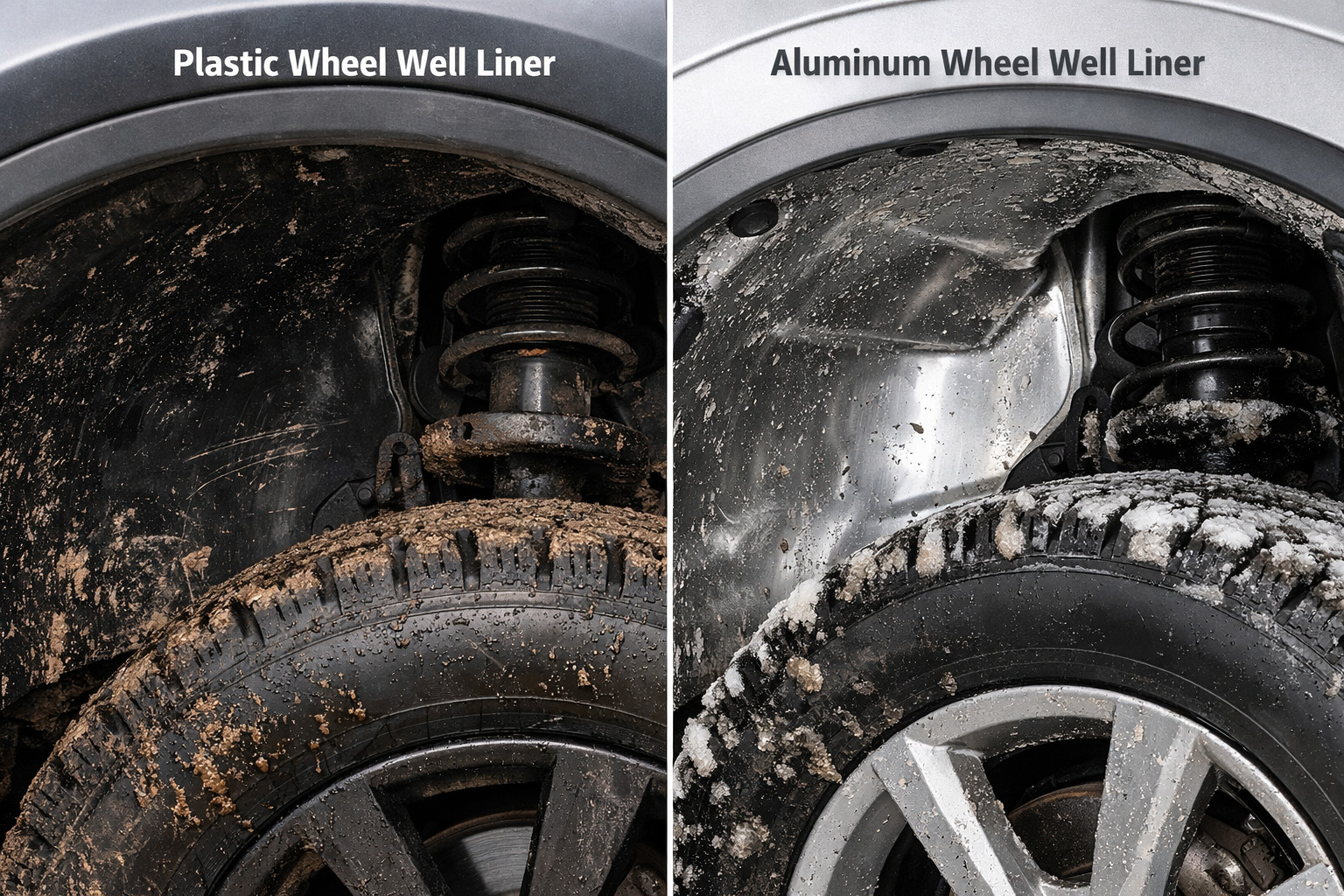
If a car drives daily through the city, on highways, through puddles, sand, and winter road salt, in most cases it’s more practical to install plastic fender liners. They’re closer to the OEM design of mass-produced cars, easier to install, don’t create galvanic corrosion by the material itself, and usually require less attention after installation.
Aluminum isn’t a mistake, but it’s a narrower use case: an old or rare car, widened arches, wide wheels, a camper, or a vehicle where manual fitting is needed. For everyday roads, it’s not only the strength of the material that matters, but the whole system: compatibility, fasteners, clearances, protection of the holes, and how the liner behaves after a season or two.
What the choice is really about
The key question here isn’t “what’s stronger,” but “what will last longer and live more trouble-free on your exact car.” On a common vehicle with stock wheel-arch geometry, plastic wins more often because it’s designed as the standard solution: it fits properly, shields the wheel well from water, dirt, and stones, and doesn’t force you to rework half the arch during installation.
An aluminum fender liner makes sense where the OEM-style plastic option is either unavailable or doesn’t cover the need. For example, when the arch is non-standard, the wheel is wider than factory, the body is old or rare, or the car actually works in harsh conditions. Then stiffness and the ability to custom-fit the part are valuable, but you pay for it with installation time and more careful protection of the mounting points.
What criteria to compare by
- Installation and compatibility. For a daily driver, this is one of the main criteria. If the liner installs without tension, doesn’t move around, and doesn’t rub on the fender edge, it’s almost always better than a “stronger” but poorly fitted option.
- Noise. The material alone doesn’t give a simple answer. There are few direct open tests comparing plastic vs aluminum, and noticeable noise differences are more often caused not by metal or plastic, but by the liner design and the quality of the mounting.
- Service life. Plastic isn’t prone to galvanic corrosion. In aluminum solutions, the weak point is often not the sheet itself, but the holes, steel clips, rivets, and areas where winter salt accumulates.
- Practicality. For everyday use, what matters is how easy it is to wash the wheel well, remove the liner for service, and whether moisture and dirt collect in critical areas.
- Price. You shouldn’t look only at the part price. Aluminum is often more expensive due to fitting, extra fasteners, hole finishing, and longer installation labor.
Quick comparison of options (table)
| Option | Strengths | Weaknesses | Who it’s for |
|---|---|---|---|
| Plastic fender liners | Easier compatibility with mass-market cars, solid protection of the wheel arch from water and stones, lower corrosion risks from the material itself, faster installation | Don’t automatically provide better sound insulation, less suitable for non-standard arches and wide wheels without modifications | Daily driving, stock suspension and wheels, city and winter cars |
| Aluminum fender liners | Rigidity, ability to hand-fit, relevant for old, rare, or modified bodies, harsher conditions | Longer installation, need to protect holes and fasteners, higher cost, doesn’t always replace plastic one-to-one | Rare cars, widened arches, campers, vehicles with non-standard geometry |
Detailed breakdown of each option
DD Tuning expert comment: The most common mistake is choosing the material separately from the fit. If the liner moves even slightly at speed, noise appears, and if it touches the fender edge, it gradually wears through the paint. For a daily driver, a precisely compatible kit is better than a stiffer material with questionable geometry.
Plastic fender liners
For production cars, this is the basic logic. Plastic works well where you need solid everyday wheel-arch protection without extra installation work. It doesn’t conduct electricity, so the material itself doesn’t create conditions for galvanic corrosion, and in salt and moisture that’s a real advantage.
Another strong point is predictability. If the model is standard, the wheels are factory size, and the arch hasn’t been modified, a plastic liner usually fits easier and faster. For the owner, that means fewer chances of problems from extra holes, poor clamping, or incorrect clearances.
But don’t expect a miracle in noise reduction from ordinary plastic. If cabin quietness is the top priority, you need to look not only at the material, but at the liner type: density, shape, presence of a sound-absorbing layer, and how well it covers the wheel well. On everyday roads, plastic is chosen primarily for practicality, not as an acoustic solution.
Aluminum fender liners
Aluminum is strong where you need not just to cover a stock arch, but to solve a non-standard task. Old bodies, rare models, wide wheels, arch extensions, camper or utility use cases—this is where it’s truly justified. Its advantage isn’t that “metal is always better,” but that it can be fitted more precisely to complex geometry.
The weak point of aluminum is installation quality. During installation it’s important not just to screw a sheet in place, but to mark the holes correctly, protect the edges and fasteners from corrosion, prevent contact that will rub the paint, and avoid turning the arch into a sealed pocket for moisture. If you neglect this, problems start not because of the material, but because of the mounting points.
That’s why on a regular daily car, aluminum often ends up being overkill. It doesn’t automatically give a noise advantage, costs more together with labor, and requires more attentive maintenance during salty winters.
Which option is better for different scenarios
In short, for most daily drivers plastic is better. It handles typical city/highway use more calmly, is easier to wash, works well with a factory arch, and doesn’t force the owner to monitor every fastener after a season.
Aluminum is worth considering when you already have a non-standard scenario: there’s no proper plastic solution, the arch has been modified, you need coverage for a wider wheel, or the car lives in conditions where the stock setup doesn’t deliver. In other words, it’s not “better in general,” but “more appropriate for a specific geometry.”
Separately about noise: if you expect a quieter wheel well, don’t automatically bet on aluminum. Much more often the noise comes from a poorly secured liner, and any acoustic gain depends on the liner’s design itself.
Use case and what to choose (table)
| Scenario | Best choice | Why |
|---|---|---|
| Daily city driving, highway, winter road salt | Plastic fender liners | Less hassle with installation, lower corrosion risks from the material, sufficient wheel-arch protection for a stock car |
| Car with factory geometry, but old liners are worn or missing | Plastic fender liners | The most logical replacement without unnecessary rework of mounts and arches |
| Old or rare body where OEM plastic doesn’t exist | Aluminum fender liners | Room for individual fitting to the real wheel-arch geometry |
| Wide wheels, widened arches, non-standard offset | Aluminum fender liners | A stiffer solution is easier to adapt to a modified vehicle |
| Main priority: less noise from the wheel wells | Plastic with a good fit or a dedicated sound-absorbing liner | Material alone doesn’t solve everything; design and absence of play matter |
Common mistakes when choosing
- Buying by the principle “metal means more reliable.” For everyday roads this is often flawed logic: if the plastic option is properly compatible, it’s more practical.
- Ignoring fasteners. A bad liner is noisy, but even more often a poorly fastened liner is noisy.
- Not checking clearance along the fender edge. If the part touches the paint, dirt and vibration will gradually wear through the coating.
- Not budgeting for installation. With aluminum, the real price is often higher not because of the sheet, but because of fitting, holes, finishing, and labor time.
- Installing aluminum for salty winters without anti-corrosion protection for the fasteners. Then the weak point becomes not the arch, but the mounting assembly itself.
- Expecting aluminum to make the car quieter by itself. If there’s play or the shape is wrong, the effect can be the opposite.
When a more expensive solution makes sense
A more expensive option is justified when you’re building not just protection from dirt, but a proper wheel-arch package: quality fender liners for a specific task, mud flaps to reduce sandblasting on the rocker panels, and if the car has widened geometry, arch trims. In this combination, the pricier solution works not because of the “status of the material,” but because the system better takes on water, dirt, and stones.
It also makes sense to pay extra for aluminum when you can’t properly cover the arch without manual fitting: on an old body, a camper, a car with wide wheels, or after modifications. But if the car is standard and the task is simple—everyday protection from salt, sand, and stones—overpaying for aluminum often doesn’t bring a noticeable gain.
From a customer’s experience: the owner of a daily wagon initially looked for an aluminum solution because he feared winter salt and rough roads. After inspecting the wheel wells, he chose a plastic kit with OEM-style fit and added mud flaps to reduce impact on the rocker panels. As a result, he got a quieter, easier-to-maintain setup without extra installation work and without the risk of fastener issues after the first winter.
Conclusion
For everyday roads, plastic fender liners win more often: they’re more practical, easier to install, and behave more calmly in salt and moisture on a standard car. Aluminum makes sense as a specialized solution—when you need rigid custom fitting, a non-standard arch, or a rare body. This conclusion is based not on the myth of a “better material,” but on real selection experience, installation practice, and real usage scenarios where compatibility, fasteners, and operating conditions are what decide the outcome.
How it works
- Assess your usage scenario First, determine where and how the car is driven: city streets, highways, puddles, sand, winter salt, or non-standard conditions. For a regular everyday car with factory-standard wheel arch geometry, plastic wheel arch liners are more often the right choice.
- Check compatibility with the wheel arch and wheels See whether the wheel arch liner fits without tension, does not move around, and does not rub against the fender edge. If the body is standard and the wheels are factory size, plastic usually fits more easily; for widened arches or wider wheels, aluminum may be needed.
- Compare installation and fastening Assess how much time and how many modifications installation requires. A plastic version is usually installed faster, while an aluminum one requires more precise hole marking, protection of the fasteners, and careful fitting.
- Consider service life and corrosion risks For everyday use, it is important that the assembly does not trap moisture and dirt and does not require frequent intervention. Plastic does not create galvanic corrosion through the material itself, while in an aluminum solution the weak points are often the fasteners and holes.
- Do not choose the material based on strength alone If practicality, quietness, and easy maintenance are the main priorities, it is better to choose a precisely compatible plastic kit. Aluminum is worth considering only when there is a non-standard arch, an old or rare body, or manual fitting is required.
- Include the full protection system in the decision Consider not only the wheel arch liner, but also mud flaps and arch trims if your car needs them. For everyday roads, the option that usually wins is plastic wheel arch liners with proper fit and minimal hassle after installation.
Pros and cons
Plastic wheel arch liners are better suited for most everyday cars with standard arch geometry: they fit in place more easily, don’t require unnecessary modifications, and are quicker to install.
Plastic does not create galvanic corrosion by itself, which is useful in wet conditions, winter salt, and everyday driving.
For typical city and highway driving, the plastic option provides sufficient protection for the wheel arch from water, dirt, sand, and stones without complicated maintenance.
Aluminum wheel arch liners make sense in special cases: older or rare bodies, widened arches, wide wheels, or cars with modified geometry.
Aluminum can be fitted more precisely to a complex arch shape if there is no factory plastic solution or if it does not meet the need.
Aluminum wheel arch liners usually require longer installation and more precise fitting, so on a regular car this adds unnecessary hassle.
In an aluminum solution, weak points are often the holes, clips, rivets, and places where winter salt accumulates, rather than the sheet itself.
Aluminum is often more expensive not only as a part, but also because of the additional fasteners, hole treatment, and installation work.
If the liner is fitted with play or touches the fender edge, it can rattle and gradually wear the paint, regardless of the material.