15.09.2026
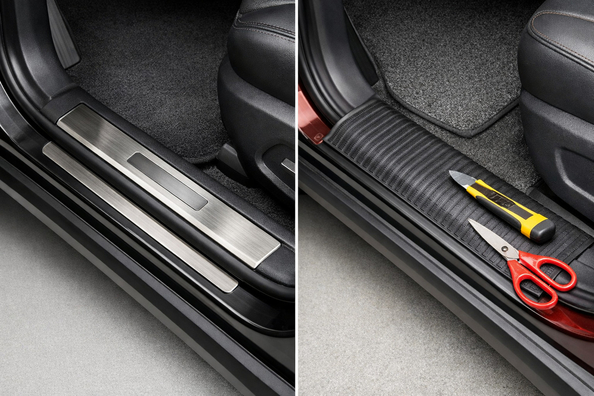
If there’s a proper vehicle-specific sill scuff plate kit for your car, it’s usually the lowest-risk choice. It follows the sill shape, fits more neatly, and less often creates issues with edges, gaps, and fitment near the seals. Universal options make sense when there’s no ready-made kit, the car is rare or modified, or when you knowingly want to save money and are ready to trim the part to fit.
The mistake here is usually not that someone chose “the wrong brand”, but that they didn’t assess the installation, potential noise from poor fitment, the lifespan of the adhesive layer, everyday practicality, and the true cost together with the risk of having to redo it. Those are exactly the points you should use to compare the two formats.
A vehicle-specific scuff plate is made for a particular body, model year, and often even a specific interior configuration. Its main advantage isn’t the name—it’s the geometry: it sits where it should, without extra trimming and with a lower chance that an edge will ride onto a curve or end up too close to the lower door edge.
A universal scuff plate is a compromise. It’s cheaper, more available, and can save you if there’s nothing ready-made for your car. But here, more depends on how accurately you measured the sill, whether you’ll need to cut around radii, and whether the edges will start lifting after the first winter or a few washes.
| Option | Strengths | Weaknesses | Who it’s for |
|---|---|---|---|
| Vehicle-specific scuff plates | More precise fitment, more coverage, cleaner look, lower risk of conflicts with seals | More expensive, tied to year, body and trim, compatibility mistakes are critical | Anyone keeping the car long-term, wanting an OEM-like look, and not wanting to deal with trimming |
| Universal scuff plates | Lower price, can be adapted for a rare or modified car, convenient as temporary protection | Often require fitting, seams and offset are more noticeable, higher risk of edge lift and noise with poor fitment | Those who have no ready-made kit, a limited budget, or are willing to install by hand |
DD Tuning expert comment: most often, the mistake isn’t in choosing the type, but in compatibility and installation. People order a kit without checking the production year, number of doors, or sill shape, and then try to “force” the part onto a curved section. If you don’t do a dry test-fit before bonding, even a good kit is easy to ruin on the first attempt.
Their strong point is predictability. A proper kit already includes the correct shape, length, and overlap area, and sometimes even specific placement guides along a seam or offset. Thanks to this, they look closer to a factory accessory and better cover the working part of the sill instead of just sitting “somewhere nearby”.
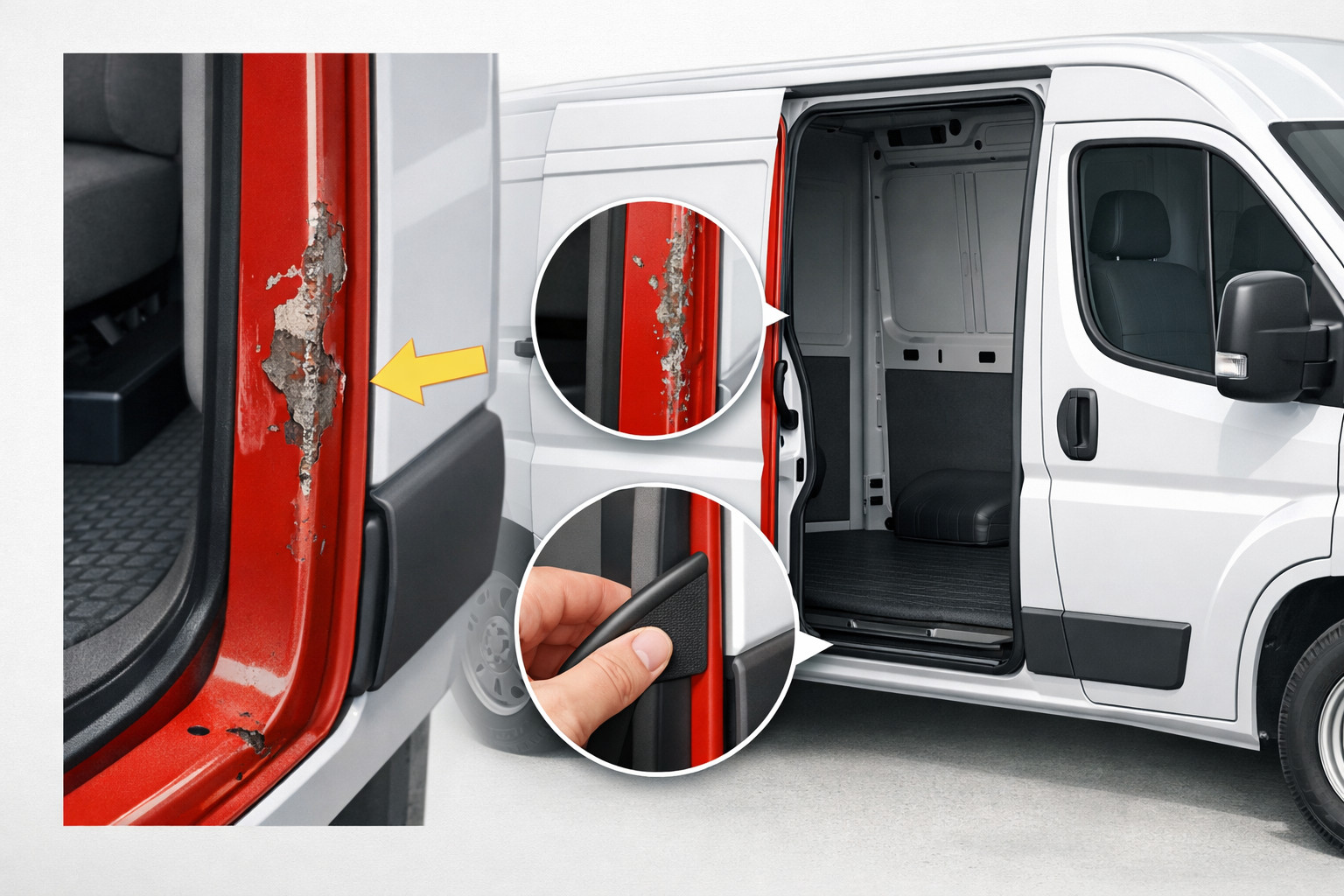
The downside is that compatibility must be checked strictly: year, body, number of doors, sometimes a 5- or 7-seat configuration. If you buy the wrong kit, the problem isn’t cosmetic—it may not follow the edge or may butt against the wrong area. Installation-wise, this isn’t an accessory for rushing: you need to stick it onto a clean, dry surface at a normal temperature, and after installation you shouldn’t go straight to a car wash.
The main advantage here is flexibility. There are thin roll-type solutions cut to length, and more rigid plates installed to position. For an older, rare, or modified car this is sometimes the only realistic option, especially if the sill geometry already differs from stock.
But “universal” means part of the work is on you. You need to measure the width, evaluate radii, and test-fit to make sure the edge won’t land on a curved section. On a simple straight sill this works fine, but on a complex shape it can look like a visible compromise. And this is exactly where complaints most often appear: lifted edges, dirt buildup under the lip, or an extra noise over bumps.
For a daily family car, where the sills constantly get hit by shoes, kids’ items, bags, or pet paws, it makes more sense to choose a vehicle-specific kit. It costs more upfront, but there’s less chance you’ll have to re-bond something after a season or live with a messy edge.
For a car without a ready-made solution, or a vehicle with non-standard modifications, a universal scuff plate is often the smarter choice. It’s not better by itself, but it’s more realistic than trying to install an “almost fitting” vehicle-specific kit. If the car is being prepared for sale, or you just need basic protection without overpaying, the universal format can also be justified.
| Scenario | What to choose | Why |
|---|---|---|
| New or well-kept car for long-term ownership | Vehicle-specific scuff plates | Better fitment, cleaner look, and lower risk of rework |
| Rare model or modified sill | Universal scuff plates | They can realistically be adjusted when there’s no exact kit |
| Limited budget | Universal scuff plates | Lower starting cost if you’re ready to spend time fitting |
| Frequent winter, salt, kids, active daily use | Vehicle-specific scuff plates | Better coverage of the working zone and less chance of edges lifting |
| Temporary or backup protection needed | Universal scuff plates | No point overpaying for an exact kit if the task is short-term |
Paying more is justified when you care not only about protection but also about how it will look in a few years. If you’re keeping the car for a long time, if you want to keep the sills tidy before resale, or the vehicle works hard every day, it’s better to look at full-featured sill scuff plates with proper fitment rather than the cheapest universal format.
The second case is when the sill has a complex shape and any inaccuracy will be visible immediately. Here, the more expensive solution often saves not money at the start, but nerves after installation. If you’re hesitating between materials, it’s useful to separately compare plastic scuff plates, and to understand where protection is actually needed, review the difference between external and internal solutions.
From a customer’s experience: an owner of a family crossover initially wanted a universal kit because of the lower price, but during test-fitting it became clear that the rear sill has a complex radius and the edge ends up too close to the seal. In the end, he chose a vehicle-specific kit because the car carries kids daily and in winter the sills are constantly covered in salt. For him, the extra cost turned out to be less of an issue than the risk of re-bonding the scuff plates after the first season.
The safe rule is simple: if there’s a quality vehicle-specific kit for your car, it should be first on your list. A universal scuff plate can also be a good purchase, but mostly when there’s no exact solution, the budget is strictly limited, or you consciously accept the need for fitting.
The key to the right choice is not the format name, but compatibility, fit accuracy, and proper installation. This material is based on real selection practice, common installation mistakes, and real-world usage scenarios—not abstract theory—so the main advice is one: it’s better to choose accurately once than to re-bond twice later.
| ✔ | Model-specific covers are matched to the exact year, body type, and interior configuration, so a compatibility mistake can ruin the whole set. |
| ✔ | Universal covers often need trimming, fitting, and more manual work, which increases installation time and the chance of getting the fit wrong. |
| ✔ | If a universal cover does not sit perfectly, raised edges, dirt under the edge, and extra noises over bumps appear more often. |
| ✔ | For both formats, installation is critical: on a dirty, damp, or cold surface, the cover may not hold for long, even if the part itself is high quality. |
| ✔ | For everyday use, they cover the sill working area better, so there is less chance you will have to reapply something or put up with a messy look after the season. |
| ✘ | Model-specific covers are tied strictly to the year, body, and interior configuration, so a compatibility mistake can spoil the entire set. |
| ✘ | For universal covers, the fit often needs trimming and trial fitting, plus more manual work, which increases installation time and the chance of making a fitment error. |
| ✘ | If a universal cover does not sit perfectly, raised edges, dirt under the edge, and unwanted noises over bumps appear more often. |
| ✘ | For both formats, installation is critical: on a dirty, wet, or cold surface, the cover may not hold for long, even if the part itself is high quality. |
Shipping to EU
Wholesale and retail
Own warehouse
Опис продукту
Подарунки не надаються при оформленні покупки у кредит під 0,01% або при покупці частинами.