 Author: Radomskyi Maksym Vasyliovych
If you need an option for years, with a proper fit and without constant readjusting, choose vehicle-specific seat covers. Universal ones are worth considering as fast, budget protection—but only when they truly match the shape of your seats and don’t cover the side airbag area.
The main mistake is simple: buying a cheaper set and expecting the look and lifespan of a precision-tailored kit. Here you should compare not only price, but also installation, movement and noise in the cabin, durability, everyday convenience, and how many times you’ll end up re-tightening or replacing them.
What the choice really comes down to
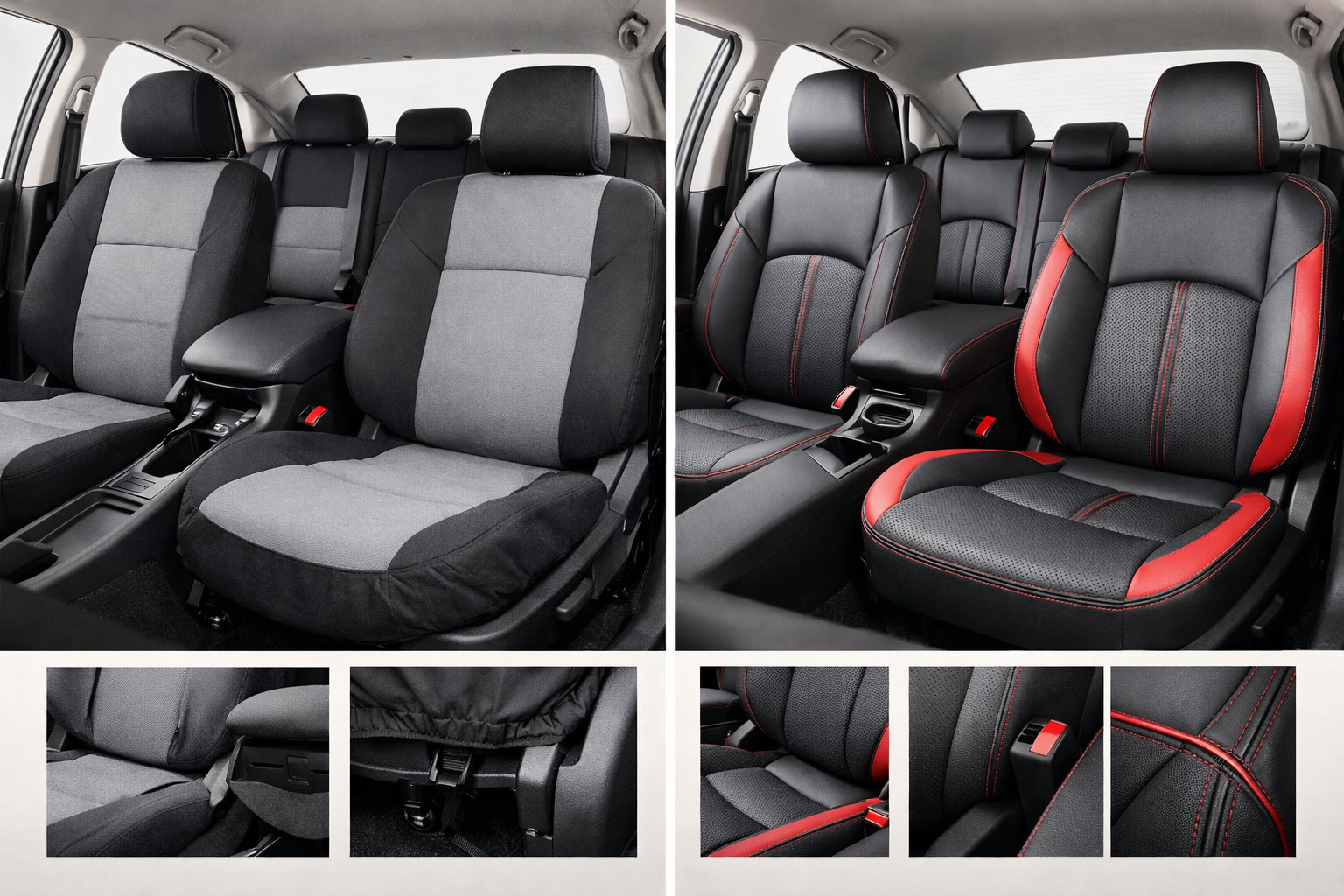
Universal covers are cut to averaged patterns, so they have to stretch over many different seats. Vehicle-specific ones are made for a particular make, model, generation, and sometimes even trim-specific details. That’s why they work better around headrests, armrests, split backrests, belts, and buttons.
In essence, you’re choosing between quick temporary protection and long, hassle-free use. For rentals, work vehicles, kids, pets, or preparing a car for sale, a universal option can get the job done. For daily driving, highway trips, and preserving the interior, a vehicle-specific set almost always wins.
Key criteria to compare
- Installation. Universal covers are usually faster to put on, but that doesn’t mean a better fit. Vehicle-specific sets require more careful tightening and can take from an hour to several hours.
- Movement and cabin noise. If a cover has play, you’ll get wrinkles, rubbing against the seat, light rustling over bumps, and the constant urge to tighten something. A snug vehicle-specific fit is usually calmer.
- Lifespan. Universal covers wear out faster at bends because they’re under tension that doesn’t match the seat’s shape. Vehicle-specific covers hold both appearance and stitching longer.
- Practicality. It’s important not just to cover the upholstery, but to use the armrest, rear row, pockets, belt buckles, and backrest folding normally.
- Compatibility with seat features. If there are side airbags, heating, or ventilation, you need to look not only at the material, but at the design of the specific set.
- Price. Universal sets are cheaper upfront, but they’re replaced more often. Vehicle-specific sets cost more, but are often better value over the full usage cycle.
Quick comparison of options (table)
| Option | Strengths | Weaknesses | Best for |
|---|---|---|---|
| Universal seat covers | Lower price, quick purchase from stock, easier start, decent temporary protection from dirt and wear | Wrinkles, sagging, shifting, weaker compatibility with complex seats, higher risk of mistakes with airbags and cabin features | Those who need a quick, inexpensive way to cover seats for a season, for a work car, or before selling |
| Vehicle-specific seat covers | Snug fit, better look, less movement on the road, longer service life, more convenient around armrests, headrests, and other elements | Higher price, longer installation, sometimes a production lead time, some sets require test fitting before final cutouts are finished | Those who drive daily, want to preserve the interior for the long term, and don’t like constantly adjusting covers |
Detailed breakdown of each option
Universal
The strong point of a universal set is that it solves the problem here and now. If you need to quickly protect the interior from dirt, wet clothing, child seats, or pet hair, it’s a workable choice. For short city trips and modest demands on looks, it’s often enough.
The problems start when seats have pronounced side bolsters, separate armrests, or complex geometry. The averaged cut creates gaps, tension that doesn’t follow the shape, misalignment, and sagging. Over long distances, that not only hurts the look—it also adds friction, fabric movement, and faster wear.
Vehicle-specific
A vehicle-specific set works differently: it’s tailored to a particular seat, so it looks tidier and “lives its own life” less under the driver. This is especially noticeable on the front seats, where any extra play is felt every day. For a family car or a vehicle you plan to keep for a long time, it’s usually the more rational purchase.
But vehicle-specific covers aren’t a magic button. They cost more, installation on tight-fitting sets can be time-consuming, and thick materials can reduce the effect of heating or ventilation. The final result depends heavily on proper installation: if you just throw them on and don’t tighten the fastenings, even a good set won’t show its true level.
DD Tuning expert comment: Most often, people make mistakes when they look only at the material and price, but don’t check the seat shape, the presence of a side airbag, an armrest, and a split backrest. The second common mistake is weak installation without proper tightening. After that, the person blames the covers, even though half the issue was incorrect fitting.
Which option is better for different scenarios
For city use, short trips, and temporary protection, universal covers can still make sense. If the car is used as a work tool and you don’t need the interior to look showroom-fresh, overpaying isn’t always necessary.
For daily driving, highway use, bad roads, and long-term ownership, vehicle-specific covers deliver a noticeably better result. They shift less, irritate you less on long trips, and usually handle constant in-and-out better.
If your seats have side airbags, heating, or ventilation, you need to be even stricter with the choice. What matters is not just the type name, but an explicit approval of the specific set for that seat design—and a sensible material thickness.
Use case and what to choose (table)
| Scenario | Best choice | Why |
|---|---|---|
| You need to quickly cover worn seats without a long wait | Universal | They’re easier to buy immediately, and the task is usually practical rather than a years-long solution |
| Daily trips and a desire to preserve the interior long-term | Vehicle-specific | They fit better, shift less, and keep a decent look longer |
| Car with armrests, complex seat shapes, split rear backrest | Vehicle-specific | In such interiors, universal covers most often end up as a compromise that quickly becomes annoying |
| Kids, pets, work clothes, mostly city driving | Universal or simple vehicle-specific | If you only need protection from dirt, you don’t have to chase an expensive solution—but you still need to check seat shape compatibility |
| Taxi, service car, intensive daily use | Vehicle-specific | The higher upfront price more often pays off in service life and fewer replacements |
| Seats with heating or ventilation | Vehicle-specific with breathable, not overly thick material | Thick covers can mute system performance, so both the cut and the material matter here |
Common mistakes when choosing
- Buying by the principle “should fit almost everyone.” For seats, that usually means an average fit in your specific car.
- Ignoring the side airbag zone. If the backrest has such a module, you can’t install a regular cover without explicit compatibility.
- Looking only at the purchase price, not the replacement cycle. A cheap set that you’ll have to replace in a year or two isn’t always truly cheap.
- Choosing thick material for seats with heating or ventilation, then wondering why the feature works worse.
- Underestimating installation. A poorly tightened cover slips, forms wrinkles, and wears out faster than it should.
When a more expensive solution makes sense
A more expensive set is justified when you’re keeping the car for a long time, want the interior to stay in good condition, and drive a lot. That’s when you’re paying not for status, but for a precise fit, less day-to-day discomfort, and longer service life.
This is especially noticeable in cars with complex seats: armrests, separate headrests, frequent rear-row folding, side airbags. In such interiors, the universal compromise usually shows up quickly—either in looks or convenience. For commercial use, reinforced vehicle-specific solutions are also more logical, because they withstand heavier daily load.
If you want to move from theory to choosing, check out the car seat covers category, separately verify when universal covers are truly justified, and before ordering review the material on how to choose car seat covers. This quickly filters out options that look great in photos but fit only average in a real interior.
From a customer’s experience: a person was looking for an inexpensive set for a family car after a child was born and first considered universal covers. After checking the seat shape with an armrest and a split backrest, it became clear that the cheaper option would create wrinkles and be inconvenient to use. In the end, they chose a vehicle-specific set, and the owner was happy that the interior looks tidy and the covers don’t need tightening every week.
Conclusion
Choosing without a mistake is simple: for long-term use, daily driving, and complex seats, go with vehicle-specific covers; for fast, budget, temporary protection, you can choose universal ones—but only after verifying compatibility with the seat shape and the side airbag area. This conclusion is based on real fitting experience, practice, and real-world usage scenarios—not on attractive promises on the packaging.
How it works
- Assess what you need the seat covers for First, define the use case: temporary protection before selling, a work vehicle, daily driving, or long-term interior preservation. For a short-term need, you can look at universal seat covers, while for regular use it’s better to focus on model-specific ones right away.
- Check the seat shape and interior features See whether the seats have armrests, a split backrest, complex contours, heating, ventilation, or side airbags. These are the features that most often make universal seat covers inconvenient or incompatible.
- Compare not just the price, but also fit and durability Assess how snugly the cover will sit, whether there will be wrinkles, shifting, or road noise. A cheaper set may seem like a better deal at first, but it may need replacing more often and constant readjustment.
- Choose the cover type for your use case For daily driving, highway use, taxi service, or long-term ownership, model-specific seat covers are the better choice: they fit more tightly and keep their appearance longer. Universal covers make sense if you need a quick, low-cost way to protect the seats from dirt or wear.
- Don’t get the material and installation wrong For seats with heating or ventilation, avoid materials that are too thick, and for sets with a snug fit, allow time for proper tensioning. Poor installation will quickly undo even a good set and cause looseness, wrinkles, and wear.
Pros and cons
Custom-fit seat covers fit the shape of the specific seat better, so they shift less, don’t wrinkle, and don’t need constant readjusting.
They are more convenient for cars with armrests, split seatbacks, headrests, and other interior elements, because the cut is designed to work around these parts.
For daily driving, custom-fit seat covers are more cost-effective in the long run, as they keep their appearance and durability longer, even if the initial price is higher.
Universal seat covers can be bought and installed quickly, so they are well suited for temporary protection of worn seats or before selling a car.
For cars with children, pets, or work clothes, universal seat covers cover the basic task of protection from dirt without extra expense.
Universal seat covers often provide a mediocre fit on seats with complex shapes, which leads to sagging, misalignment, and looseness.
If compatibility with side airbags, heating, or ventilation is not checked, you can choose a set that will work incorrectly or create a risk.
Cheaper universal options wear out faster at the fold points, so they have to be replaced more often.
Custom-fit seat covers are more expensive and may take longer to install, and in some cases they also require waiting for production.