 Author: Radomskyi Maksym Vasyliovych
If you need one accessory for everyday city driving, window deflectors are more often the more useful choice. If the car does a lot of highway driving, out-of-town routes, gravel roads, or you drive during bug season, a hood deflector makes more sense. These aren’t interchangeable: one is for cabin ventilation, the other is for protecting the front edge of the hood and the lower area of the windshield.
The main mistake is choosing by photos or price alone. What matters here is installation, noise at speed, compatibility with your exact vehicle, real usefulness in your driving routine, and whether you’re willing to put up with side effects like whistling or the need to let the mounts “set” after installation.
What the choice is really about
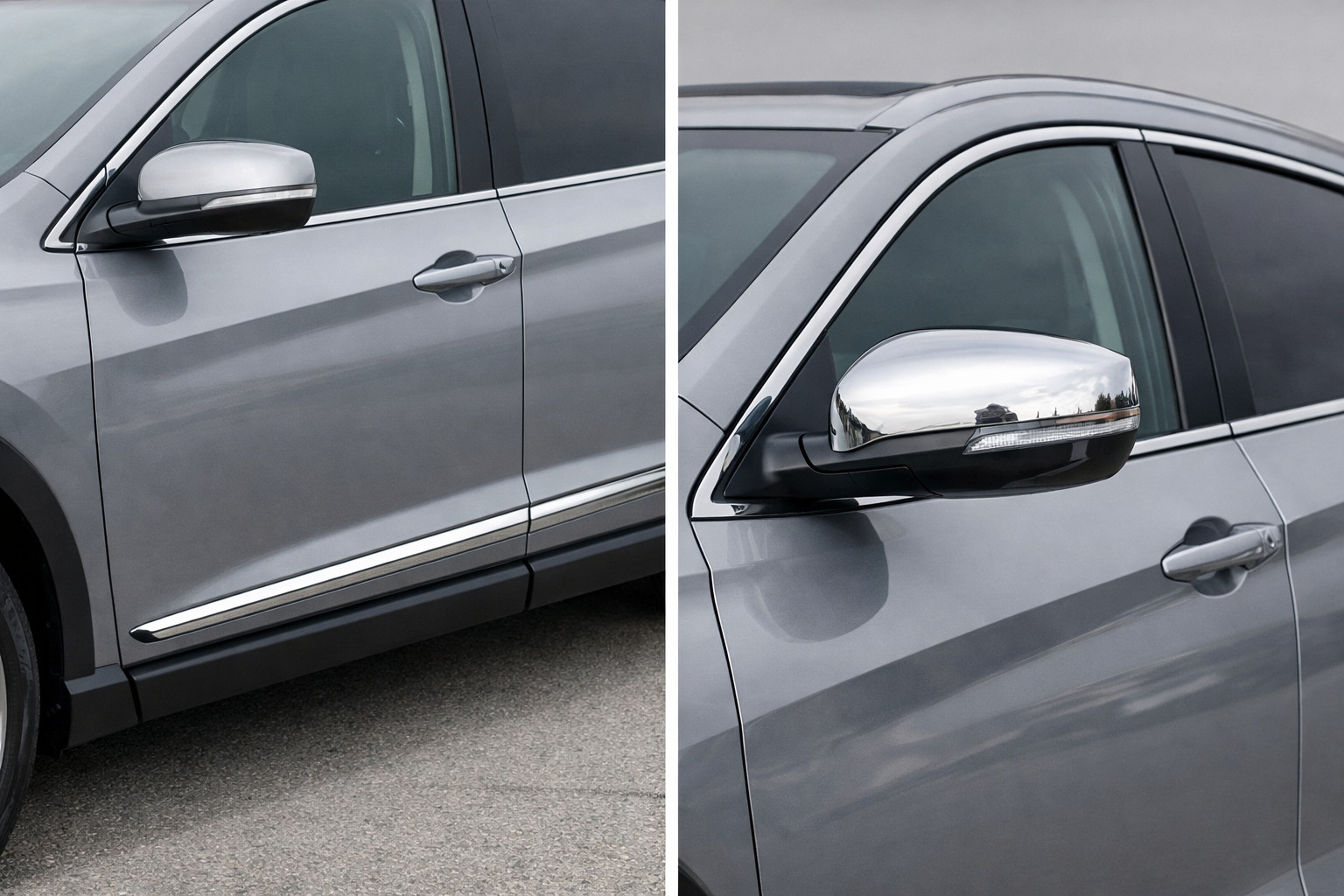
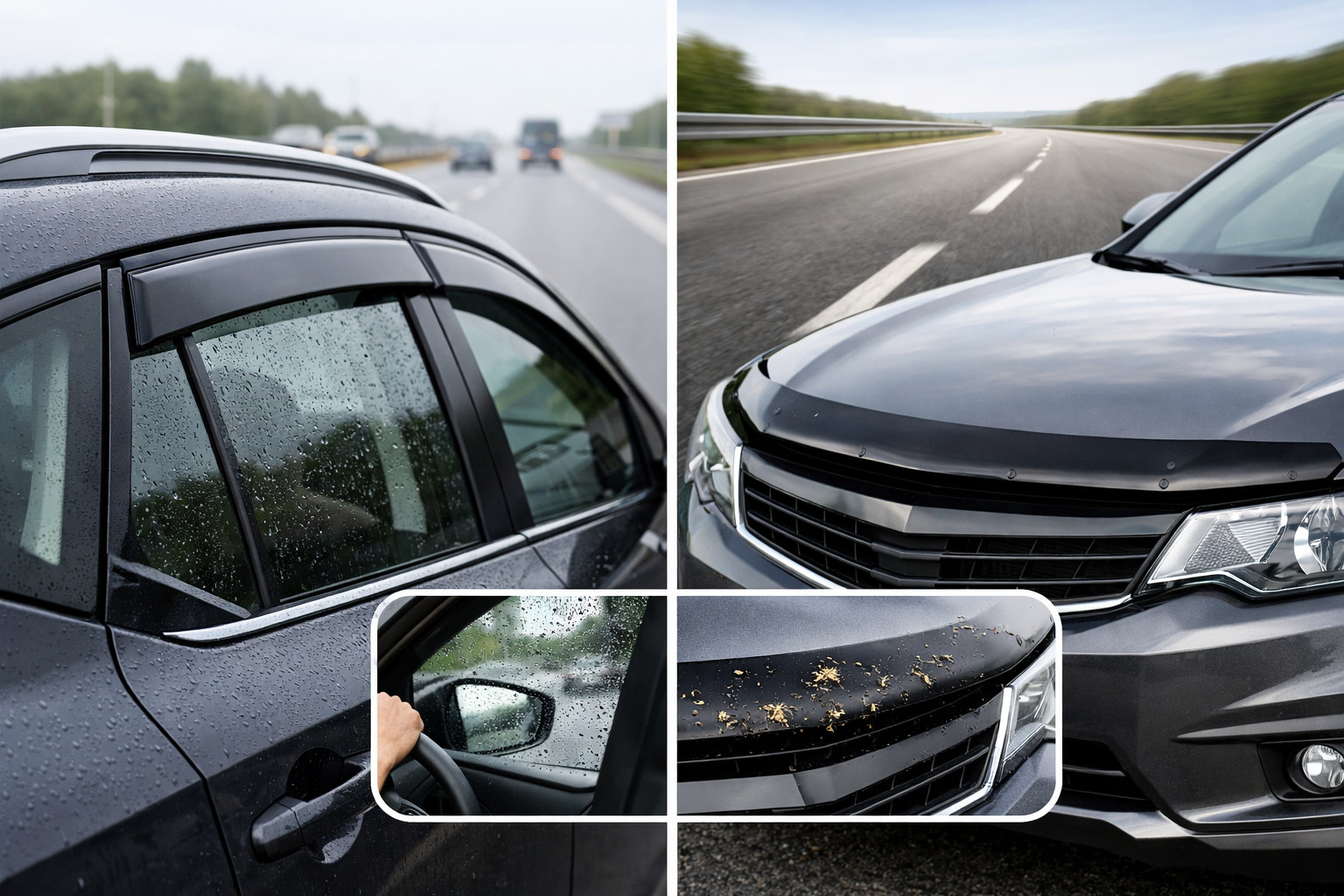
In the city, the driver benefits more often from being able to crack a window in rain or heat so the cabin ventilates and fogging is reduced. That’s exactly what window deflectors provide: they divert water away from the upper gap and let you drive with the window slightly open without direct drafts or splashes into the cabin.
A hood deflector solves a different task. At speed it redirects airflow at the hood edge, so some insects, small stones, and dirt are pushed higher. On a city car it’s less noticeable, but on highways and out-of-town routes it’s more obvious.
What criteria to compare by
- Installation. Window deflectors can be stick-on or in-channel; after installation some models need time for everything to seat properly. A hood deflector is usually quicker to install, but precise bracket geometry and clamping pressure are critical.
- Noise. Window deflectors can add a bit of noise, but with the window slightly open they often reduce air buffeting. Hood deflectors more often cause a whistle or hum specifically at speed.
- Service life. Durability depends on material, fit accuracy, and mounting quality. Cheap universal options are more likely to peel off, vibrate, or turn cloudy.
- Practicality. Window deflectors are useful every day if you actually open the windows. A hood deflector makes sense where there are insects, gravel, dust, and frequent long trips.
- Price. Paying extra is justified not by the price itself, but when it delivers an exact fit, less chance of noise, a better look, and proper installation without modifications.
Quick comparison of the options (table)
| Option | Strengths | Weaknesses | Who it’s for |
|---|---|---|---|
| Window deflectors | Ventilation in rain and heat, less fogging, everyday usefulness, no-drill installation | May add noise, not all work well with auto window up, don’t protect the hood | Those who mostly drive in the city, smoke in the car, leave the car in the sun, or want ventilation without keeping the window wide open |
| Hood deflector | Works better against insects, small stones, and dirt on highways and out-of-town roads; quick installation with vehicle-specific kits | May whistle, sometimes slightly worsens fuel economy, doesn’t replace paint protection film | Those who regularly drive on highways, out of town, or on forest/gravel routes |
DD Tuning expert comment: most often people buy a hood deflector for city driving expecting a noticeable daily effect, and then barely feel a difference. The second common mistake is buying window deflectors without checking compatibility with the auto window closer. If quietness matters, look not only at the shape, but also at fit precision and the mounting method.
Detailed breakdown of each option
Window deflectors
Their real strength is micro-ventilation. When the window is cracked open by about 25–51 mm, air enters the cabin, but rain and splashes get inside less. This is useful in traffic, during shoulder seasons, on short trips, and when the car is parked in the heat.
For installation, vehicle-specific kits work best. In-channel versions look cleaner, but this is where conflicts with auto-up or anti-pinch protection sometimes appear. Stick-on versions are more predictable in behavior, but depend more on the quality of the adhesive tape and proper surface prep.
Noise depends on the body shape, mirrors, and fitment. A deflector by itself doesn’t make the car quieter, but with the window slightly open it can remove unpleasant air buffeting. After installation, it’s important to let the parts set for as long as the instructions for the specific kit require.
Hood deflector
Its benefit shows at speed. On the highway—especially in summer and on out-of-town routes—it partially redirects airflow away from the front edge of the hood, so insects and fine abrasive hit this area less. For those who often drive long distances, it’s more practical than it looks in photos.
The downsides are real too. The wrong angle, weak mounting, or an imprecise fit can cause whistling, humming, or vibration. Also, it’s not complete front-end protection: it won’t save the entire hood surface from chips and it doesn’t replace film.
One more point is fuel economy. Sometimes a hood deflector slightly increases aerodynamic drag, so for a car that rarely leaves the city the benefit may be lower than the owner expects. After installation, it’s a good idea to periodically check the mounts and not rely on brush car washes.
Which option is better for different scenarios
For city driving, the answer is most often simple: window deflectors. They work every day when you need to reduce moisture, get air into the cabin, or avoid heat buildup while parked. If you almost never open the windows, their value drops too.
For highways and out-of-town trips, the logic is different. There, insects, small stones, dust, and long hours at speed matter, so a hood deflector makes more sense. But if cabin quietness is critical for you, you need to pay especially close attention to model quality and installation.
In mixed driving, the smartest choice depends on what annoys you more: stuffiness and fogging, or bug marks and small impacts on the front end. Sometimes the right answer isn’t to argue between these two accessories, but to install both—if the car is driven in the city daily and also sees the highway regularly.
Use scenario and what to choose (table)
| Scenario | What to choose | Why |
|---|---|---|
| Daily city driving, short trips | Window deflectors | Provides daily benefits for ventilation—in rain, heat, and when windows fog up |
| Highway driving several times a week | Hood deflector | More benefit from protection against insects and small debris at speed |
| City plus frequent out-of-town trips | Both options | One solves cabin ventilation, the other reduces load on the hood’s front edge |
| Quietness matters and you want minimal side effects | Quality vehicle-specific window deflectors or nothing | A hood deflector more often creates aerodynamic noise, especially if poorly designed |
| You almost never open the windows, but drive a lot of highway | Hood deflector | Window deflectors won’t deliver their main advantage here |
| Parking in the sun, the cabin heats up quickly | Window deflectors | Let you keep light ventilation without leaving the window wide open |
Common mistakes when choosing
- Buying a universal option instead of a vehicle-specific one when an exact solution exists for your car.
- Expecting window deflectors to make the cabin quieter on their own.
- Installing a hood deflector only for city driving, where its benefit is often minimal.
- Not considering window deflector compatibility with an automatic window closer.
- Sticking or tightening mounts without proper surface preparation.
- Ignoring the time needed for proper bonding/settling after installation.
- Assuming a hood deflector fully replaces paint protection film or clearcoat care.
When it makes sense to pay more
A pricier option is justified when you need an exact fit, less risk of whistling, better stability at speed, and proper service life without peeling. If you’re choosing between types, start with the deflector category, then look separately at window deflectors and, if you drive the highway a lot, check the breakdown of hood deflectors. The extra cost especially makes sense for cars with sensitive window frames, auto closers, or if you don’t want to experiment with fitting and re-installation.
From a customer’s experience: a crossover driver was looking for protection for intercity trips, but initially wanted only a hood deflector. After clarifying the route, it turned out the car sits in the sun daily and is often driven in the city, so window deflectors were installed first and the hood deflector was added later. In the end, the biggest day-to-day effect came from the window set, while the hood deflector became useful on longer trips.
Conclusion
For city driving, window deflectors are more often the better choice; for highway driving, a hood deflector. If you have a mixed routine, you should choose not by looks, but by which problem you want to solve first: stuffiness and fogging, or bug marks, dirt, and small stone impacts on the front end.
The material is based on real selection experience, practice, and real use cases. That’s why the conclusion is straightforward: in city use, window deflectors usually provide more noticeable daily benefit, while a hood deflector comes into its own where the car spends time at speed and often leaves the city.
How it works
- Assess your main driving pattern First, determine where the car is driven more often: in the city, on the highway, or in mixed conditions. For everyday city use, window deflectors are usually more useful, while for frequent trips out of town, a hood deflector is preferable.
- Match the accessory to the needed function If you value ventilation, less fogging, and the ability to slightly open the window in rain or heat, choose window deflectors. If you need protection for the front edge of the hood from insects, dust, and small stones at speed, a hood deflector makes more sense.
- Check compatibility with your car Do not choose based only on photos or price. For window deflectors, it is important to consider compatibility with the window regulator and the mounting type, and for a hood deflector, the precision of the bracket geometry and the fit for your exact model.
- Assess possible side effects Compare the noise that may appear after installation and your willingness to accept it. Window deflectors can sometimes add noise, while a hood deflector can more often whistle or hum at speed.
- Choose installation and quality without compromise It is better to choose model-specific kits rather than universal ones if there is a precise solution for your car. After installation, observe the time needed for the mount to set, and then periodically check its condition.
- Choose the option for your scenario For everyday city driving, short trips, and parking in the sun, window deflectors are more often the better choice. For highways, country roads, gravel, and insect season, a hood deflector is more practical; in mixed conditions, it sometimes makes sense to install both.
Pros and cons
Window deflectors are genuinely useful in the city: they let you crack the window slightly in rain or heat without direct drafts or splashes into the cabin. This helps with ventilation and reduces fogging during daily trips.
For highways and out-of-town routes, a hood deflector provides practical protection for the leading edge of the hood from insects, small stones, and dirt. This is most noticeable at speed, not in city driving.
Window deflectors do not require drilling, and model-specific sets are usually fairly easy to install. This reduces the risk of complicated installation if you choose a compatible option for a specific car.
A hood deflector makes sense for those who often drive on highways or gravel roads. In this mode, it is more useful than a window deflector, because it works against exactly the factors that occur most often there.
In mixed use, you can cover both tasks: window deflectors for cabin ventilation and a hood deflector for front-end protection. This is practical if the car is regularly used both in the city and outside it.
A hood deflector can whistle, hum, or vibrate if the angle or mounting is chosen poorly. For those who value a quiet cabin, this is a noticeable drawback.
Window deflectors are not equally compatible with all cars: sometimes they interfere with automatic window operation or anti-pinch protection. Because of this, inconveniences in use may appear after installation.
A hood deflector is not full front-end protection: it does not replace protective film and does not prevent chips across the entire hood surface. If you need complete paint protection, this accessory is not enough.
In the city, the benefit of a hood deflector is often weaker than buyers expect. If the car hardly ever drives on the highway, the money spent may bring little noticeable everyday effect.