25.09.2026
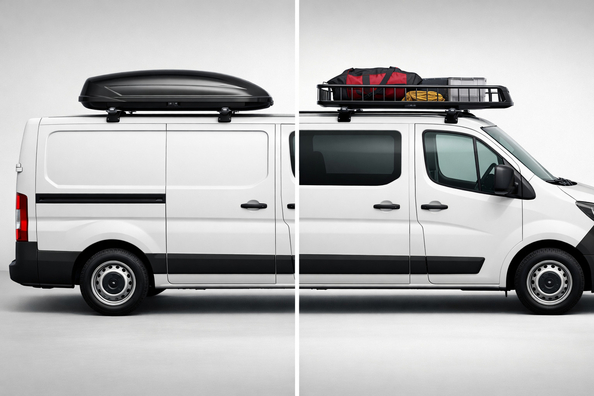

For a work van, the answer is usually simple: if you often carry ladders, pipes, profiles, sheet material, or heavy tools, a rack system or platform is more convenient. If the load is uneven, bulky, dirty, and you just need to toss it on top quickly, a roof basket is often more practical.
The biggest mistake with this choice is looking only at the accessory’s shape. In reality, what matters is your daily work scenario, the roof load limit, the accessory’s own weight, the van’s height after installation, and how easy it will be to load everything every day.
A van roof rack system isn’t one single item, but a base made up of crossbars, supports, and a vehicle-specific mounting kit. In a simple version it’s two or more crossbars; in a pricier version it’s a full-size platform. These systems work best when the cargo is long, heavy, or needs to be rigidly secured at several points.
A roof basket works differently: it’s less about carrying long items and more about providing open volume for mixed-format gear. It’s convenient for jerry cans, dirty equipment, bags, boxes, and seasonal loads. But a basket doesn’t protect the contents from rain and dirt, and its side rails don’t make it better for ladders or pipes.
| Option | Strengths | Weaknesses | Who it’s for |
|---|---|---|---|
| Crossbars / rack system | Simple base, less extra weight, convenient for ladders and pipes, easier to avoid overloading the system | Less continuous support, not very convenient for small or uneven loads, важно to cinch down properly with straps | Installers, service crews, anyone who often carries long items |
| Roof platform | Low profile, many tie-down points, better versatility, often higher load capacity of the system itself | More expensive, heavier, size choice and installation are critical | Those whose van works every day and carries different types of cargo and equipment |
| Roof basket | Easy to load items of different shapes, great for dirty and seasonal cargo, easy access | More noise at speed, no weather protection, worse for long items, adds height | Those who carry boxes, bags, gear, jerry cans, and uneven loads |
DD Tuning expert comment: Most often, people buy a basket “with room to spare” for a work van and then try to carry a ladder, pipes, and sheet material on it—things that are awkward to strap down there. The second common mistake is looking only at the accessory’s rating and forgetting the vehicle roof limit and the accessory’s own weight. If the van is tall, plan access to the load right away; otherwise even a good system will annoy you every day.
This is the most rational base for a work scenario where the cargo is typical and repeatable. If the van carries a ladder, pipes, profiles, or long boxes, crossbars provide a clear tie-down setup without unnecessary bulk. But long items must be secured not only in the middle: front and rear safety tie-downs are mandatory here.
The typical load rating of such systems can reach 75 kg, but for a specific van that’s not a guarantee. If the vehicle roof has a lower limit, that’s the number you must follow. Plus, the base system itself has weight too, even if it’s less than a platform.
A platform is already a work tool for those who use the roof regularly. It has a lower profile, a more continuous support area, many tie-down points, and better compatibility with additional accessories. That’s why it’s convenient when one van has to alternate between long items, boxes, light mounts, or other equipment.
In premium systems, the real advantage isn’t “nice looks,” but stability, faster access to the load, and less stress on the highway. Such platforms can have a high load capacity of the structure itself, but they still don’t отменяют the vehicle roof limit. The downside is obvious: more weight, a higher price, and it only makes sense where the van truly works—not when it goes on vacation once a month.
A basket wins when the cargo is awkward in shape: bags, dirty gear, jerry cans, boxes, small items you don’t want to match to separate mounts. The open format makes loading and unloading easier, especially if items are frequently removed and put back.
But for a work van, a basket has two weak points. First is noise and aerodynamics: even with a wind fairing, it can be louder at speed. Second is practicality for long loads: the side rails help keep small items in, but they don’t make the basket more convenient for a ladder or pipes. Also, the basket itself weighs a lot, which eats into the allowed roof load.
If the van is used for installation, service, electrical work, ventilation, or material delivery, a basic rack or platform is almost always more logical. They handle repeatable work cargo better and don’t force you to reinvent how to fit long items between the basket rails every time.
A basket makes sense where the load constantly changes and doesn’t need weather protection: toolboxes, consumables in containers, workwear, dirty equipment, jerry cans. For mixed tasks—ladder today, boxes and additional equipment tomorrow—the most flexible solution is the platform.
For a tall van, think separately about access. If one person has to load it, the benefit of the right system is measured not only in kilograms, but also in whether you’ll have to lift cargo over your head from a step every morning.
| Scenario | Best choice | Why |
|---|---|---|
| You carry a ladder, pipes, profiles every day | Rack system or platform | Easier to secure long items, side rails don’t get in the way, easier to arrange front and rear safety tie-downs |
| You carry boxes, bags, jerry cans, dirty gear | Roof basket | Open format loads faster and you don’t mind getting it dirty |
| One van covers different tasks during the week | Platform | Most tie-down points and the best versatility for accessories and different cargo |
| You often drive highways with an empty roof between jobs | Low-profile platform or a neat basic rack | Less chance of extra noise and drag than with a bulky basket |
| The van is tall, and one person loads it | Rack or platform with well-thought-out access | Daily ergonomics matter more than simply having side rails |
A more expensive system is justified when the van works every day, not occasionally. If the roof constantly carries cargo, tools, and auxiliary accessories, the cheap option starts losing not at checkout, but in day-to-day work: more noise, slower access, weaker versatility, and a higher need for постоянных compromises. To start, it’s worth looking at what rack systems are available and how a simple base differs from more work-oriented systems.
If you’re choosing a solution for a specific commercial body, it’s more correct to look for compatible options for the model rather than надеяться on “universality.” For example, there are dedicated racks for Mercedes Sprinter and racks for Volkswagen Transporter. It’s in the premium segment that the advantages of a lower profile, stiffer mounting, and proper compatibility with work accessories are felt the most.
From a customer’s experience: for a service van, we initially considered a basket because we needed to carry both boxes and a ladder. After a test fit, it turned out that securing the ladder in a basket every day was inconvenient, and the vehicle height became excessive for regular entries into courtyards and under canopies. In the end, we chose a platform: the boxes are strapped down, long items are easier to place, and using the system daily turned out to be faster.
For most work vans, the better purchase is not a basket, but a rack system or platform if loads are frequent, long, heavy, or repeatable. A basket makes sense where the main thing is to quickly toss an uneven, bulky, or dirty load on top and not fight with precise placement.
If you need one short piece of advice, it’s this: for working with long items, choose a rack or platform; for mixed small cargo, choose a basket—but only after checking the roof limit, the system’s own weight, and the added vehicle height. This material is based on real selection experience, practice, and real usage scenarios.
| ✔ | Better suited for long items: ladders, pipes, profiles, and sheet materials. Such loads are easier to secure firmly on a rack or platform than in a basket. |
| ✔ | A platform provides many tie-down points and a lower profile. This is convenient when a van carries different types of cargo and equipment every day. |
| ✔ | A basic roof rack is usually lighter than a platform and does not reduce the roof’s permissible load capacity as much. For work transport, this makes weight control easier. |
| ✔ | In a basket, the open design makes it easier to quickly load dirty, bulky, or irregular cargo. This is practical for boxes, canisters, bags, and gear. |
| ✔ | The article separately emphasizes that daily ergonomics are important for a tall van. A rack or platform with well-thought-out access can be more convenient than a basket if one person is loading it. |
| ✘ | A basket is less suitable for long items because its sides make it less convenient for ladders or pipes. Long items are harder to tighten and secure properly there. |
| ✘ | A basket creates more noise at speed and can worsen aerodynamics. For frequent highway driving, this is a noticeable downside. |
| ✘ | An open basket does not protect cargo from rain or dirt. If items that need protection from the weather are to be carried on the roof, this is an inconvenient solution. |
| ✘ | A roof rack, especially basic crossbars, requires careful securing of the load with straps and front and rear safety tie-downs. Without this, transporting long items is dangerous. |
Shipping to EU
Wholesale and retail
Own warehouse
Опис продукту
Подарунки не надаються при оформленні покупки у кредит під 0,01% або при покупці частинами.