
































































 Author: Radomskyi Maksym Vasyliovych
This upgrade plan is for a Toyota RAV4 2019+ owner building the car for vacations, family trips, and situations where the stock trunk is no longer enough. The scenario is simple: you need to haul suitcases, kids’ stuff, sometimes a stroller or lightweight gear—without turning the car into a noisy, uncomfortable compromise.
For a RAV4 like this, it’s not worth starting with a basket or the biggest box. First, verify the roof load limit specifically by VIN and trim, check the type of roof rails, and only then choose crossbars and the rooftop cargo format. It also matters that total roof load includes not just the cargo, but the weight of the crossbars themselves plus the box or basket.
What this upgrade needs to accomplish
In a normal scenario, this upgrade should solve several tasks at once: add volume for the trip, keep items out of the rain, preserve access to the tailgate, and stay within the permissible roof load. If even one point fails, the purchase wasn’t for your vacation—it was just for the photo.
On the RAV4 2019+, a lot depends on the trim. On some cars you need to look closely at which rails are installed from the factory, and on certain versions the roof limit is lower than owners expect. So the base rule is one: go by the lower of the vehicle limit and the mounting system limit, and if the car is from 2019–2021 or has had roof work done, also check the condition of the mounting points and sealing around the rail area.
What to upgrade first
The first step isn’t flashy, but it’s critical: check by VIN the permissible roof load, the rail type, and crossbar compatibility specifically for your vehicle. This is especially important for hybrid versions and cars where it’s easy to get the mounting wrong or buy a kit for the wrong base.
The first real upgrade should be aerodynamic crossbars. They create the correct base for any next scenario: a closed box, a basket, or mounts for specific gear. If you use the roof only a few times a year, think about the practical side right away: crossbars don’t have to stay on the car all the time, because at speed they often add noise.
Upgrade, why it’s needed, who benefits (table)
| Upgrade | Why it’s needed | Who it really benefits |
|---|---|---|
| VIN check, roof limit and rail type | Shows what you can install without mistakes in compatibility and load | Everyone without exception, especially hybrid owners, cars after roof repair, and vehicles with non-obvious trims |
| Aerodynamic crossbars | Create the base for rooftop cargo and usually make less noise than crude universal solutions | Those who actually plan to carry items on the roof, not just want an expedition look |
| Closed cargo box | Protects suitcases, textiles, and kids’ items from rain, dust, and unwanted access | Families, long-distance travelers, anyone who drives in any weather |
| Open basket | Works for dirty, wet, or awkward-shaped cargo you don’t mind carrying outside | Those hauling camping, work, or sports gear rather than regular suitcases |
| Rubber trunk mat | Reduces mess inside the car when some dirty items still ride in the trunk | Those who travel with a stroller, shoes, fuel cans, folding chairs |
DD Tuning expert comment: the most common mistake is looking only at the box volume and not calculating the mass of the entire system. A large box’s empty weight can already take a significant share of the allowable load, and a long shell can also hit the tailgate if you don’t measure the clearance. The second typical misstep is buying a basket for regular suitcases and then fighting rain, covers, and extra noise.
What makes sense to add as the second stage
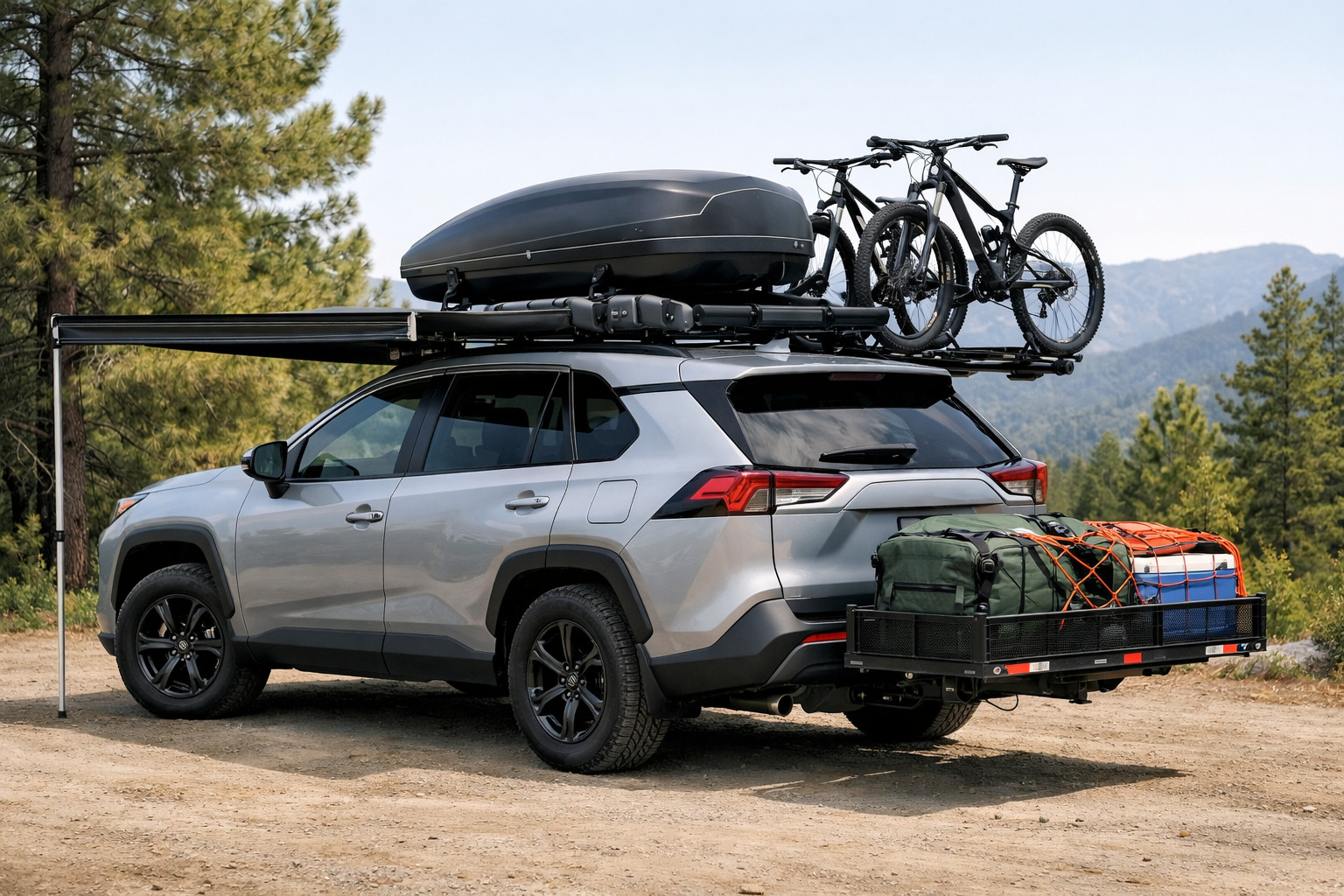
At the second stage, you choose the transport format itself. For vacations, suitcases, kids’ items, and anything that must stay dry, the logical choice is almost always the same: a closed cargo box. It’s more convenient for daily use, less annoying in the rain, and better suited to a family scenario than an open basket.
A basket only makes sense when the cargo is dirty, wet, or awkward in shape. Another point is weight. If you take a big heavy box, it can eat up roughly 17–22 kg of the available load before you even pack anything. For versions with a lower roof limit, that’s already a reason to look at a shorter and lighter option rather than chasing maximum volume at any cost.
What’s more about comfort or appearance
Low-profile crossbars look cleaner and often make less noise, so they’re a compromise between function and everyday comfort. If your RAV4 has a sunroof, the noise difference is even more noticeable, so it’s better to think not about the tallest setup, but about calm highway driving.
Power tailgate, window deflectors, side steps, chrome, and similar items should be considered only after you’ve solved the main volume problem. They can make the car nicer to use or change the look, but they don’t answer where to put the suitcases or how to keep things from getting wet on the road.
What people often buy for nothing
Most often, people waste money on a big open basket for a typical family vacation scenario. If the roof is carrying soft bags, kids’ items, and suitcases, a basket loses to a box in almost everything. The second common mistake is buying the largest available box without checking tailgate clearance and without calculating the permissible weight.
Another unnecessary expense is pricey accessories for the image when the roof base still isn’t assembled correctly. Incompatible crossbars, a kit that doesn’t match your rails, ignoring mounting-point sealing, or keeping noisy bars installed all the time creates more irritation than benefit.
What to install first, what to postpone, what’s optional (table)
| Install first | What can be postponed | What is not mandatory | For which case |
|---|---|---|---|
| VIN check, crossbars, medium-size closed cargo box | Trunk mat, small interior organization | Basket, side steps, decorative accessories | Family vacation with suitcases and kids’ items |
| Crossbars, mounting points, basket or box depending on gear type | Second set of bags, additional interior accessories | The largest box without a real need | Active recreation with dirty or odd-shaped cargo |
| Re-check roof limit, lighter system, shorter box | Any comfort accessories that don’t affect carrying | Heavy large basket or oversized box “just in case” | Hybrid or a version with a lower permissible load |
A ready upgrade plan for this scenario
- Verify by VIN the roof limit, rail type, and mounting compatibility.
- Inspect the rail and mounting area, especially on 2019–2021 cars or after roof work.
- Install aerodynamic crossbars that match your specific trim.
- Then choose a closed box as the baseline solution for vacations; consider a basket only for dirty or odd-shaped cargo.
- Before buying a large box, check its weight and the clearance to the tailgate in the open position.
- After the first trip, decide whether you need secondary items: a trunk mat, small-item organization, and storing the crossbars off-season.
When it makes sense to go with more expensive solutions
More expensive solutions are justified when you need predictable compatibility and minimal installation experimentation. In that case, it makes sense to look at original crossbars: they cover the basic task without extra adapters and reduce the risk of picking the wrong setup.
It also makes sense to pay more when you often drive long distances and want a quieter, cleaner-looking, and more everyday-friendly system. If you’re still comparing formats, it’s worth looking at all roof rack options and then deciding based on your rails, real load, and trip frequency.
A pricier basket only makes sense for those who know exactly why they need an open format. Then you can choose among roof baskets with proper mounting and adequate rigidity, but for suitcases, blankets, and kids’ items a closed box is still more practical. If the priority is less noise and easier loading, it’s better to think not about a more expensive roof setup, but about a rear hitch-mounted box.
From a customer’s experience: a RAV4 owner initially wanted a large basket because it seemed more universal and cheaper to use. After weighing the system and discussing the scenario with suitcases and kids’ items, they settled on crossbars and a more compact closed box, and left dirty gear for the cabin and the stock trunk with a mat. As a result, the car was quieter on the highway, the items stayed dry, and the tailgate opened without stress.
Conclusion
For a Toyota RAV4 2019+ for vacations, the smartest order is almost always: first check the roof limit and rail type, then install the right crossbars, and only after that choose the carrying format. For most family trips, a closed box wins, while a basket remains a niche solution for dirty or odd-shaped cargo.
Don’t overpay for size or an “expedition” look if your scenario is regular suitcases and vacation gear. This material is based on real selection experience, hands-on practice, and real use cases: what’s useful starts with compatibility and weight—not with a catalog picture.
How it works
- Check the roof limit and compatibility First, verify the permissible roof load, roof rail type, and mount compatibility by VIN for your specific RAV4 2019+ configuration. If the vehicle is from 2019–2021 or has had roof work done, inspect the mounts and the sealing area around the roof rails separately.
- Install aerodynamic crossbars The first real upgrade should be crossbars that fit your vehicle. They form the base for roof cargo and usually produce less noise than bulky universal solutions.
- Choose the cargo format for the scenario For vacations, suitcases, and children’s items, a closed box is the best choice: it protects the contents from rain and dust. An open basket makes sense only for dirty, wet, or irregularly shaped cargo.
- Check weight and clearance before buying Do not rely only on the box volume: consider the weight of the entire system, because a large box can take up a significant part of the allowable load. Also check the clearance to the tailgate when open so nothing interferes.
- Do not install secondary items before the basics The power tailgate, running boards, chrome, and other accessories should be considered only after the main space issue has been solved. For family trips, a trunk mat and simple item organization will be more useful than decorative upgrades.
- Refine the setup after the first trip After a test drive, assess whether additional small items are needed: a trunk mat, cabin organization, or off-season storage for the crossbars. If the system turns out to be noisy or inconvenient, it is better to adjust the setup rather than buy an even larger box or basket.
Pros and cons
First, checking the VIN, roof limit, and rail type reduces the risk of buying an incompatible set or exceeding the allowed load. This is especially important for hybrids and cars after roof work.
Aerodynamic crossbars provide a proper base for a roof box or other mounts and usually make less noise than bulky universal solutions. For those who use the roof a few times a year, this is also more practical in everyday use.
A closed roof box is best suited for suitcases, children's items, and textiles, as it protects them from rain, dust, and unauthorized access. For family vacations, it is more convenient than an open basket.
Low-profile crossbars look neater and often make less noise, especially if the car has a sunroof. This is useful when not only capacity but also highway comfort matters.
A rubber trunk mat helps keep the interior tidier if some dirty items are carried not on the roof. It is a useful addition for trips with a stroller, shoes, or bulky gear.
A large box can take up a noticeable part of the allowable load before you put anything in it, because the weight of the system itself also has to be considered. Because of this, “getting the maximum volume” does not always mean a practical solution.
A long or bulky box can hit the trunk lid if the clearance in the open position is not checked. This creates a real risk of inconvenience or mistakes in everyday use.
An open basket is poorly suited for regular suitcases, soft bags, and children's items, because they remain unprotected from rain. For a family vacation, it loses to a box in almost every way.
Crossbars that cannot be removed after the season can add noise at speed. If the roof is used rarely, this is an unnecessary downside in everyday driving.