03.08.2026
150
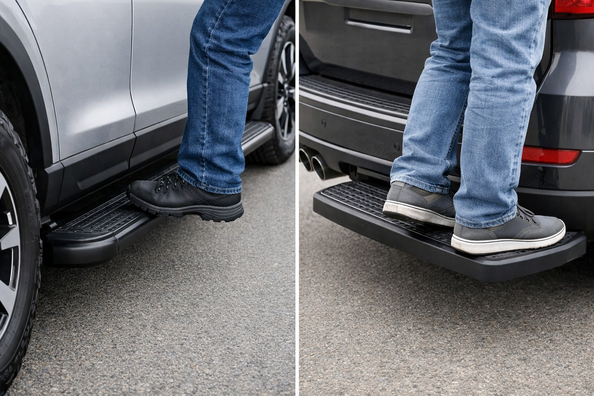

If you have to choose one solution for a high-bodied vehicle, in most everyday scenarios side steps are more convenient. They work every time you get into the cabin, help kids climb in, reach the roof, or grab items along the side. A rear step solves a different task more precisely: quick and safer access specifically into the bed.
So these aren’t truly interchangeable accessories. For a pickup or a tall vehicle with frequent work around the cargo area, a rear step is very useful, but it doesn’t solve the problem of a high step-in height into the cabin. And if there’s no bed as such, a rear step becomes a narrow, specialized add-on rather than an alternative to side steps.
The main question is simple: where do you climb up more often—into the cabin or into the bed. If it’s the cabin, side steps deliver value every day. If it’s the bed, a rear step is more convenient because it brings you right to the cargo without taking up space along the side.
For a family vehicle, a tall SUV, or a pickup used mainly in the city, side steps are almost always more practical. For a work pickup where the tailgate is constantly opened and you’re grabbing tools, boxes, or tie-downs, a rear step often matches the need more accurately.
| Option | Strengths | Weaknesses | Who it’s for |
|---|---|---|---|
| Side steps | Help when getting in and out, work for all doors, make roof access easier | Can collect dirt; narrow tube-style versions are less comfortable; retractable mechanisms are sensitive to ice and road salt | Family, daily driving, tall SUV, pickup as an everyday vehicle |
| Rear step | Best access into the bed, doesn’t take up space along the side, useful for loading | Doesn’t help getting into the cabin; benefits are limited if you rarely use the bed | Work pickup, delivery, installation work, frequent access to tools and cargo |
DD Tuning expert comment: the most common mistake is comparing these accessories as if they solve the same task. People buy a rear step and then realize it’s still just as inconvenient for kids and passengers to get into the cabin. The second typical story is buying a narrow tube instead of a proper platform and expecting the comfort of a wide step.
Their main advantage is that you feel the benefit constantly. For a tall body, this is the most direct way to reduce step-in height when getting in, especially if the vehicle is on larger tires or has a lift. A wide platform is always more comfortable than a narrow tube step: your foot is more stable, and it’s easier for kids and for people wearing winter boots.
But it’s not just about having steps—it’s also about the type. Fixed models are simpler and usually more durable. Retractable ones look neater and can have a wide platform, but they require a clean mechanism; in mud, ice, and salt they’re more demanding. Some electric solutions list a high load rating, but there can be discrepancies in descriptions, so you should check the spec sheet of the exact kit, not generic promises.
This is a specialized tool for bed-related tasks. It provides direct access to the cargo area, often works with the tailgate down, and may not interfere with towing. If you climb in several times a day to grab tools, tie-downs, boxes, or building materials, its usefulness can be felt more strongly than that of side steps.
The downside is that it changes almost nothing for the cabin. That means the driver, passengers, and kids will still have to step up just as high. Load ratings also vary a lot: for factory solutions you can see figures around 136–159 kg, so you should verify the strength margin separately—especially if you step on it in heavy footwear or with a load in your hands.
For the city, family use, and daily driving, the answer is almost always in favor of side steps. They solve the most frequent action—getting in and out—and that matters more than occasional bed loading.
For a service, construction, or farm pickup, a rear step often delivers more real-world value. If the vehicle works as a tool rather than family transport, it makes sense to optimize access to the cargo. If the vehicle does both, the best solution is a combination: side steps for the cabin and a rear step for the bed.
A special case is off-roading and winter. Here you need to assess conditions realistically: retractable systems are comfortable but more sensitive to dirt and icing. For harsh use, it’s often easier to live with a simpler fixed solution.
| Scenario | Best choice | Why |
|---|---|---|
| Daily trips, kids, frequent getting in/out | Side steps | Work at all doors and genuinely reduce step-in height |
| Constant bed access, tools, delivery | Rear step | Gives a shorter, more convenient path directly to the cargo |
| Pickup for both family and work | Combination of both | Each accessory covers its own task without compromise |
| Winter, mud, minimal maintenance | Fixed side steps or a simple rear step | Fewer moving parts, fewer chances of sticking |
| Need access to the roof or roof cargo | Side steps | A rear step hardly helps here |
A pricier solution is justified when you clearly understand what you’re paying for. If you want maximum comfort without a constantly visible step, it makes sense to look at electric retractable side steps: they’re convenient, but more complex to install and more demanding about cleanliness. If the vehicle truly drives in mud—to depots, into the woods, or onto construction sites—it’s more logical to look at heavy-duty side steps or other simple, strong solutions. And if you first need to understand the differences between formats and budgets, it’s worth browsing all tuning side steps in one section.
There’s an important nuance here: more expensive doesn’t automatically mean more comfortable for you. An electric kit may take 3–5 hours to install and provide better step-in comfort, but for a work pickup with constant mud, simple mechanics can be more practical in the long run.
From a customer’s experience: a pickup owner initially wanted only a rear step because he frequently climbed into the bed for tools. After clarifying the use case, it turned out the vehicle also carried his family every day, and his wife found it uncomfortable to get in due to the height. In the end he installed side steps as the base solution and added the rear step later, once he realized he truly used the bed often.
If you need to choose just one thing for a high-bodied vehicle, in most everyday cases side steps win. If the main task is bed access and working with cargo, a rear step will fit better. And for a pickup that both carries people and works, the smartest approach isn’t to chase universality where it doesn’t exist, but to combine both solutions.
This material is based on real selection experience, hands-on practice, and real use scenarios: that’s why the key to the right choice isn’t the accessory name, but the action you perform every day.
| ✔ | Side steps really make everyday getting in and out easier, because they work at all doors, not just in the cargo area. This is especially noticeable on tall SUVs, pickup trucks, and vehicles with a lift or large wheels. |
| ✔ | A wide side step platform is more convenient than a narrow tubular step: your foot stands more securely on it, and it’s more practical for children and people wearing winter footwear. |
| ✔ | A rear step provides shorter and more convenient access specifically to the cargo area. For a pickup, where tools, boxes, or tie-downs are often reached for, this solves the task more precisely than side steps. |
| ✔ | A rear step does not take up space along the side and is usually less noticeable in everyday use. For those who need to keep the side clear and not make cargo-area work more difficult, this is useful. |
| ✔ | Simple fixed solutions are usually more durable than complex retractable mechanisms, and the rear step often has less of a noise effect. This matters in winter, dirt, and for minimal maintenance. |
| ✘ | A rear step does not solve the problem of a high seating position in the cabin. If the main discomfort is getting into the cab, it does not replace side steps. |
| ✘ | Side steps can collect dirt, and narrow tubular versions are less convenient in everyday use. In snow and icy conditions, retractable mechanisms also require a clean and well-maintained unit. |
| ✘ | The benefit of a rear step is limited if the body is used rarely. In that case, it is more of a specialized accessory than a universal solution. |
| ✘ | Not all options are equally durable: factory rear steps are given limited load ratings, so the strength reserve needs to be checked separately. The same applies to retractable side steps, where the specific spec sheet matters, not general promises. |
Shipping to EU
Wholesale and retail
Own warehouse
Опис продукту
Подарунки не надаються при оформленні покупки у кредит під 0,01% або при покупці частинами.