 Author: Radomskyi Maksym Vasyliovych
Citroën has officially confirmed the return of the 2CV: the concept of a new electric city car will be unveiled on 12 October 2026 at the Paris Motor Show (the brand’s stand is in Hall 4; the show runs from 12 to 18 October), and the production car is due in 2028. Citroën chief Xavier Chardon spelled out three things back on 21 May 2026 at Stellantis Investor Day: the car will be 100% electric, built in Europe and priced below 15,000 euros. The rest — dimensions, battery, range, styling — is for now only what can be inferred from the teaser, interviews and the press’s guesses. We break down what is fact and what is expectation.
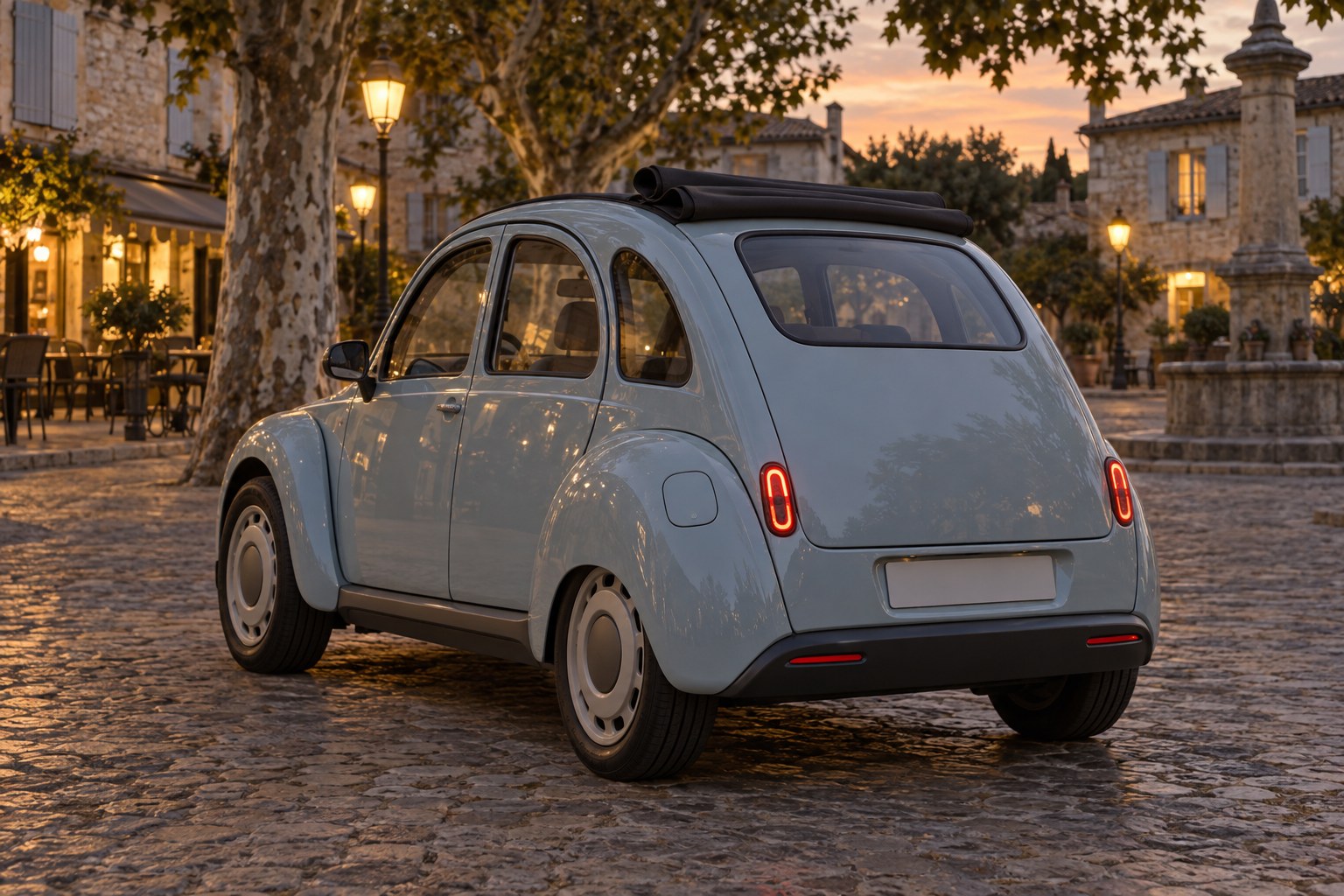
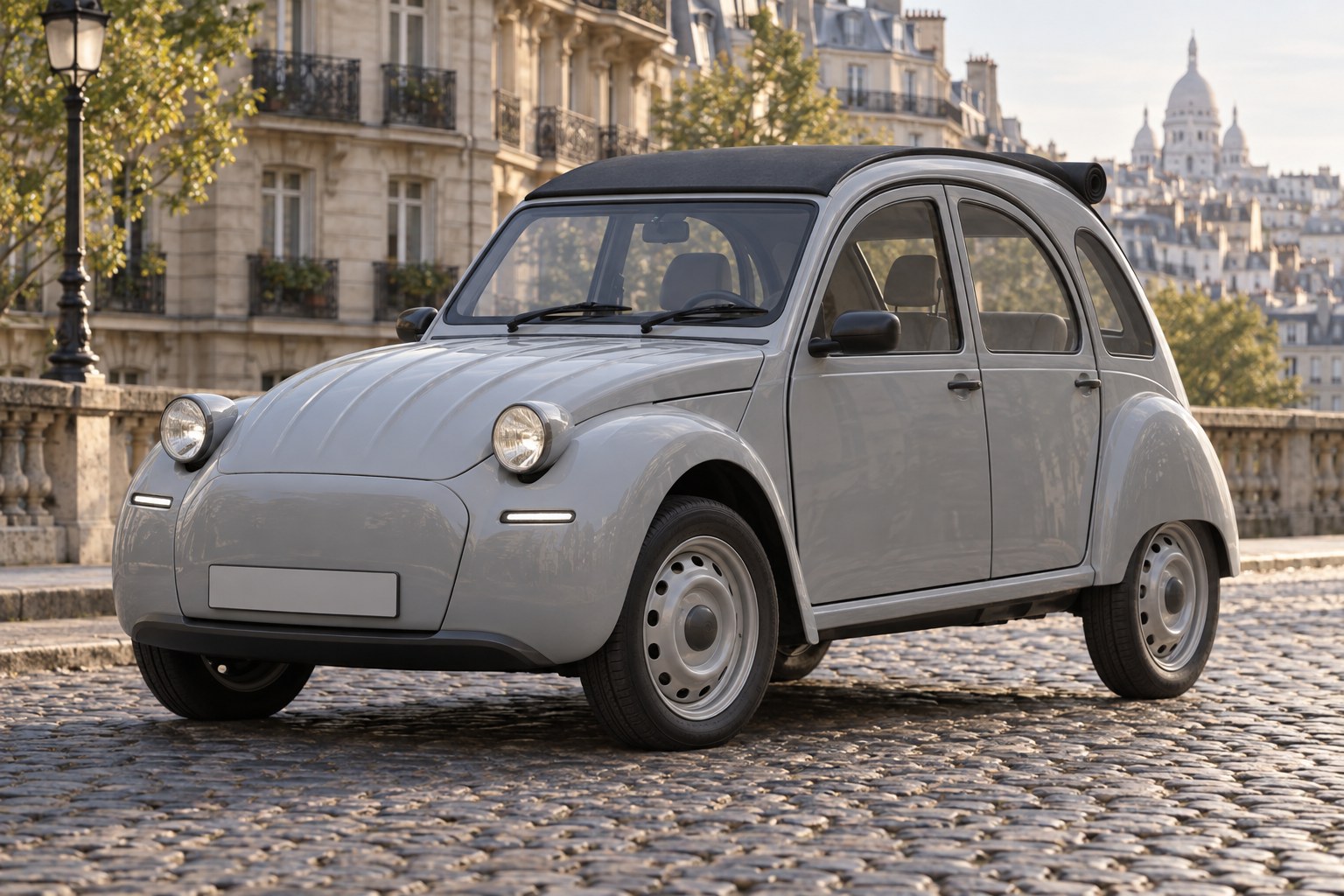
Illustrations for the article are renderings: this is how the new 2CV could look, judging by the dark official teaser. There are no real photos of the concept before 12 October.
Contents
- When the new Citroën 2CV will be shown and when it will go on sale
- What is officially known: platform, plant, price
- What the electric 2CV will look like according to the teaser
- How the new 2CV will differ from the 1948 original
- What this means for the buyer and what about accessories
When the new Citroën 2CV will be shown and when it will go on sale
The premiere date is known for sure. In the press release for the Paris Motor Show, Citroën says there will be two concepts on the stand: one “revives the brand’s icon” and brings the spirit of the 2CV into the present day; the other is being kept secret as a surprise. The press conference is scheduled for 12 October. The company is not disclosing specifications until that day — according to MotorsActu, deliberately, to preserve the wow factor of the presentation.
This will not be a production car but a concept — yet, as Chardon told the German outlet Autoflotte (as relayed by newmobility.news), it will be “very close to the production version.” Sales are planned for 2028 — exactly 80 years after the debut of the original 2CV at the same Paris show on 7 October 1948. Citroën has not said anything about Ukraine; so far, the only known detail is that the car will also be made with right-hand drive for the UK (as Chardon told Top Gear).
The announcement itself came on 21 May 2026 in Michigan, at Stellantis Investor Day. Chardon showed a short video: two horses run through the streets of Paris (2CV in French is deux chevaux, “two horses”), and at the end — a dark silhouette of the new car with its headlights on. His words: “In 1948, the 2CV gave freedom of movement to millions. Eighty years later, the new 2CV will make electric mobility accessible.”
What is officially known: platform, plant, price
There are not many confirmed facts, but they matter:
- Price — up to 15,000 euros excluding subsidies.
- Plant — Pomigliano d'Arco near Naples, where the Fiat Panda is assembled today. Stellantis is launching a family of cheap electric cars there from 2028; alongside the 2CV, a revived Fiat Panda will also appear on the same basis.
- Platform — new, shared with Fiat. “We are developing a new platform, and Fiat is also in the project,” Chardon told Top Gear. The press calls it E-Car; it is neither STLA Small nor the current “Smart Car” from the ë-C3.
- Class — European “E-Car”. The EU is preparing a separate category of small affordable Europe-built EVs with simplified requirements for driver-assistance systems. The only limit Chardon named with certainty is a length of up to 4.2 m. According to What Car?, the car will be even shorter than the original — about 3.7 m.
- Electric only. No hybrids and no range-extender generator versions are planned. At the same time, it will be a fully certified car with airbags and ESP, not a quadricycle like the Ami.
- European content — at least 70% of components.
Citroën has not named the battery or range. Chardon only joked to Top Gear that driving from Paris to Marseille in the new 2CV will take a long time, just like in the old one with its 20-litre tank, and that a top speed of 130 km/h will be available. According to newmobility.news, the press expects a small lithium-iron-phosphate battery of about 20 kWh and power well under 100 hp — this is an estimate, not a manufacturer statement. What Car?, citing Chardon, adds two more trim details: DC fast charging in the base version will be an option, and instead of full-width screens there will be a small display and three physical buttons for volume and climate.
What the electric 2CV will look like according to the teaser
The only official image is the darkened silhouette from the video. Autocar writes that the car retains the original’s “snail” profile, but in a modern manner like the recent Citroën ELO concept, which set the direction for the brand’s design. Hagerty made out in the teaser headlights that protrude slightly from the body (a nod to the old 2CV’s “eyes”), rounded fenders, an almost flat windshield, and an arched roofline. The rear wheel arch is normal and open: there will be no covered rear wheels like on the classic.
Citroën chief designer Pierre Leclercq told Top Gear that he used to be against neo-retro, but now “it would be foolish not to do it.” Chardon insists, however, that this is not nostalgia: “We are rethinking the original idea of the 2CV — affordable, simple, emotional mobility for as many people as possible. The new 2CV will deliberately not be overloaded with technology.”
Rumors worth keeping in mind until 12 October: What Car? writes about a possible return of the single-spoke steering wheel and a soft roll-back roof with manual operation (an electric one would make the car more expensive); it also mentions plans for a van version called Fourgonnette and, if there is demand, an off-road variant. Citroën has not confirmed these details.
How the new 2CV will differ from the 1948 original
To understand the scale, here is a comparison with the classic. In the concept column, only what has been stated officially or with a direct source reference is included; blank cells mean there is simply no data.
| Parameter | Citroën 2CV (1948–1990) | New electric 2CV |
|---|---|---|
| Premiere | Paris Motor Show, 7 October 1948 | concept — Paris, 12 October 2026; production — 2028 |
| Powertrain | two-cylinder air-cooled flat engine, initially 375 cm³ and 9 hp, later 602 cm³ | electric motor and battery; parameters not announced (the press expects around 20 kWh) |
| Top speed | about 65 km/h in early versions, up to 115 km/h in later ones | 130 km/h — according to Chardon to Top Gear |
| Length | 3,860 mm | up to 4.2 m by class rules; about 3.7 m according to What Car? |
| Curb weight | about 600 kg | not announced |
| Roof | canvas, rolled back | a soft roof is expected, not officially confirmed |
| Where it was / will be built | France (the last ones — Portugal, until 27 July 1990) | Pomigliano d'Arco, Italy |
| Production volume | 3,867,932 passenger cars and 1,246,299 vans | — |
| Price | “people’s car” in the lowest segment | up to 15,000 euros |
The original brief was: carry four people and 50 kg of cargo at 50 km/h on a dirt road — and take a basket of eggs across a ploughed field without breaking a single one. Chardon, speaking to What Car?, formulates the new brief almost in the same words: “The brief of the original 2CV was to make mobility accessible. It focused on the main benefit for the person and removed what was unnecessary. We apply the same philosophy to the new 2CV.”
What this means for the buyer and what about accessories
According to Chardon, by 2030 Citroën will make seven launches: five will be updates of current models, while the 2CV and one more car are meant to bring the brand into new niches. The logic is simple: by the estimate Chardon gave Autocar, Europe each year is short three million new-car buyers compared with pre-Covid times, and 60% of that drop is the disappearance of cars cheaper than 15,000 euros. The new 2CV will become the cheapest Citroën after the Ami quadricycle, positioned below the ë-C3; we have already written separately about the Citroën Ami itself.
Until 2028, it is too early to talk about model-specific accessories: nobody has seen the cabin dimensions or the shape of the arches yet. But the very concept — a cheap car without anything unnecessary — means that the owner will buy the basics separately. For that case, the catalogue includes universal solutions: car mats with a universal cut that you trim to fit the interior, and universal mud flaps — for a small city car they protect the sills no worse than OEM ones. Model-specific window deflectors for the new 2CV will appear only after the production launch; for now, everything for the brand’s current models is collected in the Citroën tuning section.
We deliver with Nova Poshta across Ukraine.