24.08.2026
156
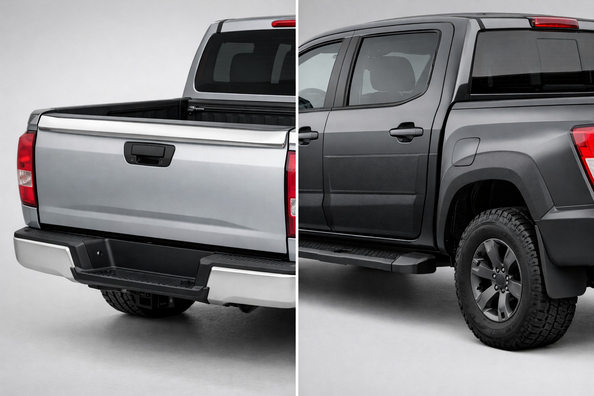
There’s no universal winner here, because these are parts with different purposes. If a pickup is regularly loaded, hauling tools, bags, boxes, or it already runs with a tonneau cover or canopy, a tailgate/bed-rail protector is more practical: it takes the contact right where the bodywork wears fastest. If the main risk is tight parking, neighboring doors, and shopping carts near stores, plastic door protectors will be more useful.
To avoid choosing wrong, it’s important to compare not the look, but the protection area, installation, compatibility, and real service life. In this article, “tailgate protector” means protection of the upper edge of the pickup’s tailgate, and “plastic protectors for the rear doors” refers to door moldings/guards against minor contacts.
A bed-rail or tailgate protector protects the load edge. This is where cargo slides, where straps and tie-downs hit, where boxes and everything you put into the bed make contact. This solution is about work and wear.
Plastic protectors for the rear doors work differently. They won’t save the tailgate and they don’t help during loading, but they do a good job catching minor side hits in city use. So the choice isn’t between “better” and “worse,” but between two types of risk: cargo use or parking dings.
| Option | Strengths | Weaknesses | Who it’s for |
|---|---|---|---|
| Bed-rail or tailgate protector | Protects the most heavily used edge of the body, takes scratches and minor hits during loading, often compatible with covers and tarps | Doesn’t help against door hits in the city, sometimes requires checking compatibility with a canopy, roller shutter, or bedside plastics | Work truck, frequent cargo hauling, mixed use with an emphasis on the bed |
| Plastic protectors for the rear doors | Better protect the sides from parking contacts, can look neat and close to an OEM-style solution | Only work where they’re installed, don’t protect the tailgate and don’t address wear in the cargo area | City pickup, frequent parking in tight places, owner wants to reduce the risk of minor dings |
DD Tuning expert comment: Most often, people make the mistake of buying a universal protector without checking the exact tailgate, model year, and compatibility with a canopy or roller shutter. The second typical issue is installing it on a cold body or without proper degreasing: at first everything looks fine, but over time the edge starts to lift. If you want long service life, not only the material matters, but also the geometry and installation conditions.
This is practical protection for a pickup that actually works. It covers the upper edge of the tailgate and part of the surface that regularly rubs against cargo. For commercial or weekend/DIY use, this is often the smartest protection point, because that’s where chips, scuffs, and small dents show up quickly.
Common materials include ABS, flexible composites, and similar plastics. The material itself matters, but it’s not decisive: if the shape is inaccurate or the tape is weak, even rigid plastic won’t deliver good service life. Installation is usually no-drill, but in cold conditions adhesion is noticeably worse, so it’s best to install this part on a clean, dry, warmed surface.
The weak spot of this option is compatibility. If the pickup already has a canopy, a roller shutter, bedside plastics, or other bed equipment, you need to check where the clips, seal, and the protector’s edge sit. Sometimes everything fits without issues; sometimes the fit needs adjustment.
Their job is different: not cargo, but side contact. In the city, they really make more sense if minor hits from other people’s doors are what bothers you. This is especially noticeable on tall pickups that are often left in tight courtyards, under the office, or near supermarkets.
Installation is also often adhesive-based. Here, accurate marking is critical: even a slight misalignment along the door line is very noticeable. Higher-quality vehicle-specific or OEM parts usually win on geometry, resistance to weather and washing, and reduced peeling.
As for noise, door protectors rarely make a noticeable difference if they sit flush. But don’t expect a single strip of plastic to save the entire door panel: if the impact hits above or below, it won’t stop the damage.
For a working pickup that’s loaded often, the answer is simple: a bed-rail protector is almost always more useful. It works every day and covers the area that quickly loses its appearance.
For a city pickup where the bed is used rarely and the vehicle spends more time in parking lots, it makes more sense to look at door protectors. They better match the real risk—accidental side contacts.
For mixed use, look not at advertising, but at the marks of real use. If the tailgate edge is already scuffed, prioritize a tailgate protector. If what bothers you most is minor touches on the doors, then moldings make sense. On the highway, the difference between these solutions is usually secondary, because these aren’t aerodynamic accessories, but local protection.
| Scenario | What to choose | Why |
|---|---|---|
| The pickup carries tools, building materials, gear every day | Bed-rail or tailgate protector | Protects the area in constant contact with cargo and reduces wear on the body edge |
| The vehicle mostly drives in the city and parks in tight spaces | Plastic protectors for the rear doors | Work better against minor door hits and side contacts |
| The pickup already has a canopy or a roller shutter is planned | Vehicle-specific bed-rail protector after checking compatibility | You need to avoid conflicts with clips, seals, and the fit on the tailgate/bed edge |
| Budget for only one accessory, and usage is mixed | Whatever covers the main risk in your specific use | Choose not by the part’s name, but by where the body actually takes damage |
A pricier option is justified when the pickup actually works, not just looks good parked. If the tailgate edge constantly contacts cargo, it’s better to consider not the cheapest universal piece, but vehicle-specific tailgate protectors with proper fitment and predictable installation.
If the vehicle lives more in the city and a clean body line matters, it makes sense to choose quality door protectors with no compromise in geometry and adhesive base. Here, the more expensive solution often wins not by “effect,” but by fitting straight, not annoying you, and lasting longer.
A separate case is a pickup with a closed cargo area. If you already have or plan a canopy, as well as a roller shutter or other equipment on the bed rails, it’s not worth saving on compatibility: a fitment mistake later costs more than the price difference itself.
From a customer’s experience: A pickup owner initially looked for door protectors because he parked in the city a lot, but on inspection it turned out the most damage was already not on the doors, but on the upper edge of the tailgate. In the end, he chose a tailgate protector because he loaded tools daily and that area suffered the most. He liked the result not for the looks, but because new contacts started landing on the plastic instead of the paint.
In short: for a working pickup, a bed-rail or tailgate protector is more practical; for city parking, plastic door protectors. These are not interchangeable accessories, and mistakes usually happen when someone chooses by the part’s name rather than by the type of damage the body actually gets.
The safest approach is simple: first assess your use scenario, then check compatibility, and only after that look at the price. This material is based on real selection experience, practical know-how, and real-life use cases—not abstract promises.
| ✔ | A bed rail or tailgate cover does a good job of protecting the edge that wears out the fastest during regular loading. For a work pickup, this is practical because it takes the impacts from cargo, straps, and boxes. |
| ✔ | Plastic rear door trims are useful in city driving, where the main risk is minor side impacts in parking lots. They suit this scenario better than protection for the cargo area. |
| ✔ | Both options can often be installed without drilling, which makes installation easier and does not interfere with the body. With proper surface preparation, this allows the accessory to be fitted quickly and neatly. |
| ✔ | On properly installed trims, the noise difference is minimal, so they do not create extra problems in everyday driving. If the part sits flush, it does not draw unnecessary attention while driving. |
| ✔ | Model-specific or branded solutions are usually more stable than universal ones because they fit the geometry and last better. This is especially important if there is a canopy, roller shutter, or other equipment that affects the fit. |
| ✘ | A bed rail or tailgate cover hardly helps against door dings in the city. If the vehicle is often parked in tight spaces, some risks remain unprotected. |
| ✘ | Plastic door trims work only within their own area and do not protect the side rail or cargo section. They do not solve wear issues where the pickup is actually loaded. |
| ✘ | Both options depend heavily on installation quality: on a cold or poorly degreased body, the edge may start to lift. In other words, the accessory itself does not compensate for installation mistakes. |
| ✘ | Universal parts without compatibility checks may conflict with a canopy, roller shutter, or other cargo-area elements. In that case, rework can end up costing more than the initial savings. |
Shipping to EU
Wholesale and retail
Own warehouse
Опис продукту
Подарунки не надаються при оформленні покупки у кредит під 0,01% або при покупці частинами.