 Author: Radomskyi Maksym Vasyliovych
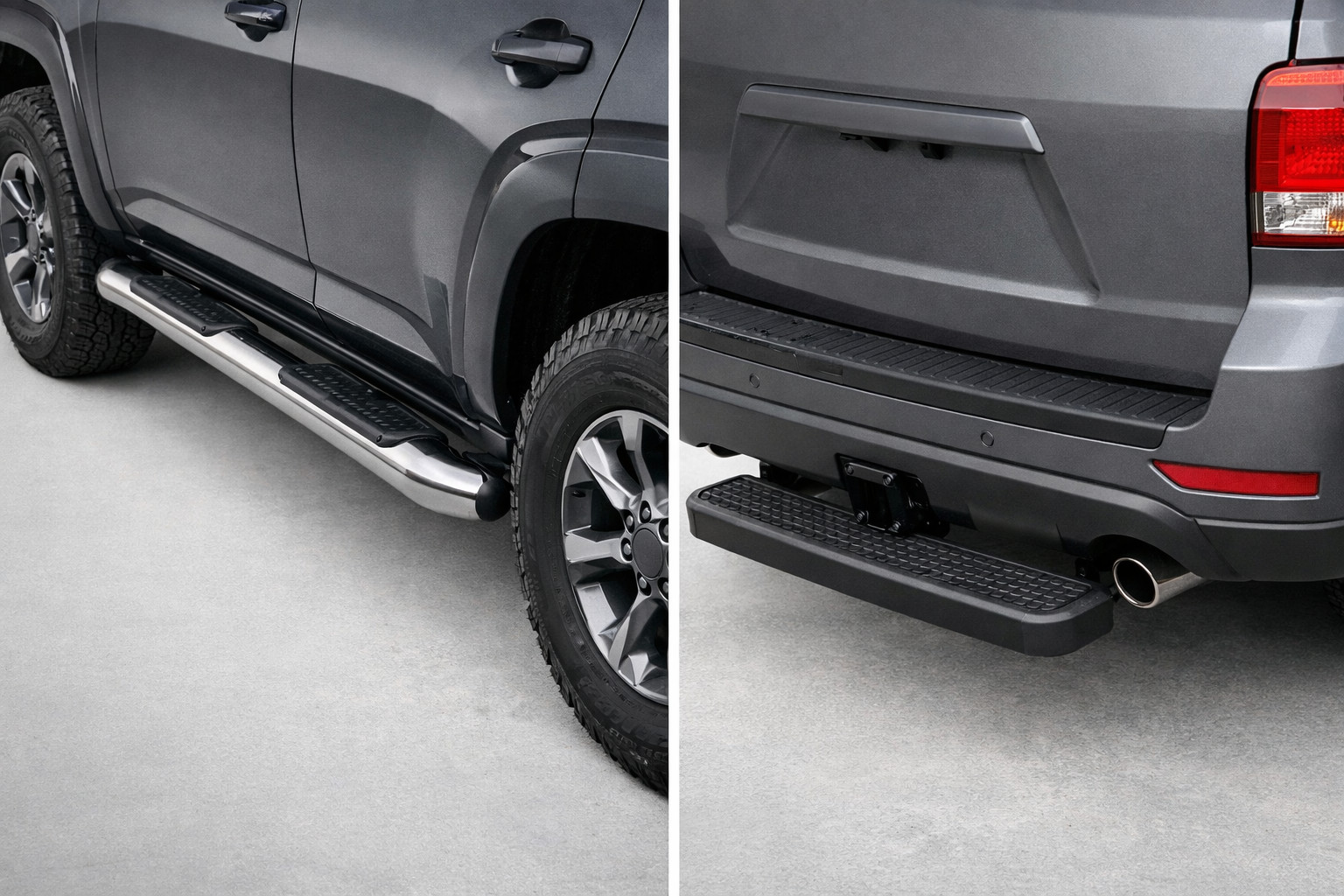
If the priority is getting into a tall vehicle comfortably every day, side tubes or running boards are more practical. If the main thing is quick access to the bed, tools, or cargo, a rear step is the more practical choice. For lifted pickups and large SUVs, the best compromise is often automatic side steps: a convenient step without constantly sacrificing ground clearance.
The typical mistake here is comparing looks instead of the task. A side solution works for the cabin, passengers, and roof access. A rear step solves a different task — access to the cargo area. That’s why these accessories are not interchangeable.
What the choice is really about
Side tubes, running boards, and steps help you get into the cabin along the full length of the doors. On a tall vehicle you feel this every day: less reaching, easier to place your foot, simpler access to a roof box. Another plus is partial protection of the rocker panel from shoes, sand, and minor impacts.
A rear step is useful where you constantly work at the back of the vehicle: pickup, van, expedition gear, heavy bags or boxes. It provides a lower foothold near the bed side or bumper, but it almost doesn’t help the driver and passengers when getting into the cabin. If you have a regular tall SUV without frequent cargo work, the rear option is often secondary.
Which criteria you should compare
- Installation. Fixed tubes are usually simpler. Automatic systems require more precise fitting, wiring, and more time.
- Noise. On fixed solutions, extra sounds usually appear only due to mounting play. Automatic ones have a motor, hinges, and a higher risk of squeaks or knocks when contaminated.
- Service life. The simpler the design, the more predictable the service life. Fixed tubes and rear steps are less demanding; moving mechanisms depend more on salt, ice, and dirt.
- Practicality. You need to honestly answer where you place your foot more often: into the cabin or into the bed. For a family vehicle it’s almost always side access; for a work pickup it’s often the rear.
- Price. Automatic side systems are usually the most expensive. If you only need access to the cargo area, overpaying for a full-length side solution is often unnecessary.
Quick comparison of options (table)
| Option | Strengths | Weaknesses | Who it suits |
|---|---|---|---|
| Fixed side tubes or running boards | Convenient for everyday entry, help reach the roof, often install without drilling | May reduce ground clearance, narrow versions aren’t always comfortable, can dirty clothing | Owners of tall SUVs, pickups, and vans where the cabin and daily comfort are the priority |
| Rear step | Works best for the bed or cargo area, simple and predictable in service life | Doesn’t solve cabin entry, on very tall 4x4s can still be too high | Those who often work with cargo, tools, the tailgate/bed side |
| Automatic side steps | Wide step, less loss of ground clearance, high rated load on quality systems | Most expensive, more complex to install, more sensitive to winter and dirt | Very tall and lifted vehicles, family use, frequent daily entry |
DD Tuning expert comment: the most common mistake is buying a rear step hoping it will make life easier for all passengers. In reality it works only at the back, and the cabin entry issue remains. The second typical story is choosing side tubes by diameter only, without checking step width and the real drop relative to the rocker panel.
Detailed breakdown of each option
Fixed side tubes and running boards
This is the most straightforward solution for a tall vehicle. It works every time you open the door: for the driver, the passenger, kids in the second row. On wide oval or full-size running boards, the support area is better than on narrow tubes or compact OEM-step solutions. Installation is usually the easiest, and noise is almost never a surprise if the mounts aren’t loose.
The main downside is geometry. A fixed element constantly hangs below, so in ruts, at curbs, and off-road it can become the first contact point. If the vehicle is tall but often drives on bad roads, this downside must be evaluated very realistically.
Rear step
This is a narrow-purpose but very useful solution for those who truly work at the back of the vehicle. When you need to climb into the bed several times a day, grab a box, or pull up cargo, a lower rear foothold is more practical than stepping on the bumper. In terms of service life it’s usually a calm option: simple design, minimal mechanics, minimal reasons for extra noise.
The weak point isn’t reliability but the use case. If you rarely use the bed, the rear step quickly moves into the “nice to have” category. On lifted 4x4s it also doesn’t always deliver the effect people expect, because the mounting point itself may still be too high.
Automatic side steps
This is the expensive answer to the main drawback of fixed solutions. When the doors are closed, the step tucks under the body and doesn’t take away as much ground clearance. When the door opens, you get a wide step; on strong systems the rated load reaches 272.2 kg per side, and on specialized winter versions it’s even higher.
But you pay not only with money. You need a motor, electrics, precise alignment, and winter care. If the vehicle constantly drives through salty slush and nobody washes the mechanism, a simple fixed tube will stay predictable longer.
Which option is better for different scenarios
For a family tall SUV where kids and adults get in daily and someone often reaches up to the roof, side running boards almost always win. Here it’s not only the presence of a step that matters, but also its width.
For a work pickup or van where the main action is access to cargo, a rear step is more practical in terms of benefit-to-cost. If you need to choose only one accessory, you shouldn’t buy side tubes instead of what you actually need at the rear.
For a lifted vehicle you want to keep capable, fixed tubes are a compromise. If the budget allows and entry matters every day, automatic side steps give the best balance between convenience and ground clearance.
Use case and what to choose (table)
| Scenario | Best choice | Why |
|---|---|---|
| Daily city use of a tall SUV | Side running boards or tubes | The benefit is felt at every entry, not only at the trunk |
| Pickup for tools, boxes, building materials | Rear step | Fastest way to simplify access to the bed and working with the tailgate/bed side |
| Lifted pickup or SUV where ground clearance is precious | Automatic side steps | They tuck away while driving, and provide a proper step when getting in |
| Family vehicle with kids and elderly passengers | Wide side running boards | Support area matters more than simply having a tube |
| Occasional trips with minimal cargo-area work | Side tubes | A rear step will sit unused, while side access will be useful constantly |
Common mistakes when choosing
- Mixing up the tasks. A rear step doesn’t replace a side running board, just like a side running board doesn’t provide convenient access to the bed.
- Looking only at tube diameter. What matters for your foot is step width, pad shape, and the real drop.
- Ignoring ground clearance. In ruts or on steep exits, a fixed running board can be the first thing to snag.
- Underestimating winter. Moving systems need more attentive care than fixed ones.
- Not checking compatibility. Model year, body style, bumper, tow hitch, and factory trim affect installation more than it seems.
- Expecting complete silence without maintenance. If play appears, the noise won’t go away by itself.
When a more expensive solution makes sense
Paying extra is justified when the vehicle’s height truly gets in the way every day: the family constantly gets into the cabin, the vehicle is lifted, and you don’t want to lose ground clearance. In that case it’s worth looking at an electric step: it gives a convenient step only when getting in, and tucks away while driving. If you need a simpler fixed stainless solution without extra mechanics, it makes sense to compare OMSA solutions.
A more expensive solution also makes sense when a comfort mistake will be felt daily: kids, elderly passengers, frequent roof access, a taller body after a lift. But if your main task is to climb into the bed once in a while, it’s smarter to invest specifically in a rear step rather than pay for a full-length side solution. For difficult cases with bad roads, it’s useful to separately weigh the difference between geometry and practicality in the article about heavy-duty rock sliders and regular steps.
From a customer’s experience: an owner of a lifted pickup initially wanted a rear step because he often carried things in the bed. After clarifying the scenario, it turned out kids get into the cabin every day, while the bed is used a few times a week, so he chose automatic side steps. As a result, the main discomfort disappeared during entry, and bed access remained acceptable even without a separate rear solution.
Conclusion
In blunt practicality terms, for most tall vehicles side tubes or running boards are more useful because they work every day and for all doors. A rear step wins when the vehicle is regularly used as a work tool and the key task is the bed or cargo area. The most expensive, but often the smartest compromise for lifted vehicles, is automatic side steps.
The main thing is not to buy an accessory “just in case,” but to tie it to the real action you repeat most often. This material is based on real selection experience, practice, and real usage scenarios, so the logic is simple: cabin — side solutions, bed — a rear step, daily comfort without losing ground clearance — automatic steps.
How it works
- Define the main task First, honestly figure out what you do more often: getting into the cabin or working with the body. For everyday entry into a tall vehicle, side tubes or side steps are more useful, while for access to the cargo area — a rear step.
- Assess the vehicle type and use case For a family SUV, where children and adults often get in, or you need to reach the roof, it is better to look toward a side solution. For a pickup, van, or a vehicle regularly used with tools and cargo, a rear step will be more practical.
- Compare the options by installation, noise, and durability Fixed side tubes are usually easier to install and less demanding. Automatic side steps are more complex, require electricity and maintenance, but they tuck away while driving and reduce ground clearance less.
- Check whether ground clearance and off-road capability will be affected If the vehicle often drives on bad roads or off-road, a fixed step may catch first. In such cases, automatic side steps provide a better balance between convenience when entering and preserving off-road capability.
- Avoid common mistakes before buying Do not choose an accessory based only on appearance or tube diameter. Check the step width, compatibility with the body and bumper, and also keep in mind that a rear step does not replace a side solution for getting into the cabin.
- Choose the solution according to your priority If you want everyday comfort for passengers — choose side running boards or tubes. If the main goal is access to the cargo area, install a rear step. If the vehicle is very tall and it is important not to lose ground clearance, the best compromise will be automatic side steps.
Pros and cons
Side bars, rocker panels, or running boards are convenient for daily entry into a tall vehicle: it’s easier to place your foot, you don’t have to reach as far, and it’s simpler to get to the roof. For a family vehicle, this is more practical because the benefit is felt every time the door opens.
Fixed side solutions are usually easier to install and more predictable in use. The article also notes that they are less sensitive to salt, ice, and dirt than moving mechanisms.
A rear step is very useful for a pickup, van, or a vehicle where the cargo area is used all the time. It provides a more convenient lower foothold near the side or bumper when you need to climb into the bed frequently.
Automatic side steps are the best compromise for lifted vehicles: while driving they retract and reduce loss of ground clearance, and when getting in they provide a wide step. This is especially convenient if the vehicle is tall but you need to get in every day.
Wide side rocker panels provide a better standing surface than narrow tubes. This is important for children, elderly passengers, and everyday entry, where comfort depends not on appearance but on step width.
Fixed side tubes or side steps can reduce ground clearance and be the first to hit ruts, curbs, or off-road obstacles. For a vehicle that often drives on bad roads, this is a noticeable drawback.
A rear step does not solve the problem of getting into the cabin. If the vehicle is used mainly for passengers, it quickly becomes secondary and does not provide noticeable everyday benefit.
Automatic side steps are the most expensive and harder to install because they require electricity, a motor, and precise fitting. Because of this, choosing them is not always justified, but only when everyday convenience and preserving ground clearance really matter.
Moving mechanisms are more affected by winter, salt, ice, and dirt, and can squeak or rattle when dirty. Without maintenance, they are less predictable than simple fixed solutions.