 Author: Radomskyi Maksym Vasyliovych
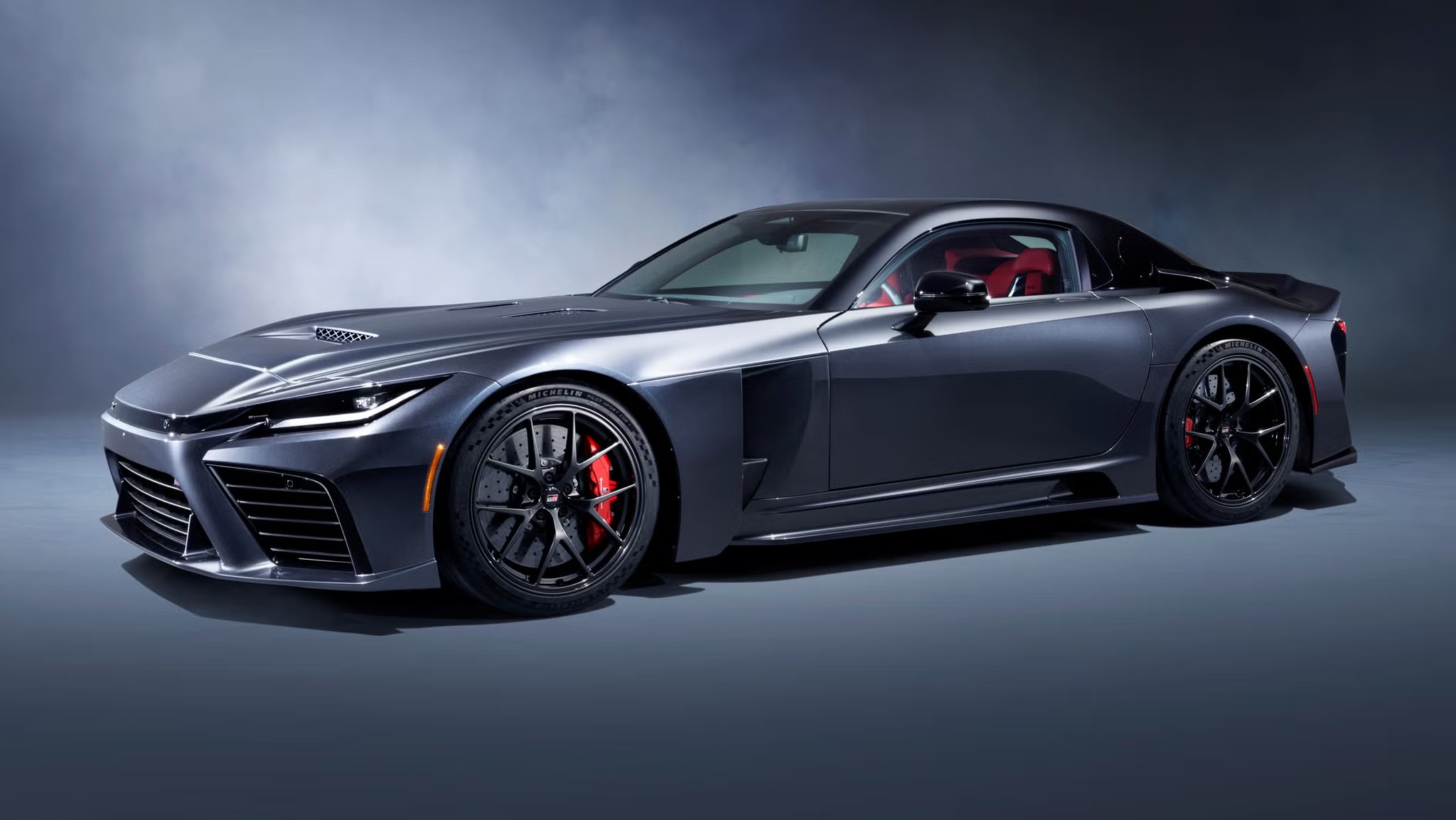
Toyota GR GT has already moved beyond the abstract teaser stage: on December 5, 2025 the manufacturer officially presented it in Tokyo as a prototype, with a stated launch around 2027. What we have is a 2-seat, front-engined, rear-wheel-drive supercar with a new V8 hybrid, positioned not as a comfort-focused grand tourer but as a road car built with racing logic.
The key point is simple: the manufacturer has officially confirmed the architecture, layout, powertrain type, gearbox, and target development figures. But the battery, exact production output, production volume, final price, and sales markets have not yet been announced, so some conclusions have to be framed as a cautious forecast.
What has already been shown (status: concept / prototype / pre-production / official reveal)
The manufacturer has officially confirmed that this is a prototype—neither a production car nor just a show car. Alongside it, GR GT3 and a philosophy-related Lexus concept were shown, but it’s important not to mix these projects: the road-going GR GT is a separate model, and all numerical parameters for it currently have the status of development targets.
| What’s known | What’s expected | What’s unknown |
|---|---|---|
| GR GT was officially shown on December 5, 2025 as a prototype. | The production version will retain the overall idea of a hardcore road supercar. | How close the lighting and aerodynamics will be to the prototype. |
| Confirmed: 2 seats, front engine, rear-wheel drive, and a new aluminum architecture. | Most likely, production will be limited and access won’t be mass-market. | The exact production volume and the quota allocation scheme. |
| Official targets: 650 hp+, 850 Nm+, 320 km/h+, curb weight up to 1750 kg. | In the author’s view, 0–100 km/h will be around 3 seconds. | Final certified performance, consumption, and real-world range. |
| Launch is planned for roughly 2027. | According to preliminary information, the first markets could be Japan and North America. | Final price, order start date, and the full list of markets. |
Platform and construction
The most interesting thing about GR GT isn’t just the engine, but the base. Toyota talks about a new race-derived architecture, shared in principle across GR GT, GR GT3, and the LFA concept, but for the road model it separately emphasizes an all-aluminum body frame. That’s an important signal: this is not a reworked production platform, but a dedicated chassis designed for high stiffness, a low center of mass, and precise balance.
The layout is telling as well: a big engine up front, but a rear transaxle and a 45:55 weight distribution suggest the engineers are deliberately pushing the car toward track stability. In real use, that should deliver composure at speed, strong drive on corner exit, and less of a “heavy nose” feeling than you might expect from a classic front-engined coupe.
Powertrain (ICE / hybrid / EV) — confirmed and expected
The manufacturer has officially confirmed a new 4.0-liter V8 with two turbochargers, a dry sump, a single electric motor, and a new 8-speed automatic gearbox. Also stated: a wet launch clutch instead of a torque converter, a mechanical limited-slip differential, and a rear transaxle. In terms of how it should feel on the road, this setup isn’t about electric economy, but about fast response, dense torque delivery, and stable operation under load.
It’s still unknown whether this will be a plug-in hybrid. Since the manufacturer hasn’t stated that, the author considers it more logical to expect a compact hybrid system with a small battery that helps with launch, pickup after a corner, and smoothing turbo lag, rather than providing a long EV-only mode.
DD Tuning expert comment: The most common mistake with prototypes like this is choosing wheels, brake solutions, or body components before production part numbers exist. On cars with large carbon-ceramic brakes and non-standard wheel geometry, even a few millimeters decide compatibility. It’s better to wait for the final hub, caliper, and mounting dimensions than to rely on premiere photos.
Design and interior
Visually, GR GT is built around the principle of “aerodynamics first”: a long hood, a low roofline, a very wide stance, and a short glasshouse. The dimensions of 4820 × 2000 × 1195 mm show that this is no longer a Supra-sized sports coupe, but a full-size supercar body with a big footprint on the road. If you need a reference point to the brand’s current sports coupe, it’s worth recalling the Toyota Supra V generation, but GR GT sits noticeably higher—both in size and ambition.
The interior hasn’t been fully revealed yet, so some assumptions are necessary. Most likely, the cabin will be highly functional: a low seating position, a massive center tunnel, clear digital telemetry, minimal decorative solutions, and more focus on visibility, body support, and handwork than on luxury trim.
Stated and expected specs
According to official development targets, GR GT should deliver 650 hp or more, 850 Nm or more, reach 320 km/h, and weigh no more than 1750 kg. Double-wishbone suspension front and rear, carbon-ceramic brakes, Michelin Pilot Sport Cup 2 tires, and a 45:55 balance make it clear the car is already tuned for a fast pace rather than a soft daily mode.
At the same time, this is not a final specification. 0–100 km/h, fuel consumption, range, and hybrid behavior under sustained load haven’t been officially announced. In the author’s view, if the weight is truly kept within the stated limit, performance will be on par with serious modern supercars, but the decisive factors will be thermal resilience and repeatability over several quick laps—not peak power.
Competitors and positioning
In essence, this is a car between a track-focused special tool and an expensive road supercar. It doesn’t follow the pure mid-engine exotic format, but it has a chance to occupy a very rare niche: a front-engined hybrid supercar with hard racing logic and limited production.
| Model | What it’s strong at today | Where GR GT could answer |
|---|---|---|
| Aston Martin Vanquish | A powerful grand tourer with a big engine and a prestige-forward presentation. | A similar architectural idea, but with a harder track emphasis and hybrid boost. |
| Ferrari 296 GTB | A light mid-engine hybrid with very high performance. | Toyota is unlikely to replicate its format, but could offer a different character: more stability and mechanical feel. |
| Ford Mustang GTD | A road-legal track car with a transaxle and very aggressive aerodynamics. | This is where GR GT looks closest ideologically. |
| McLaren 750S | Low weight, very lively response, and true supercar pace. | GR GT will likely respond not with lightness, but with the combination of V8, hybrid, and high-speed stability. |
| Porsche 911 GT3 RS | The benchmark for track precision among production road cars. | Toyota can play the exclusivity and torque cards, but precision still has to be proven by the production car. |
Release date, markets, and indicative price
Officially, only a rough reference has been given: around 2027. It’s still unclear whether that means the start of production, the start of sales, or the first customer deliveries. The manufacturer also hasn’t disclosed launch markets; according to rumors, Japan, the USA, and Canada could be first via selected GR or Lexus channels.
The price picture is even more vague. The lower end of market estimates starts at around $225,000, but other assumptions go much higher. So for now, the honest way to put it is: this car definitely won’t be cheap, but final positioning will only be shown by the production announcement and the actual production volume.
What’s still unknown
The list of open questions for GR GT is still long, and it’s exactly what separates a strong prototype from a clearly defined production model.
- Battery capacity, chemistry, and the operating principle of the hybrid portion.
- Whether there will be plug-in charging, or a conventional hybrid without external charging.
- Final power, weight, aerodynamic package, and noise regulations for the production version.
- Production volume, markets, sales process, and the service model for owners.
- Real-world fuel consumption, range, and behavior off-track.
From a customer’s experience: one typical request in stories like this isn’t about ordering the future model itself, but about understanding the ownership scenario. The person initially wanted one expensive sports car for everything, but after a practical breakdown concluded that a GR GT-level car makes more sense as a separate weekend vehicle rather than the only sporty machine in the garage. That removes inflated expectations around comfort, tire life, and daily usability.
Expectations (conclusion)
In the author’s view, Toyota is aiming very high: if the dry sump, rear transaxle, weight up to 1750 kg, and an honest V8 hybrid without excessive electronic softness make it to production, GR GT could become one of the most interesting front-engined supercars of the decade’s second half. But for now, this is expectation—not a promise: production specs have not yet been officially announced.
The material is based on real selection experience, practical know-how, and real usage scenarios, so the main takeaway is simple: GR GT already looks technically very strong, but it should be judged not by the wow effect of the premiere, but by what Toyota preserves by the time of the production launch.