14.08.2026
150
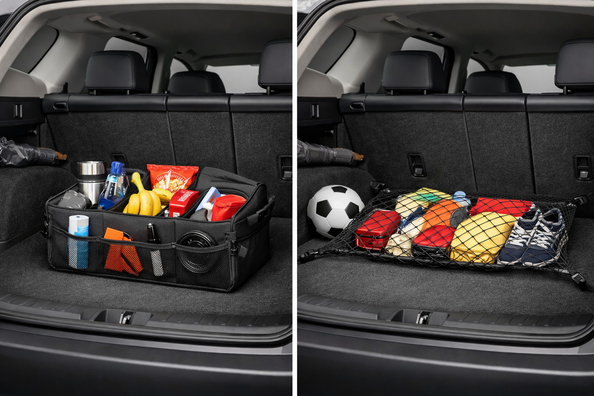
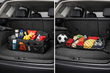
If your trunk carries groceries, bottles, car chemicals, kids’ items, or small tools every day, an organizer is more convenient. If you just need to keep 1–2 light bags from sliding around without permanently taking up space, a trunk cargo net is simpler and cheaper.
The difference isn’t which one is “better” overall, but how they handle cargo. A net only restrains items, while an organizer divides the space and keeps things separate. For a daily driver, this affects order, trunk noise, and whether something tips over in a turn or during hard braking.
A trunk cargo net wins where a minimalist solution is needed: quick to install, quick to remove, and it barely reduces usable trunk volume. It works well for light shopping bags, small purchases, and items that simply shouldn’t roll around on the floor.
An organizer wins when you need not just to hold things, but to sort them. Bottles, household cleaners, a car kit, wipes, chargers, a pump, kids’ small items, or snacks for the road stay separated and don’t mix together. That’s why for most everyday trips it’s more practical.
| Option | Strengths | Weaknesses | Who it’s for |
|---|---|---|---|
| Trunk cargo net | Fast installation, barely takes up space, good for light bags and small items | Depends on mounting points, weak for heavier items, doesn’t protect from spills and dirt | For those whose trunk is empty most of the time and only need basic restraint |
| Soft trunk organizer | Divides space, folds up, convenient for daily shopping and a small set of items | Cheap models crease, slide, and can be noisy without a non-slip bottom | City cars, family trips, everyday use |
| Rigid trunk organizer | Better secures bottles, tools, boxes; performs better over potholes and during sharp maneuvers | Takes up more volume, more expensive, less flexible for loading | For those who carry mixed or heavier small cargo and want stability |
DD Tuning expert comment: Most often people choose a net just because it’s cheaper, and then try to secure a jerrycan, car chemicals, or a tool set with it. Another common mistake is buying an organizer without a non-slip bottom and expecting it not to slide around the trunk. If you carry different items every day, it’s smarter to look not at the price itself, but at the rigidity of the construction and the anchoring method.
Its main advantage is speed. A net installs in a minute, folds compactly, and stays out of the way when you don’t need it. For a few grocery bags, wipes, small accessories, or light luggage, this is often enough.
But a net doesn’t create compartments and doesn’t hold its shape. If your trunk carries bottles, tools, household chemicals, or anything that can tip over, it only partially limits movement. Another nuance is compatibility: if the car doesn’t have convenient mounting points, you may not get a good result.
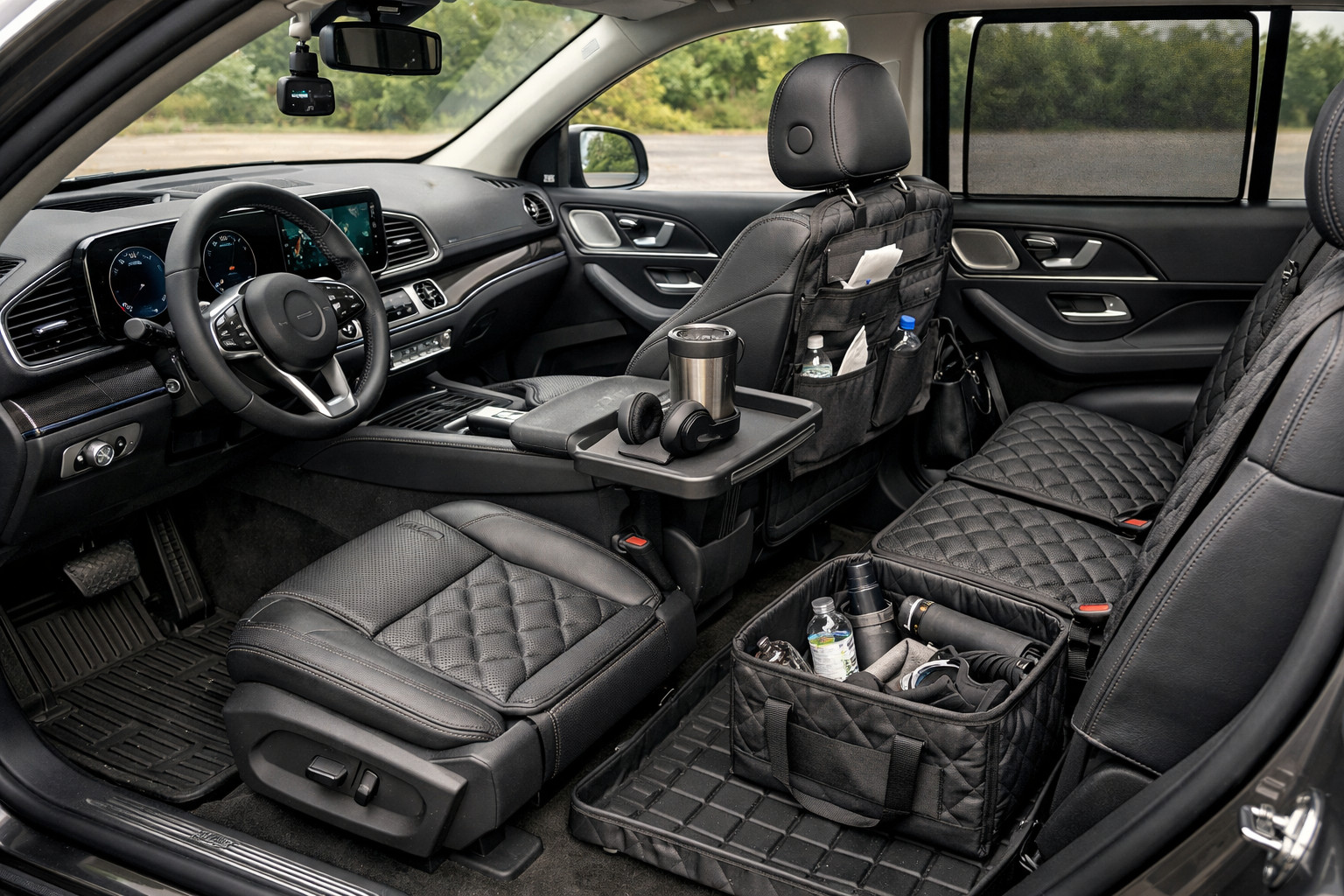
This is the most convenient format for the city. It separates groceries, keeps items upright, often has dividers and handles, and doesn’t take much space when folded. For an everyday set like water, chargers, gloves, a car kit, and small purchases, it’s more practical than a net.
The weak point of soft models is stability. If the sidewalls are too soft and the bottom is slippery, the organizer itself starts shifting, especially over potholes. So it’s worth looking not only at the number of compartments, but also at the bottom, seams, and the presence of straps, Velcro, or other anchoring.
The rigid option is better for items that need to stand upright: bottles, car chemicals, tools, boxes, consumables. It holds its shape better, handles hard acceleration and braking better, and is usually easier to clean after dirt or small spills.
Its downside is that it’s less flexible. If the trunk is small or you often carry large items, a rigid organizer can get in the way. So it makes sense not by itself, but when the car constantly carries a work or family set of items that needs to stay stable.
For daily shopping, short city trips, and family use, an organizer almost always wins. It prevents bottles from falling over, separates fragile items from heavier ones, and reduces chaos when the trunk carries bags, a car kit, and small items at the same time.
If your trunk is empty most of the time and the task is simply to secure bags after the supermarket once in a while, a net is more logical. It doesn’t permanently take up space and doesn’t force you to work around its shape.
For tools, service items, winter chemicals, wet items, or trips on rough roads, a stiffer organizer works better—and ideally an organizer plus a net as an auxiliary element. A net complements the system well, but rarely covers all everyday tasks on its own.
| Scenario | What to choose | Why |
|---|---|---|
| Daily shopping, bottles, household chemicals | Soft or rigid organizer | It divides cargo into sections and prevents items from tipping over and mixing |
| Trunk is almost always empty, occasionally 1–2 bags | Trunk cargo net | Minimal space taken, quick installation, and sufficient restraint for light items |
| Tools, car kit, consumables | Rigid organizer | Holds shape, weight, and order better for small but heavier cargo |
| Wet items, winter fluid, dirty gear | Rigid organizer | Easier to contain dirt and clean up than after using a net alone |
| Highway, potholes, gravel roads, frequent sharp maneuvers | Organizer with anchoring, plus a net if needed | A stiffer body and mounting control contents better, and a net can help with light bags |
A more expensive organizer is justified when it truly works every day: the car constantly carries mixed cargo, liquids, kids’ items, tools, or the trips aren’t only around the city. In that case, you’re paying not for status, but for stiffer walls, a stable bottom, better anchoring, easier cleaning, and a lower chance that everything will get mixed up after the first pothole.
The most practical compromise for a daily driver is an organizer plus a net as auxiliary restraint. To build a system without unnecessary purchases, it’s worth first looking at trunk organization, and a separate useful piece on choosing an organizer; and for wet and dirty items, you’ll often also need rubber trunk mats.
From a customer’s experience: a driver was looking for a solution for daily shopping, kids’ items, and small tools. He first installed only a net, but bottles and car chemicals still tipped over in turns, so he switched to a foldable organizer and kept the net for bags on the side. As a result, the trunk didn’t become less spacious, but small cargo stopped mixing and rattling.
For most everyday trips, a trunk organizer is more convenient because it doesn’t just restrain items—it keeps them organized. A trunk cargo net makes sense as a simple, quick, inexpensive solution for light bags or as an addition to an organizer, but rarely as the only tool for every day.
In short: if you carry few items and want to keep maximum free space, choose a net; if you regularly transport groceries, bottles, car chemicals, or a set of small gear, choose an organizer; if you want the most convenient everyday setup, combine both. This conclusion is based on real selection experience, practical use, and real-life scenarios—not just a formal feature comparison.
| ✔ | The organizer is better suited for everyday trips with varying cargo: it separates groceries, bottles, car care products, and small items into compartments, so they don’t mix together or fall over in corners. |
| ✔ | A rigid organizer holds its shape well over potholes and during hard braking, so it secures bottles, tools, and boxes more steadily than a net. |
| ✔ | For wet, dirty, or spillable items, an organizer is more practical because it contains the mess in one place and is easier to clean up. |
| ✔ | A trunk net is convenient when you only need to keep 1-2 light bags in place from time to time: it installs quickly, takes up almost no space, and doesn’t make trunk access more difficult. |
| ✔ | When folded, a soft organizer doesn’t take up much space, but it provides more order than a net when small purchases, chargers, gloves, or a car kit are regularly carried in the trunk. |
| ✘ | The net depends on the factory hooks or rings in the trunk, so without convenient mounting points it may work only moderately well. |
| ✘ | The net doesn’t create separate compartments and is not well suited for heavier or unstable items such as bottles, car care products, or tools. |
| ✘ | Cheap soft organizers can wrinkle, slide, or rattle if they have a weak base and no proper fastening. |
| ✘ | A rigid organizer takes up more space and is less flexible when loading, so in a small trunk or when transporting large items, it can get in the way. |
Shipping to EU
Wholesale and retail
Own warehouse
Опис продукту
Подарунки не надаються при оформленні покупки у кредит під 0,01% або при покупці частинами.