20.09.2026
103
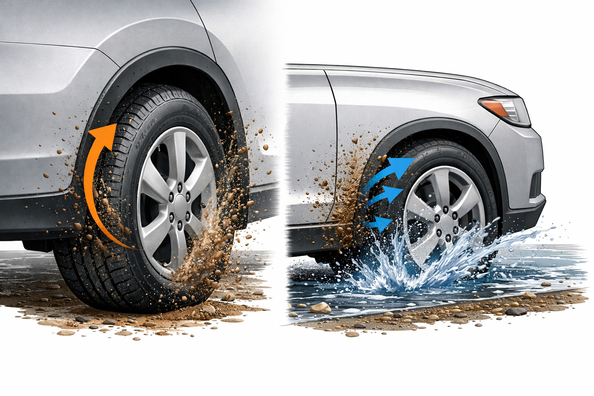
Dirt along the sides of a car after rain almost never comes from “the whole road” — it mostly comes from the front wheels. The tire picks up water, fine sand, and road dust, and the airflow near the wheel arch presses this mix onto the sills and the lower part of the doors. That’s why even a freshly washed car can quickly get a dark stripe along the side.
Completely eliminating this effect usually isn’t possible, because it depends on water on the asphalt, speed, tire shape, and the body itself. But if you correctly identify the source of the dirt, you can noticeably reduce the mess without unnecessary expense.
When a wheel rolls over a wet surface, it doesn’t just throw water backward. Part of the water film and dirt is carried by the tread, part is pushed sideways, and then all of it is picked up by the airflow in the wheel-well area. That’s why the dirtiest sections are usually seen from the front arch to the middle of the door and the sill.
The situation gets worse in rain, slush, and in winter, when water mixes with salt, dust, and de-icing chemicals. This mixture is stickier, dries longer, and clings better to paint, liners, and body seams.
DD Tuning expert comment: a typical mistake is looking for one part that will completely eliminate dirt. In real-world подбор, the best results come from a combination: a proper front mud flap, an intact liner without misalignment, and a clean arch without caked-on sand. Another common issue is installing a universal mud flap too high or crooked, so it barely intercepts the spray.
| Symptom | Likely cause | What to do |
|---|---|---|
| Dirt forms a stripe right behind the front arch | Main spray from the front tires, weak or missing front mud flap | Start with front mud flaps, check arch cleanliness and the liner shape |
| After highway driving the sides are much dirtier than in the city | High speed and a thick water film on the road | Don’t expect full elimination, but reduce it with proper mud flaps and clean arches |
| Lots of wet sand, leaves, and salty deposits inside the arch | The arch and underbody haven’t been washed for a long time | Thoroughly wash the arches, underbody, seams, and hidden cavities |
| Paint scuffs or rubbing marks visible near the arch | Liner shifted, broken fastener, or incorrect fitment | Realign the part, replace the fasteners or the liner itself |
| The front is a bit cleaner, but the rear side and bumper are constantly dirty | Air turbulence behind the body and the work of the rear wheels | Rear mud flaps may help partially, but won’t remove the effect completely |
The best practical results usually come from front mud flaps if the main dirt stripe starts at the front arch. The front wheels are most often the main generator of dirt along the sides of the car.
The second important step is intact and clean wheel-arch liners. If they’re packed with sand, deformed, or installed crooked, the water flow exits the arch with less control. Also, dirt in seams holds moisture longer.
The third thing that really works is regular washing of the arches and underbody during the rainy season and in winter. Washing just the outside of the doors doesn’t change much if the dirt source remains in the arches.
It also helps to have realistic expectations about speed: on a wet highway, even a good set of accessories won’t keep the sides dry, but it can noticeably reduce how much dirt sticks and how wide the stripe is.
If the dirt starts at the front arch, it makes sense to look at mud flaps — they most often deliver the first noticeable effect. If the arch lacks rigidity, has cracks, or broken clips, you should check the wheel-arch liners, because a misaligned liner not only holds back dirt poorly, it can also rub the paint.
When a car is driven both in the city and on the highway, and roads are often wet or dirty, it’s useful to separately figure out how to choose mud flaps for your conditions. Accessories make the most sense when the factory setup clearly can’t cope — not when expectations are simply too high.
| Solution | When it works | When it’s not worth spending money |
|---|---|---|
| Front mud flaps | When the dirt stripe starts at the front arch and runs along the sill and doors | If the liner is misaligned or the arch is clogged with dirt, fix that first |
| Rear mud flaps | When the rear bumper and the area behind the rear wheel get very dirty | If most of the dirt comes from the front wheels, the effect will be secondary |
| Replacing liners or fasteners | When the part is cracked, coming loose, or touching the fender | If the liner is intact and properly installed, and the issue is typical for a wet highway |
| Regular washing of arches and underbody | When sand, salt, and wet dirt build up in the arches | Don’t treat it as the only solution if mud flaps are missing |
| Protective body coating | When you want to wash the sides more easily after rain | If you expect it to stop dirt from sticking |
| Switching to less “aggressive” tires | When the set is due for replacement anyway, and the current tires clearly throw a lot of water | If you’d be replacing them only for a small reduction in spray |
From a customer’s experience: after every rain, the person ended up with a black sill and lower door area, even though they washed the body regularly. During inspection, it turned out the front mud flaps were missing, and a dense layer of sand had accumulated in the arches. After installing proper front mud flaps and washing the arches, the problem didn’t disappear completely, but the dirt stripe became much narrower and the car needed washing less often.
If dirt from the wheels keeps sticking to the sides of your car after rain, in most cases the cause is simple: the front tires lift water and sand, and the airflow near the arch smears it over the sills and doors. Front mud flaps, serviceable liners, clean arches, and regular underbody washing help most often — but there’s no magic way to remove it completely.
This material is based on real подбор experience, practice, and real usage scenarios: the best results come not from one single part, but from the right combination of accessories, sound mounting hardware, and proper care of the wheel wells.
| ✔ | The main source of dirt can be identified quickly: if the streak starts from the front wheel arch, the problem is mostly with the front wheels and the lack of protection around them. This helps avoid wasting money on random solutions. |
| ✔ | Front mud flaps really do make a noticeable difference, especially when dirt is thrown onto the sill and lower part of the doors. The article directly notes that they often reduce the width of the dirty streak. |
| ✔ | Clean and intact wheel arch liners are important not only for reducing dirt, but also for preventing paint rubbing. If an element is misaligned or broken, it can be identified by wear marks near the wheel arch. |
| ✔ | Regular washing of the wheel arches and underbody helps reduce the buildup of sand, salt, and wet dirt. This is more practical than washing only the body, because the main source of contamination accumulates in the wheel arches. |
| ✔ | There are clear tips on how to distinguish an urban problem from a highway one: if after 80-100 km/h the sides get much dirtier, speed and spray from the wheel play the decisive role. This allows you to choose a more accurate way to deal with it. |
| ✘ | It is impossible to remove dirt buildup completely, because it depends on a wet road, speed, the shape of the tires and body. Even after installing accessories, the effect can only be reduced, not eliminated. |
| ✘ | Rear mud flaps help only partially if most of the dirt is coming from the front. In other words, they do not solve the problem completely when the source of contamination is the front wheels. |
| ✘ | Wax or protective coating alone do not eliminate the splashing mechanism. Such products can make washing easier, but after the first wet drive, the dirt appears again. |
| ✘ | Washing the body without the wheel arches and underbody gives only a short-term effect. If sand and dirt remain in the wheel wells, they will start flying onto the sides of the car again. |
Shipping to EU
Wholesale and retail
Own warehouse
Опис продукту
Подарунки не надаються при оформленні покупки у кредит під 0,01% або при покупці частинами.