12.08.2026
107
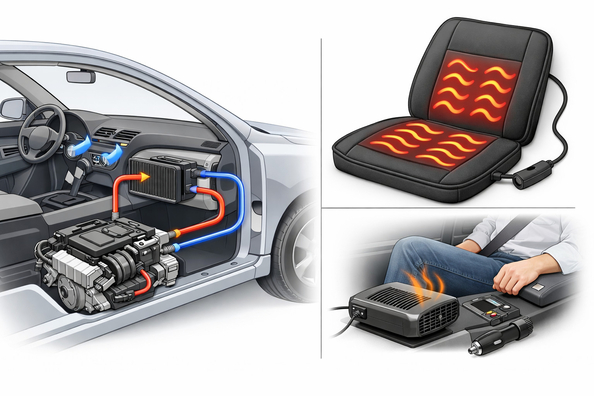
If the cabin is cold and there’s no factory seat heating, don’t start with a seat cover. In most cases, the problem is either that the cabin simply hasn’t had time to warm up yet, or that the heating system is working weakly: not enough airflow, not enough heat from the heater core, or moisture is building up inside.
Seat heating solves only local discomfort. It won’t warm the windows, won’t stop fogging, and won’t replace a properly working heater. In gasoline or diesel cars, cabin heat appears only after the engine warms up, while in EVs the cabin heater works separately—so preheating during charging is especially useful there.
Cold in the cabin almost always comes down to two separate things: the cabin isn’t getting enough heat, or that heat isn’t reaching the people and the glass. The first happens when the engine doesn’t reach operating temperature, the coolant level is low, or there’s an issue with the heater core or thermostat. The second is when the heater can produce heat, but the airflow is weak due to a clogged cabin filter, a blower fan issue, or incorrect climate settings.
In winter, moisture adds another layer. Snow and water from shoes, constant recirculation, and short trips create that “damp cold” feeling: the windows fog up, your feet get cold, and the air seems warm only right next to the vent.
DD Tuning expert comment: The most common mistake is buying any 12V heated seat cover when the real cause of the cold is actually the thermostat, the filter, or low coolant. The second typical mistake is not checking accessory compatibility with side airbags and seat sensors. If the cabin heating is working properly and you only lack local warmth in the first minutes, then an accessory makes sense; if cold air comes from the vents with a warmed-up car, diagnostics come first.
| Symptom | Likely cause | What to do |
|---|---|---|
| The engine takes a long time to reach operating temperature, the cabin stays cool the entire trip | Thermostat stuck open or trips are too short | Check engine temperature and thermostat; for short routes also consider local seat heating |
| Air blows weakly even at maximum speed | Clogged cabin filter, faulty blower fan, or fuse | Start with replacing the filter, then check blower operation |
| Airflow is normal, but the air is cold even after warm-up | Low coolant, air in the system, issue with the water pump or heater core | Check fluid level, look for leaks, diagnose the heating circuit |
| Windows fog constantly, there’s a sweet smell, moisture underfoot | Possible heater core leak | Don’t mask the problem—repair it; this isn’t an accessories story |
| It heats, then suddenly blows cold; clicking under the dash | Blend doors or their actuator work incorrectly | Check actuators and climate control settings |
| In an EV the cabin is warm only right after starting from the charger, then cools quickly | Regular heating heavily loads the battery; no preheating | Use preconditioning while charging, then decide whether local heating is needed |
Accessories make sense when the factory cabin heating is generally working, but you’re cold specifically in the first 10–15 minutes or your trips are very short. In that scenario, seat heating is appropriate: it provides local warmth faster than the whole cabin can warm up.
Seat covers make sense as a compromise if you need a quick removable solution, but only with proper fixation, auto shut-off in the heated version, and compatibility with side airbags and seat sensors. If the issue is the heater, they only mask the discomfort.
It’s also worth mentioning EVA floor mats. They don’t heat, but they help keep water and snow from shoes under control, so the cabin is less damp and the windows fog less. It’s a good add-on, but not a replacement for repairing the heating system.
| Solution | When it works | When it’s not worth spending money |
|---|---|---|
| Short pre-warm | When the car is technically sound and the issue is only the first minutes of driving | If the engine doesn’t build temperature or the heater blows cold all the time |
| Replacing the cabin filter | When airflow is weak, the windows take a long time to clear, there’s little air in the cabin | If airflow is strong but there’s no heat due to the thermostat, heater core, or low coolant |
| Checking antifreeze level and fixing leaks | When there’s cold airflow, signs of moisture, a coolant smell | Don’t delay it: it’s basic repair, not an option |
| Thermostat or blend door repair | When the engine doesn’t warm up or the cabin temperature “jumps” | If you simply want to warm up faster on short trips with a working system |
| Additional seat heating | When the heater works fine, but you lack local comfort without factory seat heating | If you expect it to replace cabin heating or haven’t checked compatibility with your seat |
| Seat cover or mats as a supporting accessory | When you need to slightly improve comfort and reduce moisture from snow and water | If the main problem is a technical fault in the heating system |
From a customer’s experience: a driver was looking for any heated seat cover because he was sure the problem was only the lack of factory seat heating. After checking, it turned out the cabin filter was clogged, and the climate system was constantly set to recirculation, so airflow was weak and the windows fogged quickly. After replacing the filter and setting the airflow correctly, the cabin started warming up properly, and for short city trips the person then separately chose local seat heating.
If the cabin is cold, the absence of factory seat heating is not always the main cause of discomfort. First, you need to distinguish between weak airflow, lack of heat from the heater, excess moisture, and a real need for local heating. When the heating system is working properly, accessories are truly appropriate; when it isn’t, they only delay the repair.
This material is based on real selection experience, hands-on practice, and real usage scenarios: diagnose the cause first, then apply a targeted solution, and only after that spend money on accessories.
Shipping to EU
Wholesale and retail
Own warehouse
Опис продукту
Подарунки не надаються при оформленні покупки у кредит під 0,01% або при покупці частинами.