04.08.2026
185
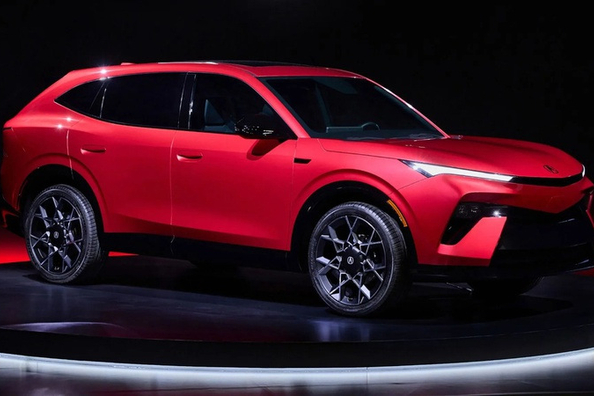
On May 14, 2026, Acura unveiled a next-generation hybrid crossover prototype in Tokyo. By status, it is exactly a prototype with an official premiere at Honda’s global briefing—not a production model and not a fully finished pre-production vehicle. The manufacturer explicitly calls it a new Acura hybrid crossover, but did not mention the RDX in the May announcement, so the link to the future RDX looks very convincing, yet it is still not a direct statement from the brand.
The key point here isn’t the name, but the technical direction: a new platform, an updated dual-motor hybrid system, and a new electric all-wheel drive have all been officially confirmed. Everything else—power output, battery, dimensions, interior, price, and exact on-sale date—has either not been announced yet or remains at the level of expectations.
In form, this doesn’t look like a fanciful show dummy, but rather a fairly production-close prototype. It’s already clear that Acura is preparing a premium crossover with a sporty profile and a clear tie-in to the upcoming hybrid lineup for North America. It has also been officially confirmed that the model is part of Honda’s broader strategy: new hybrids will start launching from 2027.
| What’s known | What’s expected | What’s unknown |
|---|---|---|
| Acura has already shown a next-generation hybrid crossover prototype | It is very likely this is a precursor to the next RDX | When the brand will directly name the model RDX |
| A new platform has been officially confirmed | The architecture will be adapted from the outset for a hybrid layout | Wheelbase, weight, body stiffness, suspension layout |
| An updated dual-motor hybrid system has been confirmed | The focus will be on smooth low-end pull and lower fuel consumption | Power, torque, battery capacity |
| A new electric all-wheel drive has been confirmed | Acura will try to preserve handling feel, not just efficiency | How exactly torque will be distributed between the axles |
| Honda’s new hybrid launches start from 2027 | Acura sales are likely in 2027 or as a 2028 model year | The exact month of the production debut and the start of order intake |
There is one solid anchor here: a new next-generation platform has been officially confirmed. For Acura, this matters because a hybrid crossover designed around this powertrain layout from scratch typically packages the battery better, has a lower center of mass, and forces fewer compromises in cargo space and second-row room.
In my view, the platform will be engineered not only for efficiency, but also for sharper chassis response—exactly what people expect from Acura in this segment. To understand the baseline the brand is working from, it helps to recall the third generation Acura RDX: the new model will likely be less dependent on classic gasoline-first architecture and more tailored to electrified drive.
On the powertrain side, there’s a clear line between fact and assumption. An updated dual-motor hybrid system and a new electric all-wheel drive have been officially confirmed. This means Acura is betting not on a mild hybrid, but on a more full-fledged electrified layout with a noticeable contribution from the electric motors to propulsion.
Everything regarding the specific gasoline engine, transmission, and final output has not been announced yet. Based on preliminary information, a 2.0-liter four-cylinder paired with two electric motors is possible, but this is not yet the manufacturer’s specification. In the author’s opinion, a combined range of roughly 260–320 hp would be logical for such a crossover, with priority on elasticity and quiet urban driving rather than chasing record numbers.
DD Tuning expert comment: a common mistake is assuming accessories from the current RDX will automatically fit the future hybrid. In such transitions, the cargo area shape, seat mounts, floor height, and sill geometry often change. Before the production version is out, you should focus not on the model name, but on exact body and interior dimensions.
Visually, the prototype reads as a premium compact crossover with tenser proportions than a typical family SUV. Official images show a low front end, wide body shoulders, and clean sides without unnecessary visual clutter. That’s a good sign: Acura is trying to build not just an efficient hybrid, but a car with character.
The interior has effectively not been revealed yet. So the only honest take is this: expect a more digital cockpit, a more neatly integrated center screen, less small decorative trim, and better sound insulation. If this prototype truly points to a new RDX, the cabin needs to feel more mature in materials and control logic, because this segment is very crowded right now.
On the strategic level, two important things have been officially confirmed: the next generation of hybrids is expected to deliver more than a 10% improvement in efficiency, and the system cost is planned to be reduced by more than 30% compared with the 2023 hybrid system. For the buyer, this is an indirect signal that the manufacturer wants the model to be not only technically interesting, but also commercially viable.
But it’s best not to overdraw the picture. Officially, neither acceleration, nor top speed, nor EV-only range, nor cargo volume has been announced. Most likely, the production version will focus on real everyday efficiency and fast AWD response rather than show numbers in press materials.
If the link to the future RDX is confirmed, the new model will land in a very clear class: premium compact crossovers where the buyer simultaneously wants quietness, solid performance, a high-quality interior, and reasonable fuel consumption. I see Acura’s positioning like this: a sportier alternative to the Lexus NX and a more pragmatic option versus the more expensive German models.
| Model | What’s already on the market | How it pressures the future Acura |
|---|---|---|
| BMW X3 | Strong handling, wide range of versions | A high benchmark for chassis tuning and premium feel |
| Audi Q5 | A well-balanced interior and everyday comfort | A very even product without obvious weak points |
| Genesis GV70 | Strong design and richer standard equipment | Pressure on trim quality and visual impression |
| Lexus NX 350h | A proven hybrid setup and a strong efficiency reputation | One of the key rivals in terms of purchase logic |
| Mercedes-Benz GLC | Strong brand image and a comfort-first character | Buyer expectations for cabin quality and quietness are very high |
| Volvo XC60 | A mature interior and a calm character | Competes not with numbers, but with a sense of quality and safety |
It has been officially confirmed that the rollout of new hybrid models within this strategy begins in 2027, and the key region will be North America. For Acura, that’s logical: that’s where the RDX makes the most sense as a product.
As for this specific model, the official on-sale date is still unknown. Rumors suggest the production debut could happen either in early 2027 or closer to the end of 2027 as a 2028 model year. A price reference starting around $48,000 looks plausible for the segment, but it’s only an estimate, not the manufacturer’s pricing.
The biggest unknown is when Acura will directly say that this prototype is the next RDX. It’s also still unclear what exact hybrid configuration it will use: which gasoline engine, what battery capacity, whether there will be a separate sportier version, what the cargo area will look like, and whether the second row will be affected by the powertrain packaging.
Dimensions, ground clearance, weight, towing capability, infotainment, the exact safety-system suite for this model, and markets outside North America have also not been announced. Even if Honda’s new driver-assistance system is planned from 2028, that doesn’t automatically mean the first production examples of this Acura will get it right away.
From customer experience: when the first teasers of a new generation appear, some owners want to buy accessories in advance, especially floor mats and a cargo liner. In practice, it’s better to wait for exact body dimensions, because hybrids often change floor shape, storage wells, and rear-row geometry. This approach helps you avoid paying twice and trying to make items fit a vehicle that hasn’t yet reached production.
As of today, this is one of the strongest hints at a future hybrid Acura in the RDX format, but it’s important not to substitute wishful thinking for facts. Officially confirmed are the platform, the dual-motor hybrid, the electric all-wheel drive, and the start of a new wave of hybrids from 2027. The RDX name, power, exact timing, and price remain either very likely or simply expected.
My assessment is this: the production version should arrive as a premium compact crossover with a stronger emphasis on efficiency without losing Acura character. If the manufacturer doesn’t compromise the interior and keeps lively chassis tuning, the model will have good odds against the Lexus NX, BMW X3, and Genesis GV70. This material is based on real selection experience, practical know-how, and real-world use cases for crossovers in this class, so the main takeaway is simple: the prototype already points in the right direction, but the production truth still requires official numbers.
Shipping to EU
Wholesale and retail
Own warehouse
Опис продукту
Подарунки не надаються при оформленні покупки у кредит під 0,01% або при покупці частинами.