 Author: Radomskyi Maksym Vasyliovych
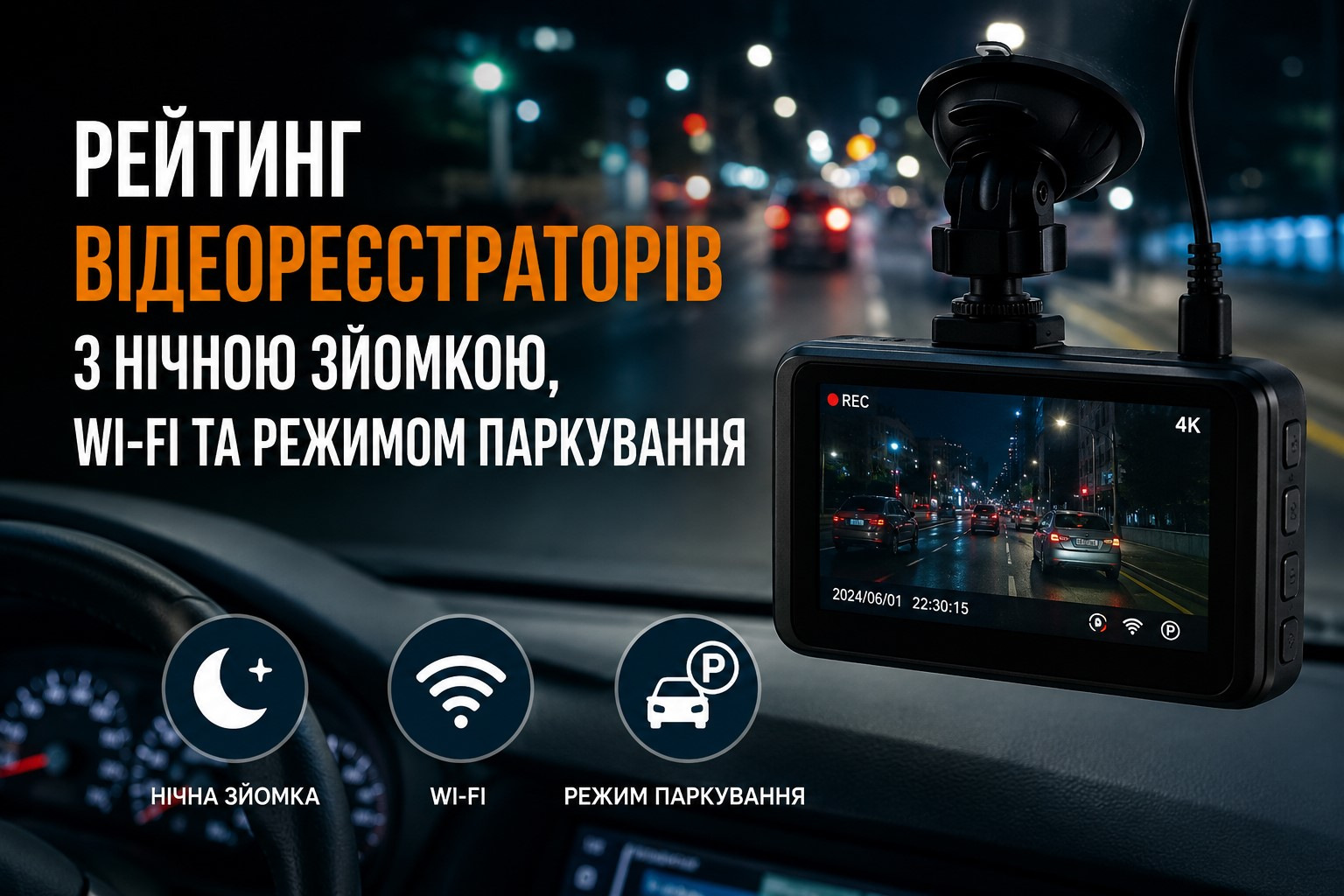
The segment of dash cams with night recording, Wi‑Fi, and parking mode has noticeably changed: today it’s not just the 4K models that win, but those that combine a modern sensor, HDR, fast clip transfer to a phone, and full-fledged recording after the ignition is turned off.
Below is a conditional ranking based on a combination of three things that deliver real value for a driver: nighttime image readability, convenient file access via Wi‑Fi, and the maturity of the parking mode. The positions are based on official specifications; Ukrainian prices, availability, and real-world footage on a specific car may differ.
What’s known about the topic
The strongest class in this segment is formed by models with Sony STARVIS or STARVIS 2 sensors, HDR support, dual-band 2.4/5 GHz Wi‑Fi or Wi‑Fi 6, and buffered parking mode. This matters because at night it’s not the “4K” on the spec sheet that decides, but the camera’s ability to retain license plates, headlight glare, and contrast without harsh noise.
In the premium class, dash cams are already moving beyond the role of a “camera on the windshield”: a radar is added for a more economical parking mode, plus LTE, cloud alerts, and remote viewing. That’s why this ranking should be read as a подборка of different use cases, not as a simple race for resolution.
| Position | Model | Why it’s in the top | Who it’s for |
|---|---|---|---|
| 1 | VIOFO A229 Pro 2CH | 4K front + 2K rear, Sony STARVIS 2 on both cameras, HDR front and rear, 2.4/5 GHz Wi‑Fi, buffered parking mode | Those who want the most balanced dual-channel option without obvious compromises |
| 2 | Thinkware U3000 | 4K or 2K 60 fps, STARVIS 2, built-in radar, several parking modes including energy saving | Those for whom parking matters more than anything else |
| 3 | BlackVue DR970X-2CH LTE Plus II | 4K front + Full HD rear, Wi‑Fi, GPS, LTE slot, cloud features, and battery discharge protection | Those who want remote control, not just local recording |
| 4 | 70mai A810S | 4K, STARVIS 2, Wi‑Fi 6, 4G platform, AI motion detection, parking via hardwire kit | Those looking for a modern feature set with a fast wireless module |
| 5 | VIOFO A119 Mini 2 | 2K 60 fps, STARVIS 2, HDR, compact body, and buffered parking mode | Those who don’t need a rear camera but do need strong night recording |
| 6 | Thinkware Q1000 | 2K, HDR, Super Night Vision 3.0, Bluetooth and 2.4/5 GHz Wi‑Fi, energy-saving parking modes | Those who want a mature 2K system with good parking performance |
| 7 | BlackVue DR770X-2CH II | Full HD front and rear, Sony STARVIS sensors, Wi‑Fi, GPS, support for microSD up to 1 TB, hardwire cable included | Those who bet on a stable dual-channel system without chasing 4K |
| 8 | Nextbase 422GW | 1440p, fast F1.3 optics, Enhanced Night Vision, QuickLink Wi‑Fi, Intelligent Parking Mode | Those who need a simpler, straightforward option without a complex ecosystem |
The most points go to models where strong night footage is combined with full-featured parking. That’s why single-channel devices like VIOFO A119 Mini 2 can have very strong night recording, but they lag behind dual-channel systems in versatility.
Why it matters
For a Ukrainian driver, the difference between “just a dash cam” and a truly successful model most often shows up at night and while parked. In those moments you need not just the fact of recording, but a clear clip with a plate number, the silhouette of a car, or the sequence of the event.
Wi‑Fi has long stopped being a minor extra. When you need to quickly send a video to an insurance company, the police, an employer, or simply save it to your phone before it gets overwritten, slow copying via a weak wireless module is just as irritating as mediocre optics. Dual-band Wi‑Fi or Wi‑Fi 6 noticeably reduce transfer time for large files.
Parking mode is especially important for cars that spend the night in a courtyard, near an office, or in an open parking lot. But this is exactly where buyers often make mistakes: they expect the function to work on its own, even though it usually requires proper constant power via hardwire, OBD‑II, or another direct-connection kit.
Practical implications for drivers and the market
The main shift in choice is simple: demand has moved from “how many megapixels” to “how the camera behaves at night, how quickly it delivers a file, and whether it will drain the battery in parking mode.” Because of this, the mid and upper segments are increasingly perceived not as a standalone gadget, but as a kit with a power cable, a memory card, and sometimes a rear camera.
For services and stores, this means a different level of consultation. It’s not enough to explain only resolution: you need to discuss the type of parking mode, the need for separate power, microSD endurance, and the difference between single- and dual-channel systems. It’s convenient to cross-check basic criteria with the rules for choosing a dash cam, and only then compare brands.
| Parameter | What it delivers in practice | Sign of a strong model | Typical mistake |
|---|---|---|---|
| Sensor and night processing | Better license plate readability, less noise, calmer image in backlight | STARVIS or STARVIS 2 paired with HDR | Looking only at the 4K label and ignoring the sensor |
| Wi‑Fi | Fast copying of clips to a smartphone | 2.4/5 GHz or Wi‑Fi 6 | Buying a 4K dash cam and then waiting a long time for file transfer |
| Buffered parking mode | Saves not only the impact itself but also a few seconds before the event | Auto event detection, timelapse, or low bitrate | Confusing it with standard recording only after the sensor is triggered |
| Parking power supply | Automatic switching to parking mode and protection against battery discharge | Hardwire, OBD‑II, or an OEM constant-power kit | Powering the camera only from the cigarette lighter and expecting full parking operation |
| Number of channels | Coverage not only in front but also behind | 2CH for dense urban use | Saving on the rear camera if the car often sits in a courtyard |
| Memory card | Stable loop recording without corrupted files | Endurance microSD designed for continuous recording | Putting a cheap card in an expensive dash cam |
For the market, it’s also a signal that premium features are gradually moving down. What used to be considered exotic—like buffered recording or fast Wi‑Fi—is already becoming the norm, while LTE, cloud, and radar still remain markers of the upper segment.
What to pay attention to
If you strip away the marketing, the choice comes down to a few specific questions.
- Night footage. Look for the combination of sensor + HDR + optics, not just high resolution. In today’s top picks, systems based on Sony STARVIS 2 look the most convincing.
- Recording scenario. For the city and daily parking, a dual-channel setup is more useful because it captures events front and rear. If your priority is compactness and fewer wires, a single-channel dash cam can also be a great fit.
- Parking mode. It’s better when there is buffering, auto event detection, timelapse, or low bitrate—not only recording after an impact.
- Power connection. Without the right kit, many parking functions either won’t turn on or will work inconsistently.
- File transfer. For 2K and 4K video, 5 GHz or Wi‑Fi 6 is desirable; otherwise copying to a phone will be slow.
- Memory card. A dash cam constantly overwrites files, so saving on microSD often ends with corrupted clips.
By use case, the choice looks quite clear: VIOFO A229 Pro 2CH is the universal leader, Thinkware U3000 is the bet on parking, BlackVue DR970X-2CH LTE Plus II is for remote control, and VIOFO A119 Mini 2 is for compactness without falling apart at night.
Before buying, it’s useful to go through a broader checklist too—from viewing angle to app usability. For that, the article about how to choose a reliable dash cam will work well.
Pros, limitations, and risks
- Pro: modern models really perform better at night than generations where the main argument was only Full HD or 4K without a strong sensor.
- Pro: Wi‑Fi is no longer a formality but a full tool for quickly transferring clips to a smartphone.
- Pro: in top systems, parking mode turns the dash cam into a basic security module for the car.
- Limitation: official specs do not replace a real night test; similar models can read plates differently in rain, in backlight, or on an unlit street.
- Limitation: in Ukraine, availability, prices, and комплектації may differ; the same model is sometimes sold in front-only, 2CH, or LTE versions.
- Risk: incorrect parking-mode wiring can result in either a function that stays off all the time or excessive load on the battery.
- Risk: a cheap memory card often becomes the weak link even in an expensive dash cam.
- Risk: cloud features, LTE, and remote alerts may require a separate module, a SIM card, or additional connectivity costs.
Separately, it’s worth checking local rules for the use of recordings and privacy—especially if the camera runs while parked in a courtyard or near an office. From a practical standpoint, this is well explained in the article whether a dash cam is legal.
Conclusion
In this segment, the winners are not the dash cams that simply record at high resolution, but the models with balanced night performance, fast Wi‑Fi, and a well-implemented parking mode. If you need one universal reference point, the strongest options are VIOFO A229 Pro 2CH, Thinkware U3000, and BlackVue DR970X-2CH LTE Plus II—each with a different emphasis on image, parking, or remote control.
The main thing to remember before buying: 4K by itself does not guarantee a better result. Much more important is which sensor is inside, how the dash cam is powered in parking mode, how quickly it delivers files to your phone, and whether the memory card can withstand the daily recording cycle.
How it works
- Determine what matters most to you First decide what to focus on: night recording, fast file transfer via Wi-Fi, or full parking mode. In this area, these three parameters provide the most practical benefit, rather than just the 4K label on the box.
- Check the sensor and image processing Look for models with Sony STARVIS or STARVIS 2 paired with HDR — they handle license plates, headlights, and contrast better in the dark. If the camera has a strong sensor, that matters more than resolution itself.
- Choose the right recording format For city driving and parking, dual-channel models are more convenient because they capture events at the front and rear. If you value compactness and fewer wires, you can choose a single-channel dash cam, but it will be less versatile.
- Make sure parking mode will actually work A function description alone is not enough: parking mode usually requires proper постоянне power via hardwire, OBD-II, or an OEM kit. It is better if there is buffering, event auto-detection, timelapse, or low bitrate, rather than recording only after impact.
- Pay attention to Wi-Fi and the memory card For 2K and 4K video, it is desirable to have Wi-Fi 2,4/5 GHz or Wi-Fi 6 to quickly transfer clips to a phone. You also need a durable microSD card, because cheap cards often produce corrupted files during continuous loop recording.
- Compare the model with your use case If you need a versatile option, look at the VIOFO A229 Pro 2CH; if parking matters above all else — the Thinkware U3000; if you need remote control — the BlackVue DR970X-2CH LTE Plus II. For a compact solution without nighttime drop-off, the VIOFO A119 Mini 2 is a good fit.
Pros and cons
Models with Sony STARVIS/STARVIS 2 and HDR are truly aimed at night recording, so in the dark, what matters more is not just 4K, but sensor quality and image processing. This is practical for license plate readability and less noise in the frame.
Wi-Fi 2.4/5 GHz or Wi-Fi 6 provides faster transfer of clips to a smartphone, which is convenient when a file needs to be sent quickly to an insurance company, the police, or saved before it is overwritten. For large 2K and 4K videos, this saves noticeable time.
Buffered parking mode is more useful than recording only after impact, because it preserves a few seconds before the event. This increases the chance of seeing the actual cause of the incident, not just the result.
In dual-channel models, there is monitoring not only at the front but also at the rear, which is important for the city, courtyards, and everyday parking. This setup is more versatile than a single-channel option.
Premium models already have built-in features like LTE, cloud, or radar, so the dash cam can work as a more complete vehicle monitoring module. This is convenient for those who need remote access, not just local recording.
The actual quality of night shooting does not always match the official specifications, so without a real test it is difficult to assess how the model reads license plates in rain or backlight. Paper specifications do not give the full picture here.
Parking mode will not work properly without the correct постоянного power supply via hardwire, OBD-II, or the appropriate kit. If the camera is powered only from the cigarette lighter, some parking functions will be unavailable or unstable.
Cloud features, LTE, and remote notifications may require an additional module, SIM card, or separate communication costs. This increases the real cost of use compared with the base purchase.
A cheap or short-lived microSD can become a weak point even in an expensive dash cam, because the device constantly overwrites files. In this case, broken clips and recording stability issues appear.