13.06.2026
302
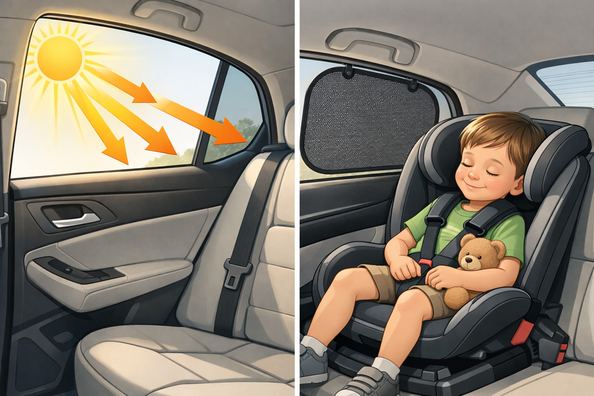
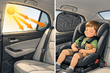
If a child is uncomfortable in the back, specifically on the door side, the problem is most often not the air conditioner. The reason is direct sunlight through the side window: the cabin air may already be cooling down, but the ray keeps heating the face, head, arms, the child seat harness, and the nearby surfaces.
It feels stronger than it seems to the driver up front. Side windows make up a large share of the car’s glazing, and they’re usually less protective against UVA than the windshield. That’s why localized overheating in the rear row often appears quickly, especially in the morning and evening when the sun is low.
The air conditioner cools the mass of air, but it doesn’t block radiation coming through the glass. Because of that, the cabin can feel “tolerable,” while the child on the sunny side still squints, turns away, or gets fussy—because the heating isn’t even, it’s concentrated in one spot.
The situation gets worse after parking in the sun. The cabin can be 20–30 °C hotter than outside, and in the first 10 minutes the temperature inside can rise by about another 11 °C. For a child this matters more, because they heat up faster than an adult and sit closer to the glass.
DD Tuning expert comment: The most common mistake is buying a universal shade at random and covering the wrong glass. In practice, the ray often comes not through the center of the door, but through the upper edge, the rear quarter window, or the sloped rear glass. Before buying, it’s better to sit in the back once at the same time of day and accurately see the sun’s path.
| Symptom | Likely cause | What to do |
|---|---|---|
| The child feels bad only on the sunny side | Direct sun through the side window | Install a shade or film on that specific glass, not blindly across the whole car |
| Worst in the morning or evening | Low sun angle, ray hits the eyes and head | Check whether protection is also needed for the rear quarter window or the rear glass |
| After parking, the first minutes in the cabin are very hard | Overheated cabin even before driving | Pre-cool the car before seating the child |
| A slightly open window hardly changes anything | Ventilation is a bit better, but the ray remains | Don’t rely only on a window crack; add physical sun protection |
| It’s hot for everyone in the cabin, not only the child in the back | Insufficient overall cabin cooling | Separately check A/C efficiency and the condition of the cabin filter |
The best result comes from combining a few simple things, not one “magic” option. If the car regularly carries a child during sunny hours, this approach works:
If the discomfort repeats every day, it’s logical to move from “putting up with it” to passive protection. For targeted blocking of the ray, the most practical option is to look at sun shades: they work on the exact glass where the child sits, and don’t depend on whether the cabin has fully cooled down.
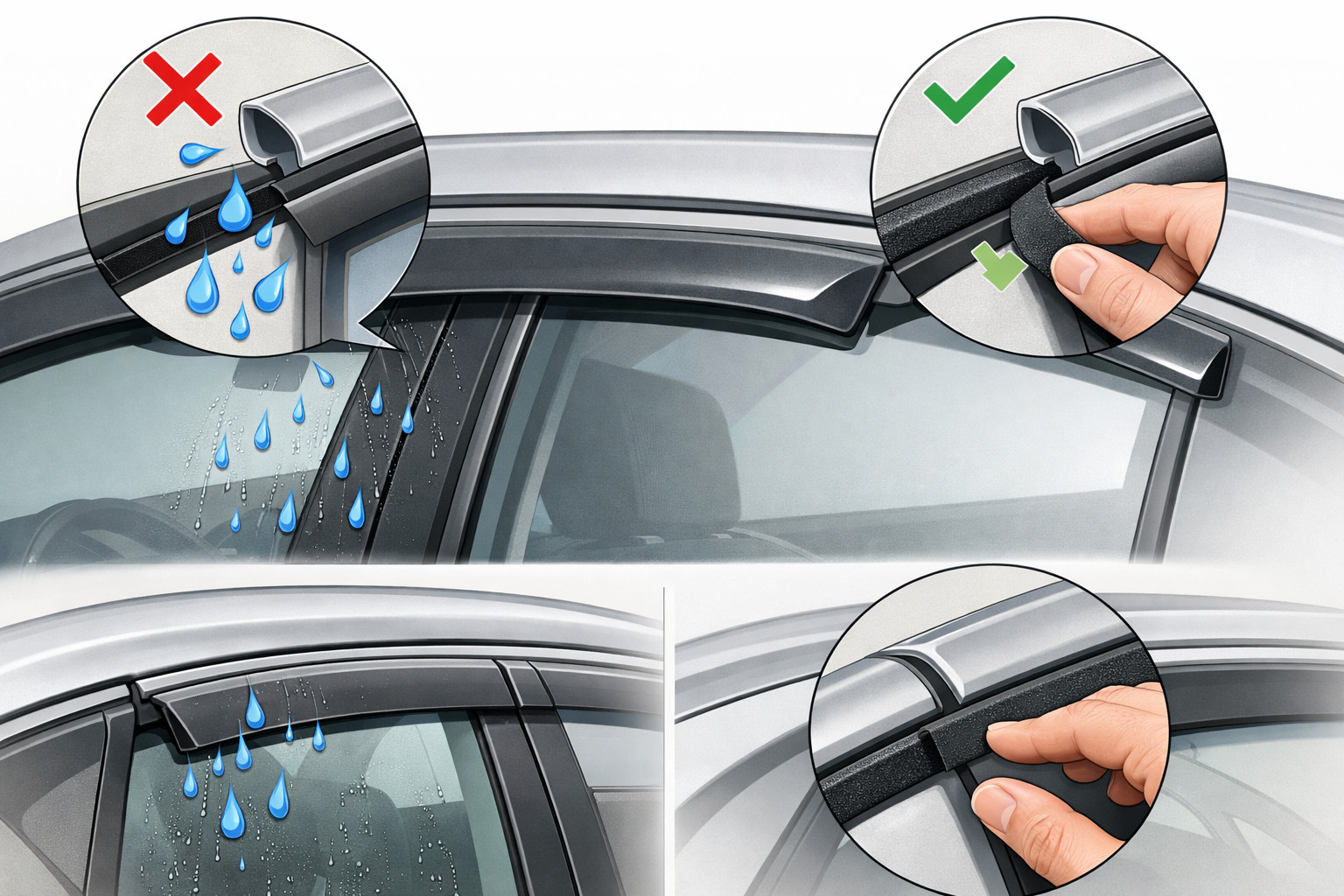
If you sometimes want to ventilate the cabin with a small window crack, you can consider window deflectors. But this is an auxiliary option: a deflector improves ventilation, it doesn’t block the sun.
When the problem is constant and the car drives a lot in sunny hours, it makes sense to deal with film separately. For that, check the guide on types of window tint and choose not the darkest option, but the one that truly reduces heat load without unnecessary visibility compromises.
| Solution | When it works | When it’s not worth spending money |
|---|---|---|
| Framed or precisely fitted shade | When the sun hits through a specific side window and you need to quickly remove localized discomfort | When the ray comes through the rear quarter window, rear glass, or roof, not through the door |
| Legal heat-rejecting film | When the car often drives in hot weather and you need a constant effect without daily installation | When you expect film alone to fully replace a shade on the sunny side |
| Pre-cooling the cabin | After parking in the sun, when the cabin has already stored heat | When you want it to solve direct rays while driving |
| A slightly open window or deflectors | When you need slightly better ventilation and less stagnation of hot air | When the child is burning specifically from sun on the face or arm |
| Very dark tint | Almost never a first step for a family car | When night visibility, legality, and real comfort without side effects matter |
From a customer’s experience: on city trips the child wasn’t fussy all the time, only on one side of the car after lunchtime. After a simple test with a temporary shade, it became clear the A/C had nothing to do with it: the problem was low sun through the rear door. In the end, we chose a proper shade for the needed glass, and on parking started pre-cooling the cabin—this was enough without overly dark tint.
When the sun burns into the cabin through the side windows, the main cause is usually direct radiation, not “weak cold” from the air conditioner. That’s why the most effective measures are not random small fixes, but targeted protection for the right glass, pre-cooling, and—if needed—reasonable film. This material is based on real selection experience, hands-on practice, and real usage scenarios, where the key is not to buy extra, but to correctly identify the overheating source in your specific car.
| ✔ | The air conditioner is described as useful, but the issue is explained more precisely: when a child is being scorched specifically through the side window, you can see that the cause is direct sunlight, not the overall cabin temperature. |
| ✔ | The article includes a simple diagnostic method — a temporary sunshade or a test on a specific window. This helps quickly check whether the discomfort is really caused by a sunbeam, not the climate system. |
| ✔ | The recommendations are practical and step-by-step: pre-cooling the cabin, a sunshade on the right window, allowed tinting, or moving the seat to the less sunny side. |
| ✔ | It is explained that a slightly opened window or deflectors can only improve ventilation, but do not remove the root cause of overheating — this helps avoid spending money on a weak solution. |
| ✔ | There is a clear warning about cheap suction-cup sunshades and overly dark tinting, so you can avoid bad purchases and unnecessary compromises with visibility. |
| ✘ | Some solutions require precise selection for a specific window and sun direction, otherwise you may install the sunshade where it is not really needed. |
| ✘ | Film or tinting provide only a partial effect and do not fully replace a sunshade on the sunny side if the problem is already noticeable while driving. |
| ✘ | Some options do not work in all scenarios: for example, a sunshade on the door will not help if the ray comes through the rear quarter window or the rear glass. |
| ✘ | Pre-cooling the cabin helps only after parking in the sun, but does not solve local overheating from direct rays while driving. |
Shipping to EU
Wholesale and retail
Own warehouse
Опис продукту
Подарунки не надаються при оформленні покупки у кредит під 0,01% або при покупці частинами.