
05.08.2026
263
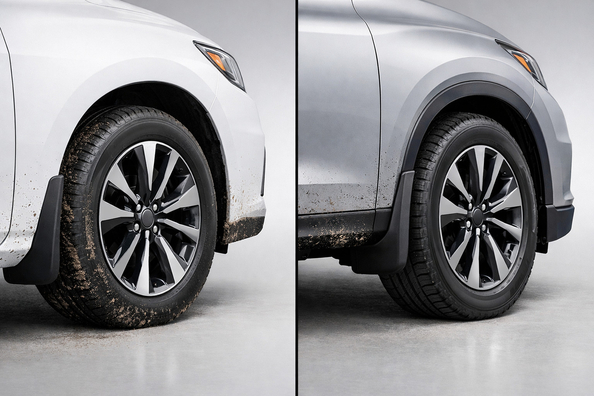
If the goal is to quickly remove dirt from the sills and the lower part of the doors, on most passenger cars it’s worth starting with the front pair of mud flaps. It’s the front wheels that throw the most water, sand, and slush along the body. A full set for all wheels is justified when the car often drives in winter, on gravel, on the highway, or under load.
Using the Audi 80/90 example, the site shows exactly the front pair: 2 rubber mud flaps sized 35 × 23.5 cm, designed for screw mounting, with no fasteners included. This is a typical starting option: lower cost, easier installation, and the most noticeable effect right where the body gets dirty the fastest.
The main question isn’t whether to buy 2 or 4 pieces, but where the main dirt is coming from in your specific driving scenario. The front axle dirties the sills and the lower part of the doors the most. The rear axle has a bigger impact on how clean the rear bumper stays, the lower rear end, and the spray stream behind the car.
That’s why for city use and daily asphalt driving, the front pair usually offers the best price-to-effect ratio. A full set makes sense when you need maximum protection from both axles: from salt, wet snow, gravel, and long water trails on the highway.
| Option | Strengths | Weaknesses | Who it’s for |
|---|---|---|---|
| Front pair | Fastest reduction of dirt on sills and lower doors, cheaper, easier to install | Hardly affects the rear bumper or the dirt stream behind | City, daily driving, decent asphalt, limited budget |
| Rear only | Helps keep the rear cleaner, useful for cars with a trailer or frequent driving under load | Does little to solve dirty sills and doors, sometimes harder to install | A narrow use case where the rear of the car is the main concern |
| Full set | Maximum protection of both axles from water, salt, stones, and slush | More expensive, more mounting points, long pieces may snag more often | Winter, highway, gravel, towing, commercial use |
DD Tuning expert comment: the most common mistake is buying the longest universal mud flaps without checking the arch shape and mounting points. The second type of miss is expecting the rear pair to remove mud from the sills, even though that’s the front axle’s job. If in doubt, start with the front and after a season evaluate whether you really need rear protection.
This is the most sensible start for most passenger cars. The front wheels carry water and abrasive along the side, so the effect is visible quickly: less caked-on dirt on the sills, less stress on the paint in the door area, and less wet slush in winter.
The downside is that the rear of the car remains almost without extra protection. If you often drive on the highway in rain or in winter on de-icing chemicals, the front pair covers only half the job.
As a first purchase, this is rarely the best choice. Rear mud flaps don’t address the main source of dirt on the sills and doors, so the owner often spends money but doesn’t get the result they expected.
They make sense when what bothers you more is rear-end dirt, when the car often tows a trailer, or when you need to slightly reduce the stream of water and stones thrown backward. This isn’t a baseline solution—it’s a targeted upgrade for a specific usage pattern.
A full set isn’t just “two more pieces”—it’s a more complete body protection package. It works better in winter, on highways, and on gravel because both axles stop throwing dirt in their respective directions. In practice, that means less salt film, less wet sand on the doors, and a cleaner rear end.
There’s one drawback: it costs more and requires closer attention to compatibility. Rear pieces more often conflict with the inner fender liner, trim parts, or simply require more time to fit. If the car is low, an overly long set can be inconvenient in everyday use.
For calm city driving, the answer is simple: the front pair. It handles the main dirt stream, costs less, and doesn’t add extra installation complications. For older models like the Audi 80/90, it’s also a logical way to start without big expenses.
For mixed use with highway driving, winter, and bad roads, it’s better to look at a full set right away. In those conditions the rear axle isn’t passive anymore: it also throws dirt, salt, and small stones, which makes the difference between a front pair and a full set noticeable.
Rear only makes sense when the task is narrow: less dirt behind, less spray onto a trailer, slightly calmer operation under load. But if what annoys you is dirty sills, it’s almost always the wrong starting point.
| Scenario | Best choice | Why |
|---|---|---|
| Daily city driving, asphalt, moderate budget | Front pair | Gives the most noticeable effect on doors and sills without extra cost |
| Winter with de-icing chemicals and slush | Full set | Protects both axles, reduces dirt and salt not only on the sides but also at the rear |
| Frequent highway trips | Full set | At speed, the entire spray stream matters, so the rear axle is important too |
| Gravel, bad roads, small stones | Full set | Better contains abrasive from all wheels |
| Need less dirt on the rear bumper or on a trailer | Rear only | This is a narrow but logical scenario specifically for the rear axle |
| Low car, frequent curbs, car wash with guide rails | A shorter front pair or a compact model-specific set | Less risk of snagging than with long universal pieces |
A more expensive option makes sense when you need not just the presence of a mud flap, but precise fitment, a neat edge by the arch, proper stiffness, and predictable installation. This is especially important for anyone who doesn’t want vibrations, misalignment, and trimming universal parts after purchase.
If you want to start with a basic option, you can check out the front pair for Audi 80/90. If you need a broader selection for this model, it makes sense to go to the category of mud flaps for Audi 80/90. And when the car regularly takes abrasive hits along the edge of the arches, sometimes it’s more practical to add protection with arch trims rather than simply installing the longest set.
From a customer’s experience: the owner of an older sedan initially wanted a full set for all wheels, but drove mostly in the city and complained specifically about dirty sills. In the end, he installed the front pair, got noticeably cleaner doors after the first rains, and didn’t overpay for the rear parts that brought little benefit in his usage. He returned to the question of rear mud flaps only before winter highway trips.
If you need a short answer, then for most passenger cars it’s better to start with front mud flaps. They reduce dirt on the sills and doors faster and more noticeably, and they’re simpler in both price and installation. A full set is worth buying when conditions are harsher: winter, highway driving, gravel, a trailer, regular loads.
The main thing is not to confuse your scenario with someone else’s. This material is based on real selection experience, hands-on practice, and real usage scenarios: that’s why in most cases the front pair is the right starting point, and a full set is the next step only when the rear axle also truly creates a problem.
| ✔ | The front pair quickly reduces dirt on the sills and lower part of the doors, because the front wheels are the ones that throw water, sand, and slush most strongly along the body. |
| ✔ | It is cheaper than a full set and usually easier to install, so it is a practical start for city driving and everyday use. |
| ✔ | A full set provides better body protection in tough conditions: in winter, on the highway, on gravel, and under load, when dirt flies both from the front and rear. |
| ✔ | Rear mud flaps make sense in narrow scenarios — when it is important to have less dirt on the rear end, on a trailer, or during work under load. |
| ✔ | Vehicle-specific solutions with a properly matched shape and mounting reduce the risk of misalignment and vibrations compared with universal long elements. |
| ✘ | The front pair hardly solves the problem of a dirty rear bumper and does not provide full rear protection, so it covers only part of the task. |
| ✘ | A full set is more expensive and may require more complex installation, especially with the rear elements and compatibility with wheel arch liners or trim pieces. |
| ✘ | Long mud flaps more often catch ice, curbs, and car wash guides, which is especially inconvenient for low cars. |
| ✘ | If you buy the rear pair first when the problem was dirty sills, the effect may be weak and the money will go into the wrong protection direction. |
Shipping to EU
Wholesale and retail
Own warehouse
Опис продукту
Подарунки не надаються при оформленні покупки у кредит під 0,01% або при покупці частинами.