01.07.2026
563
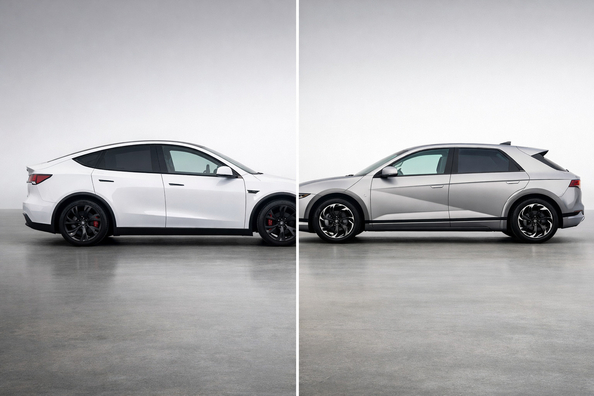
If you boil the choice down to the essentials, the Hyundai Ioniq 5 usually offers a better everyday balance: a lower entry price, a smoother ride, fast charging on an 800-volt architecture, more familiar controls, and a longer warranty. The Tesla Model Y is stronger where range, a large trunk, a 7-seat option, and the most seamless interaction with the Tesla ecosystem matter.
There’s one mistake here: treating these cars as direct equivalents without adjusting for trim level and use case. In base and higher versions, differences in range, charging, ground clearance, noise, and even day-to-day convenience are felt more strongly than in the marketing numbers.
The Tesla Model Y is the more logical pick for those who need one all-purpose electric crossover for everything: city, highway, family, luggage, regular long trips. It costs more upfront, but pays it back with range, capacity, and easier integration with the brand’s charging network.
The Hyundai Ioniq 5 will appeal more to those who drive in the city every day and want fewer compromises in daily life. It’s more comfortable over rough surfaces, charges quickly at high-power stations, has CarPlay and Android Auto, and the interface is easier to get used to.
A proper comparison starts not with the brand, but with matching trim logic: rear- or all-wheel drive, standard or larger battery, base or higher equipment level. If you don’t do that, you may accidentally compare a cheaper Ioniq 5 to a higher-spec Tesla, or vice versa.
| Option | Strengths | Weaknesses | Who it suits |
|---|---|---|---|
| Tesla Model Y | Longer range in key versions, very spacious trunk, 7 seats, strong charging ecosystem, refreshed interior is quieter and higher-quality | Higher entry price, firmer suspension, almost everything controlled through the screen, no CarPlay or Android Auto | Those who often drive on the highway, carry a lot of stuff, or want one universal vehicle without a weak cargo area |
| Hyundai Ioniq 5 | Lower starting price, more comfortable ride, very fast DC charging, V2L, more user-friendly interface, longer warranty | Smaller trunk, no 7-seat version, range depends more on trim level, some users report issues with winter charging | Those who value city comfort, quick top-ups, familiar ergonomics, and don’t need maximum cargo capacity |
DD Tuning expert comment: Most often people compare the wrong trims and then draw conclusions about the whole model. The second typical mistake is looking only at the stated range, ignoring highway noise, suspension firmness, winter charging, and everyday practicality. If the car is bought as the only vehicle in the family, these things affect daily satisfaction more than the difference in acceleration.
The Model Y’s strong point is versatility. It gives you more space for cargo, has a front trunk, and for some buyers the decisive argument is the 7-seat configuration. On long routes it’s one of the most convenient formats: good range and the straightforward charging ecosystem reduce the number of small hassles.
The weak spots are obvious too. The suspension is firmer; on broken asphalt the ride is tighter and less relaxed than in the Hyundai. In addition, the lack of CarPlay and Android Auto and the near-total reliance on the central screen isn’t for everyone—especially those who want quick physical actions without extra taps.
The Ioniq 5 wins not with show, but with everyday usability. It has a more comfortable suspension, more traditional interaction with the car, and very strong fast charging—if a high-power station is available. In daily use, CarPlay, Android Auto, V2L, and the longer warranty are additional pluses.
The compromises are in practicality for big family tasks. The trunk is smaller, there’s no 7-seat option, and range depends on the version more than many expect. If you often drive in cold weather or at high speeds, choosing the right Ioniq 5 trim requires more attention than it seems at first.
For city driving and short daily trips, the Ioniq 5 feels calmer and easier to adapt to. For highways and regular business trips, the Model Y offers more confidence thanks to range, trunk space, and overall long-distance logic.
If your family has kids’ gear, a stroller, suitcases, or you need one car for all tasks, Tesla is more practical. If roads are average or poor and you want less shaking and fewer noise annoyances, Hyundai is more pleasant in real life.
| Scenario | What to choose | Why |
|---|---|---|
| Daily city driving, traffic, short trips | Hyundai Ioniq 5 | More comfortable ride, simpler ergonomics, more user-friendly multimedia for most drivers |
| Frequent highway trips | Tesla Model Y | Longer range and a strong long-route logic |
| Family car with lots of luggage | Tesla Model Y | Noticeably better cargo capacity and an available 7-seat configuration |
| Bad roads, joints, uneven surfaces | Hyundai Ioniq 5 | Softer ride and less fatigue from everyday road surfaces |
| Need the fastest possible DC charging | Hyundai Ioniq 5 | 800-volt architecture delivers a very strong energy replenishment pace |
| Need one car for everything without compromising on cargo space | Tesla Model Y | Better covers several tasks at once: highway, family, cargo, charging ecosystem |
Paying extra for the Tesla Model Y is justified when you truly use it as a long-distance family crossover: you often drive highways, carry a lot of gear, want the maximum from the cargo area, and don’t want to think about a 7-seat alternative separately. In that case, it makes sense to look not only at the Tesla Model Y itself, but also practical items like a trunk mat for Model Y, because large volume works for you only when it’s convenient to use every day.
With the Ioniq 5, a more expensive trim starts to make sense when you’re buying not just an EV, but a comfortable daily tool: fast charging, a calmer suspension, everyday features and, in the case of XRT, better suitability for poor roads. If the car regularly drives on wet, dirty, or winter roads, a practical add-on is mud flaps for Ioniq 5, because the wide, low body quickly picks up dirt.
From a customer’s experience: a buyer was choosing between these models as the only family car for the city and a few long trips each month. At first, the priority was only range, but after test drives the deciding factors became comfort, quietness, and day-to-day convenience. In the end, the choice fell on the Ioniq 5, and the owner was satisfied specifically with the softer ride and fast charging, although for carrying a large amount of stuff the Model Y is objectively stronger.
For most calm city and mixed scenarios, the Hyundai Ioniq 5 looks like the smarter balance of price, comfort, warranty, and fast charging. The Tesla Model Y is the better choice when you truly need its strong trump cards: longer range, a big trunk, 7 seats, and a more cohesive long-distance logic.
The key is not to look for an abstract “better” car, but to honestly match your usage pattern. This piece is based on real selection experience, hands-on practice, and real-world use cases, so there isn’t only one right choice here: Ioniq 5 is about comfort and everyday convenience, Model Y is about versatility, range, and cargo capacity.
| ✔ | Hyundai Ioniq 5 feels more convenient for everyday use: it has a softer suspension, simpler ergonomics, and more familiar controls. This is especially noticeable in the city and on rough roads. |
| ✔ | Model Y is better suited for long trips and family scenarios: it has a longer range, a more spacious trunk, and a 7-seat configuration. If the car needs to handle many tasks at once, this is a practical advantage. |
| ✔ | Ioniq 5 stands out with fast DC charging on an 800-volt architecture. At powerful stations, this reduces charging time in everyday trips and on the road. |
| ✔ | Hyundai offers CarPlay, Android Auto, and V2L, making it more convenient for those who want to rely less on the manufacturer’s ecosystem. For many drivers, this makes getting used to the car easier. |
| ✔ | Hyundai comes with a longer warranty, which adds peace of mind at purchase. This is important if the car is bought for the long term and is planned for active daily use. |
| ✘ | The Tesla Model Y has a higher starting price, so the entry cost of ownership is higher. This should be taken into account even before comparing trim levels. |
| ✘ | The Ioniq 5 is less practical than Tesla for large loads: the trunk is smaller, and there is no 7-seat version. For family trips with a lot of luggage, this can be a significant limitation. |
| ✘ | The Model Y has a stiffer suspension, and on broken pavement it feels less comfortable. If you drive on bad roads every day, this starts to get irritating quickly. |
| ✘ | Tesla has no CarPlay or Android Auto, and most functions are tied to the central screen. For those used to physical controls, this is inconvenient. |
| ✘ | For the Ioniq 5, the choice of trim matters more than it may seem at first: range, cold-weather behavior, and charging noticeably depend on the version. Because of this, it’s easier to make a wrong purchase decision if you look only at the model’s general name. |
Shipping to EU
Wholesale and retail
Own warehouse
Опис продукту
Подарунки не надаються при оформленні покупки у кредит під 0,01% або при покупці частинами.