05.06.2026
454
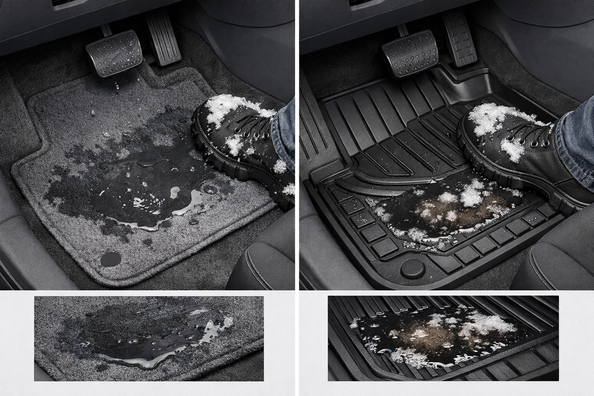
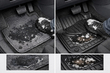
If the cabin is constantly wet in winter, the first step is to distinguish between two situations: water is brought in on shoes, or it gets inside through a leak. For the first case, the most convenient option is not carpeted but molded all-season tray mats made of rubber or TPE: they don’t absorb moisture, keep slush contained, and are quick to wash. For the second case, a new set of mats will only hide the symptom, not remove the cause.
Textile mats look nicer and feel softer underfoot, but in winter they take longer to dry, collect salt, and easily turn melted snow into constant dampness. That’s why the right decision starts not with a purchase, but with a quick check: does it get wet only after driving in snow, or also after rain, parking, and A/C use.
In winter, a lot of water ends up on the floor even in a perfectly sound car. Snow from the soles melts, mixes with dirt and road chemicals, and evaporates slowly in a cold cabin. If the mat is flat or has a low edge, water spills onto the factory carpet and then soaks into the sound-deadening layer underneath.
Because of this, the driver often sees not just a wet mat, but the feeling that it’s damp all the time. The problem shows up especially quickly in a car used for short city trips: the cabin doesn’t have time to warm up, and the floor doesn’t have time to dry.
Another scenario is when moisture appears not only from shoes. Then the source may be seals, the area under the windshield, the sunroof, the A/C drain, or the heater core. In that situation, the mat is important, but it’s no longer the main solution.
The simplest method is to fully dry the problem area, remove the mat, and place dry paper or tissues underneath it for 24 hours. Then watch when moisture returns. If only after driving in snow, the cause is almost certainly water from shoes and an unsuitable mat. If after rain or while parked, check for a body leak.
The location also points to the cause. Wetness under the front passenger with a sweetish smell means it’s worth checking the heater. Dampness appearing after A/C use—check the condensation drain. Moisture along the pillars, roof edges, or near the sills is more often related to the sunroof, doors, or seals.
For leak checks, a controlled water test works: one person pours small amounts of water onto the suspect area while another watches inside to see exactly where a drop appears. It’s important not to blast a strong jet from below upward into the area under the windshield, because it can easily produce a false result.
DD Tuning expert comment: the most common mistake is replacing mats without drying the floor underneath. The second typical issue is choosing a universal set instead of a molded one matched to the cabin geometry, then wondering why water runs along the edges. If you drive daily in winter, look not only at the material, but also at sidewall height, channel depth, and the presence of retainers.
| Symptom | Likely cause | What to do |
|---|---|---|
| It gets wet only after driving in snow, and the mat itself is full of water | A flat or short mat doesn’t retain meltwater | Install a molded tray mat with a high sidewall, regularly pour out the water and dry the floor under the mat |
| After rain or a car wash, moisture appears even without driving | Door, windshield, sunroof seals or the area under the windshield lets water in | Do a water test, check seals, fix the leak point instead of only replacing the mat |
| Wet mainly in the front right, with a sweetish smell and greasy window fogging | Heater core leak | Check the cooling system and repair the heater; a new mat won’t solve it |
| Moisture appears after A/C use, with a musty smell | Clogged A/C drain | Clean the drain and then completely dry the carpet and sound-deadening layer |
| Dampness runs along the edge of the floor, near the sill, or from the pillar | Door membrane, sunroof drains, or seals | Check water direction during the test, clean drains, repair membranes and seals |
For daily winter use, molded all-season rubber or TPE mats work best. Water is not absorbed into the material; it stays inside. With a raised sidewall and deep channels, meltwater is much less likely to reach the carpet.
The second important thing is an exact fit to the floor of your specific car. A model-specific mat covers more area and leaves fewer gaps near the left footrest and the edges of the center tunnel. Retainers or a grippy backing are just as important: the mat must not slide under the pedals.
Another proven approach is two sets per year. In winter, you use a practical set that’s easy to wash; in the warm season, you switch back to textile. And separately: if the floor has already gotten wet under the mat, it must be dried out—otherwise dampness will remain even with the right set.
Universal rubber mats without a sidewall are most often a compromise that won’t stand up to a snowy winter. They may look practical, but water quickly escapes along the edges or back under the driver’s heel.
Relying only on textile in winter isn’t very practical either. It can be more comfortable, but it holds moisture longer, dries longer, and often creates the impression of constant cabin dampness even when the water source is ordinary.
Cosmetic fixes instead of a real solution also barely help: quickly blotting the top with a tissue, spraying air freshener, or treating rubber with a slick glossy product. Moisture under the mat will remain, and near the pedals the risk of slipping increases. Likewise, you must not stack mats on top of each other.
If the problem occurs only from snow on shoes, the most straightforward solution is rubber cabin mats with a high sidewall. If you need a different surface format to collect dirt, you can look at EVA mats. And for the warm season or a dry climate, it makes sense to have separate textile cabin mats so you’re not driving all year on a winter set.
Replacing seals, cleaning drains, or repairing the heater core makes sense when it gets wet without snow on shoes—after rain, a car wash, or A/C operation. In that case, an accessory is needed to protect the floor, but not as the main “treatment” for the issue.
| Solution | When it works | When it’s not worth spending money |
|---|---|---|
| Molded tray mats made of rubber or TPE | When water in the cabin comes mainly from snow, slushy dirt, and wet shoes | When moisture comes through a body leak, a drain, or the heater |
| A separate winter and summer set | When the car is used daily and a lot of snow is brought into the cabin in winter | When the floor is already constantly damp due to an unresolved technical cause |
| Cleaning the A/C drain | When it gets wet after A/C use or a musty smell appears | When moisture appears only after snow on shoes |
| Repairing seals, the area under the windshield, door membranes | When water gets in after rain, a car wash, or while parked | When the cabin gets wet only on snowy drives and the body is sealed |
| Replacing the heater core | When there’s a sweetish smell, greasy window fogging, and moisture in the front | When the issue is clearly related only to mats and meltwater |
From a customer’s experience: a person was looking for a new set because the driver’s area was wet every day and it seemed the cause was “bad rubber.” After a simple check, it turned out moisture appeared only after driving in snow, not after rain, so instead of another flat set they chose molded mats with a sidewall and thoroughly dried the floor underneath. After that, water stayed in the mat itself rather than in the carpet.
If the cabin gets wet in winter specifically from shoes, the most convenient option is a molded all-season tray mat made of rubber or TPE—preferably model-specific, with a high sidewall and proper retention. Textile in winter is only more comfortable on a dry floor, but in real snowy use it loses on practicality.
If water appears without snow—after parking in the rain or together with odor and window fogging—you need to look for a leak, not just buy a different set. This material is based on real selection experience, practical know-how, and real-world usage scenarios: first identify the moisture source, then spend money on an accessory or a repair.
| ✔ | Molded all-season tub mats made of rubber or TPE do not absorb moisture, so melted water stays inside and the cabin gets less damp. They are also easier to wash quickly after snow and dirt. |
| ✔ | Model-specific high-edge mats better cover the floor of a particular car and are less likely to let water run over the edges onto the carpet. This is especially useful for everyday winter trips. |
| ✔ | Fasteners or a rough backing reduce the risk of the mat sliding under the pedals. This is an important practical advantage specifically for the driver’s area. |
| ✔ | A separate winter set lets you avoid wearing out textile mats in the snowy season, and in the warm season return to a more comfortable option. This approach makes sense if the car is used every day. |
| ✔ | Before buying, it is easy to figure out the source of moisture: if it is damp only after trips in the snow, the right mat will help; if after rain or parking, you need to look for a leak. This helps avoid spending money on an unnecessary replacement. |
| ✘ | Textile mats dry for a long time in winter and collect salt, so after melting snow they often only maintain a feeling of constant dampness. In practice, this is inconvenient if the floor gets wet regularly. |
| ✘ | Universal flat rubber mats without a lip do not hold meltwater properly, and it quickly runs over the edges or back under the driver’s foot. For a snowy winter, this is a weak solution. |
| ✘ | If moisture gets into the cabin through seals, drains, or the heater radiator, a new set of mats will not solve the problem. It will only hide the effect, not the cause. |
| ✘ | Even a good mat will not help if the carpet or sound-absorbing layer underneath it is already wet. First, the floor needs to be dried, otherwise the dampness will remain. |
Shipping to EU
Wholesale and retail
Own warehouse
Опис продукту
Подарунки не надаються при оформленні покупки у кредит під 0,01% або при покупці частинами.