
































































 Author: Radomskyi Maksym Vasyliovych
If mud keeps sticking to the wheel arches and the sides of the body get sprayed with grime, buying the first mud flaps you see isn’t the best start. Often the problem begins earlier: the inner fender liner pulls away, the drainage is clogged, the wheel sits wider than the factory geometry, and the dirt stream doesn’t fly downwards but in an arc onto the doors and sills.
Properly selected mud flaps really do reduce contamination of the lower part of the body, but they don’t make the car completely dry and clean. This is especially true for the upper mist around the mirrors and along the upper part of the doors: it’s determined not only by the mud flap, but also by the arch shape, the tire, the speed, and the wheel fitment.
Why this problem happens
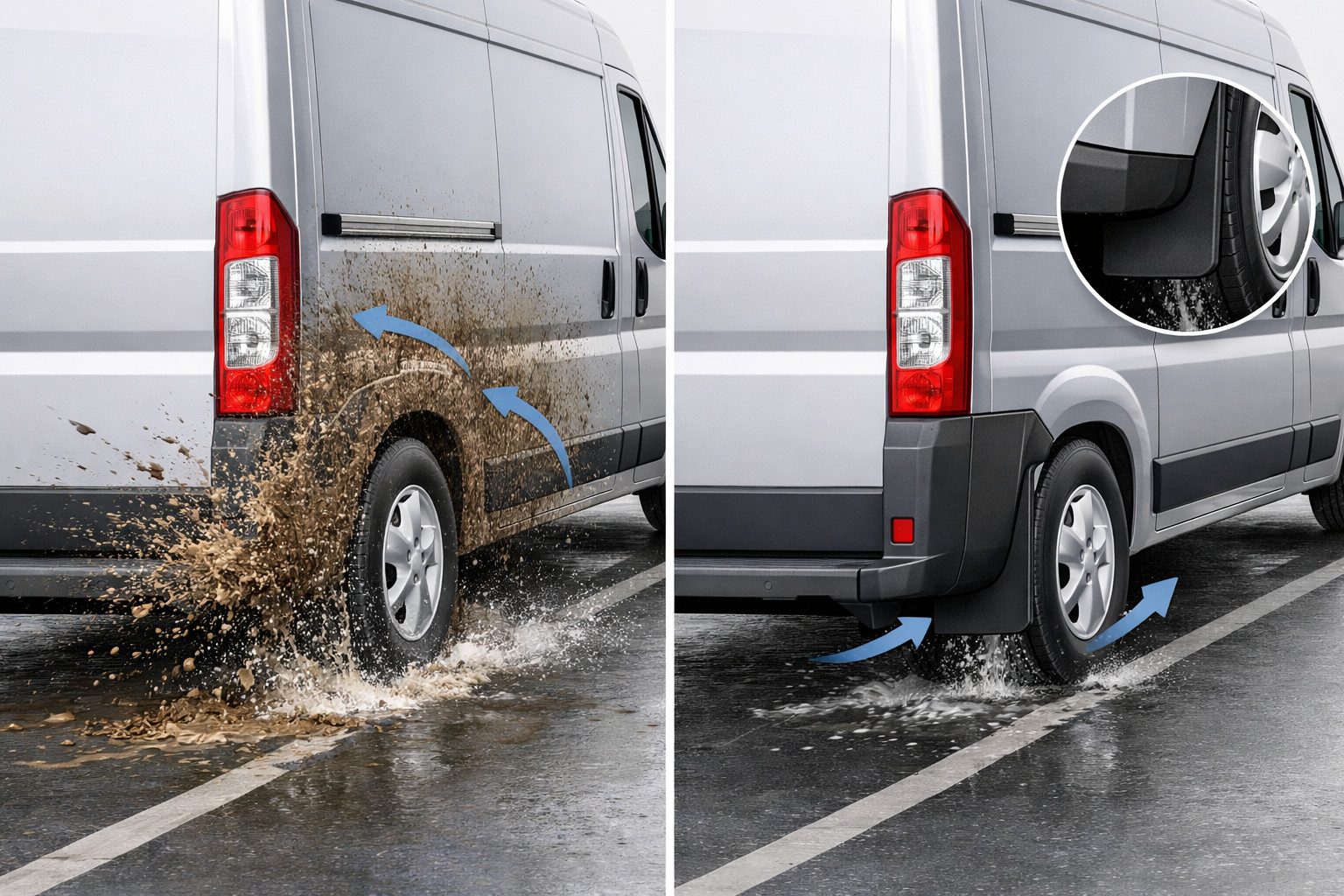
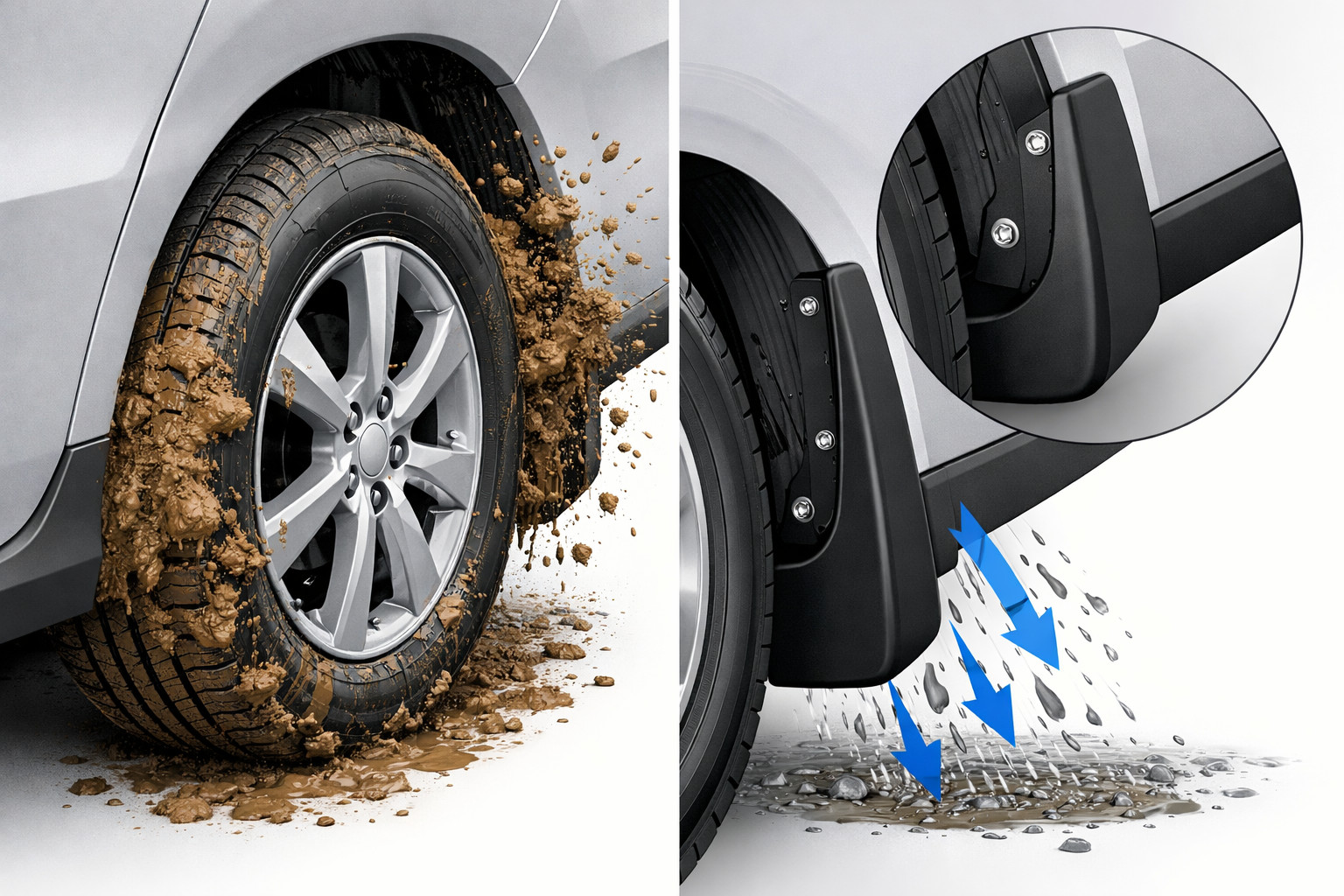
Dirt doesn’t fly onto the body on its own—it comes from the tread. The wheel picks up water, sand, and clay, spins them inside the wheel arch, and then the stream exits through the lower and rear part of the wheel well. If wet mass builds up inside the arch, there’s more of it, and it gets thrown out not as fine spray but in clumps.
This is most noticeable in the wet season, after driving on dirt roads, and at the end of winter when heavy grime accumulates in the arches. If the liner isn’t seated tightly or drainage doesn’t remove water, the arch works like a pocket for buildup rather than a protected channel.
Main causes
- The inner fender liner is shifted or poorly secured. Through gaps, dirt packs deeper, then gets thrown outward.
- Clogged drainage zones in the arch. Water and mud can’t escape, accumulate, and keep the arch constantly wet.
- Wider tires or increased wheel offset. The tread protrudes more beyond the arch contour and throws dirt wider.
- No mud flaps or they’re too small. A short flap doesn’t intercept the main flow from the lower part of the wheel.
- Poor installation geometry. If the mud flap is tilted, has a gap, or sits too high, its effect drops sharply.
How to understand what the cause is in your case
- Look at the dirt pattern. If most dirt is on the sills and the lower part of the doors, the main stream is going sideways from the wheel. If the arch is packed with mud inside, first look for the issue in the liner and drainage.
- Inspect the arch after a wash. On a clean wheel well it’s easy to see missing clips, bent liner edges, and spots where it doesn’t sit flush.
- Check tire protrusion. If the tread visually extends past the edge of the arch or is nearly flush with it, a short factory mud flap is often weak.
- Assess the current mud flap from the side. A tilt, a large gap to adjacent plastic, or rub marks on the wheel means it’s either the wrong fitment or installed incorrectly.
- Separate the problem by front and rear axles. If dirt is mainly on the front part of the sill, start with the front wheels. If the rear side of the body and the bumper suffer, the cause is often the rear wheels.
DD Tuning expert comment: the most common mistake is installing mud flaps on a car with a loose inner fender liner and expecting results. The second typical mistake is choosing a short rigid set for a car with a wider wheel or increased offset. When selecting, it’s always important to look not only at the accessory brand, but at whether it actually covers the real dirt-throw trajectory.
Symptoms, causes, and what to do (table)
| Symptom | Likely cause | What to do |
|---|---|---|
| Sills and the lower part of the front doors are constantly dirty | The front wheels throw the stream past the factory protection, or the mud flaps are too small | Check the front pair of mud flaps, their height and coverage width |
| Clumps of mud accumulate inside the wheel arch | Clogged drainage or the inner fender liner isn’t seated tightly | Rinse the arch, clean the drainage, restore clips and liner fitment |
| Dirt flies high, up to the mirrors | Upper aerodynamic spray-off from the tire at speed | Don’t expect a full effect from mud flaps; the reduction will be partial |
| After installation, the mud flap pulls away from the body or is crooked | Incorrect hole alignment or overtightened fasteners | Reinstall using the markings, align it, don’t tighten fasteners with excessive force |
| The mud flap hits curbs or the car wash | A rigid flap sits too low for this car | Choose a shorter or more flexible option |
What really helps
The best result comes not from one accessory, but from the right sequence of actions. First, wash the arches, check drainage, liner seating, and fasteners. If there are already pockets for dirt inside, a new mud flap will only partially reduce the effect, but it won’t remove the cause.
For a regular road car with factory wheels, a tightly fitted model-specific rigid or semi-rigid mud flap usually works best. It blocks dirt from the lower panels and sills well, as long as there isn’t a big gap to the arch and it isn’t installed crooked.
For a car with a lifted suspension, wider tires, or wheels pushed outward, a wider flexible flap with extra coverage works better. In this setup, the problem isn’t the mud flap material—it’s that a short factory option simply doesn’t cover the real spray pattern from the tread.
What almost doesn’t work or helps only briefly
- Installing a short universal mud flap just because it’s cheaper and quick to mount.
- Installing a new set on an inner fender liner that has already pulled away or is held by only some of the clips.
- Expecting that one front pair will remove all dirt from the sides and the rear of the body.
- Choosing a very rigid and low flap for a car that often drives over curbs, ruts, or goes through an automatic car wash.
- Ignoring wheel geometry: if the tire protrudes outward, a small mud flap will work weakly regardless of brand.
When accessories or replacing parts makes sense
If you have factory wheels, normal ground clearance, and want a neat fit along the body contour, it makes sense to look at model-specific mud flaps. They’re appropriate when the main goal is to reduce dirt on the sills and the lower part of the doors without excessive protrusion.
If the wheel is wider, the suspension is higher, or the tread clearly works outside the arch contour, universal mud flaps with extra width and height make more sense. They’re not as tidy visually, but they cover the throw zone better.
But when dirt primarily accumulates inside the wheel well rather than simply flying onto the body, you should start not with the flap, but with restoring the arch—meaning check and, if needed, replace the inner fender liners and fasteners. Otherwise you’re treating the symptom, not the source of the problem.
Solutions: when they work and when it’s not worth spending money (table)
| Solution | When it works | When it’s not worth spending money |
|---|---|---|
| Washing the arches and cleaning the drainage | When mud builds up in the arch and moisture stays for a long time | When the main cause is the wheel protruding too far beyond the arch |
| Replacing clips or the inner fender liner | When there are gaps, play, or misalignment of the inner plastic | When the arch is assembled correctly and the problem is only the lack of protection from the stream |
| Model-specific rigid mud flap | For factory wheel geometry and a tight fit to the body | For cars with wide tires, increased offset, or lifted suspension |
| Wider flexible flap | When you need more side coverage and extra clearance to the tire | When the car is low and maximum neatness is important without the risk of scraping the bottom |
| Front pair of mud flaps only | When the sills and the front part of the side panel suffer the most | When dirt also hits the rear bumper and the rear part of the body |
| Rear pair of mud flaps only | When the main dirt comes from the rear wheels | When the problem starts from the front arches and runs along the entire side |
From a customer’s experience: at first the person was simply looking for wider mud flaps because after rain the entire sill and rear doors were covered in mud. After inspection, it turned out that several clips were missing in the front arch and the inner fender liner had pulled away at the bottom. After restoring the fasteners and installing a properly selected pair of mud flaps, the body didn’t become perfectly clean, but heavy dirt along the lower doors and sills decreased very noticeably.
Conclusion
If dirt sticks in the arches and gets thrown onto the body, start not with a random purchase but with diagnostics: inner fender liners, clips, drainage, tire protrusion beyond the arch, and only then the mud flap type. For a factory road car, tightly fitted model-specific solutions are usually best, while for wide wheels and lifted suspension, wider flexible flaps with greater coverage work better. But it’s important to understand the limits of the effect: they protect the lower part of the body well, and the upper mist only partially.
This material is based on real selection experience, installation practice, and real usage scenarios, where it’s important not just to buy an accessory, but to target the root cause of the problem.
Pros and cons
Before buying mud flaps, you can first check the wheel arches, drains, wheel arch liners, and clips — this helps avoid spending money on an accessory if the real problem is the mounting or a mud-clogged space.
Tightly fitted vehicle-specific mud flaps do a good job of reducing dirt on the sills and the lower part of the doors, if the wheels are stock and there is no large gap to the wheel arch.
For cars with wider tires or increased offset, a wider flexible flap covers the actual dirt ejection path better than a short stock version.
Inspecting the dirt pattern helps determine where to focus: on the front pair, the rear pair, or on restoring the arch itself.
If you properly combine wheel arch cleaning, restoration of the mounts, and the right type of mud flap, the effect on the lower part of the body becomes noticeable without complex modifications.
Mud flaps do not completely solve the problem: the upper spray near the mirrors and along the upper part of the doors still remains, especially at speed.
A short or improperly installed mud flap hardly works if the tire sticks out past the arch or the wheel arch liner has already come loose.
A stiff low flap can catch on curbs, ruts, or an automatic car wash if the car has poor ground clearance or often drives on rough surfaces.
If mud builds up in the wheel arch, a new mud flap alone will not solve the cause — first you will have to clean the drains and restore the fit of the wheel arch liners.