14.07.2026
328
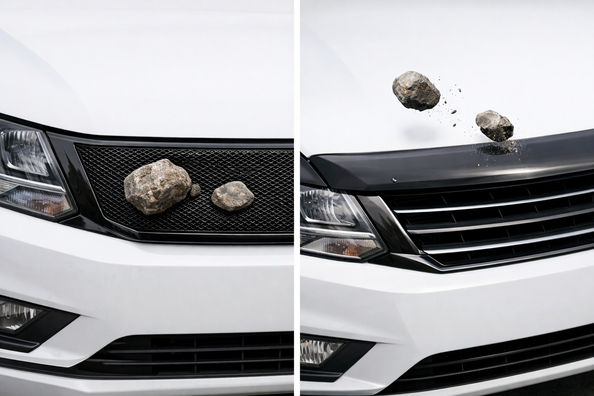

If the question is specifically about stones on the highway, the better protection is a grille mesh. It creates a physical barrier in front of the radiator, condenser and, if present, the intercooler. A hood deflector works differently: it helps more with insects, dirt and some small impacts on the hood edge, but it doesn’t shield the components behind the grille from a direct hit.
So it’s not worth looking for “what’s better in general” here. You need to decide what exactly you want to protect: the expensive radiator stack or the front edge of the hood. Below is an unvarnished comparison: installation, noise, service life, practicality and price.
A grille mesh and a hood deflector don’t duplicate each other. The mesh sits in the zone where stones actually fly at highway speed, so it’s better for protecting what’s behind the front end. The deflector changes airflow over the hood and can reduce the number of insects, dirt and some minor impacts on the hood, but its effect against stones is less predictable.
If what scares you most is a punctured radiator or condenser, the choice usually leans toward a mesh. If the main request is fewer marks on the hood, easy installation and minimal intervention in the car’s design, then a deflector makes sense as the simpler solution.
The first criterion is installation. A deflector is often installed without drilling, sometimes simply on adhesive tape. Mesh varies a lot: on some cars it installs relatively easily, on others it requires removing clips, partial disassembly of the front end, or even drilling.
The second criterion is noise. An external deflector can cause whistling, rattling or extra hood vibration at speed. With a mesh, this risk is usually lower because it’s hidden inside the grille, but if the openings are too fine or the mesh is clogged with dirt, airflow becomes the issue.
The third and fourth criteria are service life and practicality. A deflector’s lifespan depends on plastic quality, mounting and how it handles car washes and seasonal grime. A mesh’s lifespan depends on the metal, coating and winter use. In everyday use, the deflector is simpler, but the mesh is more useful where the cost of a mistake is high.
The fifth criterion is price. A deflector is usually cheaper both to buy and to install. A quality vehicle-specific mesh kit is more often pricier, but it addresses the core problem better—protecting expensive components from stones.
| Option | Strengths | Weaknesses | Who it’s for |
|---|---|---|---|
| Grille mesh | Better protects the radiator, condenser and other components behind the front end; more logical for highway driving; in good kits it can be convenient to clean | More complex installation; needs to be kept clean; overly fine mesh can worsen airflow | Those who often drive on highways, outside the city, or want to reduce the risk of expensive front-end repairs |
| Hood deflector | Easier to install; usually cheaper; helps with insects, dirt and the hood edge | Doesn’t provide the same direct protection for the radiator; stone protection depends on body shape; possible noise and dirt under the visor | Those who need a simple solution for daily driving and don’t want to disassemble the front end |
DD Tuning expert comment: The most common mistake is buying a deflector when the person is actually worried not about chips on the hood, but about a punctured condenser or radiator. Another typical story is choosing a mesh only by photos, without checking compatibility and cell size. If in doubt, assess not the accessory, but the risk zone: the hood, the windshield, or the radiator stack.
For highway driving, this is more direct protection. A stone flies into the front end—the mesh sits right in the path to the heat exchangers, so its effect is more straightforward. This is especially important on cars where the front cooling pack is expensive or sits close to an open grille.
The downsides are practical too. On some cars installation is simple, while on others it means working with clips, fasteners and access from the inside. Maintenance is also mandatory: the mesh must be cleaned, because a dirt-clogged guard is already a compromise for airflow.
A deflector is convenient because it’s almost always easier to install. For many cars it’s a no-drill solution that can be fitted quickly without taking the front end apart. In daily use it really can reduce insects and dirt on the hood, and it also takes some of the small road debris.
But as protection specifically against highway stones, it’s weaker and less predictable. On some cars the difference is noticeable; on others it’s minimal. Add possible whistling, vibration at speed, and the buildup of dirt or snow under the visor—and it becomes clear why a deflector doesn’t replace a mesh when the goal is saving the radiator.
For long highway trips, passing behind trucks, rural roads, and cars with an expensive front cooling pack, a mesh works better. It’s not as convenient at the start, but it solves the more expensive problem. For city driving, infrequent highway runs and a request for easy installation, a deflector looks more reasonable.
If both the hood edge and the components behind the grille matter equally, sometimes these solutions are combined. But it only makes sense when the mesh is selected without harming airflow, and the deflector is needed specifically as separate hood protection—not as a replacement for a grille mesh.
| Scenario | What to choose | Why |
|---|---|---|
| Frequent highway driving at high speed | Grille mesh | Better intercepts stones before they reach the radiator or condenser |
| City, short trips, main annoyance is insects and dirt | Hood deflector | Easier to install, cheaper to get into, useful specifically for the hood and lower windshield area |
| A car with an expensive or vulnerable front cooling pack | Grille mesh | The risk of component repair is higher than the inconvenience of installation and maintenance |
| You don’t want to take the front end apart and need a quick solution | Hood deflector | On many models it installs without drilling and without complicated installation |
A more expensive vehicle-specific mesh is justified when the car regularly runs highways, and damage to the radiator, condenser or intercooler would cost much more than the accessory and installation. If you want to see the format of such solutions, start with aluminum meshes; it’s also useful to read the piece on protecting the radiator from stones and compare it with where a deflector actually provides more benefit.
Overpaying isn’t always justified. If the car mostly lives in the city and the request comes down to less dirt on the hood and easy installation, a deflector often covers the need without complex work on the front end.
From a customer’s experience: A crossover owner initially wanted a deflector because they were looking for simple protection “from little stones.” After clarifying the route, it turned out the car drives on the highway behind trucks every week, and there were already traces of minor hits on the front end. In the end they chose a vehicle-specific grille mesh: a bit more maintenance, but it covered exactly the zone the person was truly worried about.
In short: for stones on the highway, a grille mesh is better because it protects the components behind the front end with a direct barrier. A hood deflector is a simpler and usually cheaper solution for insects, dirt and partial protection of the hood edge, but it’s not a full replacement for a mesh. This conclusion is based not on the theory of “what sounds better,” but on real selection experience, real installation practice and real use scenarios where a wrong choice quickly shows up in costs.
| ✔ | A grille mesh provides better protection for the radiator, condenser, and intercooler, as it creates a physical barrier right in the path of stones from the road. This is especially important for cars with an expensive front cooling package. |
| ✔ | For frequent highway driving, its effect is more predictable than a hood deflector, which does not protect the components behind the grille from direct hits. In other words, it better addresses the problem of stones themselves, not just the damage on the hood. |
| ✔ | A hood deflector is usually easier to install, often without drilling and without disassembling the front end. This is convenient if you need a quick solution without complicated installation. |
| ✔ | A deflector helps with insects, dirt, and some minor impacts on the hood edge. For city driving and occasional highway trips, this can be a fairly practical option. |
| ✔ | A deflector is usually cheaper both to buy and to install. If the main priority is minimal cost and simplicity, this is its strong side. |
| ✘ | A grille mesh may require a more complicated installation: sometimes clips need to be removed, the front end partially disassembled, or even drilling may be needed. On some cars, this is no longer a quick install. |
| ✘ | It needs to be cleaned regularly, because a mesh clogged with dirt worsens airflow. An overly dense mesh can also negatively affect air movement. |
| ✘ | A hood deflector does not provide such direct protection for the radiator as a mesh, and its effect against stones is less predictable. On different cars, the result can differ noticeably. |
| ✘ | A deflector may whistle, vibrate, or create additional speed-related vibration, and dirt or snow can also accumulate under the cover. This makes it not entirely trouble-free in everyday use. |
Shipping to EU
Wholesale and retail
Own warehouse
Опис продукту
Подарунки не надаються при оформленні покупки у кредит під 0,01% або при покупці частинами.