29.07.2026
194
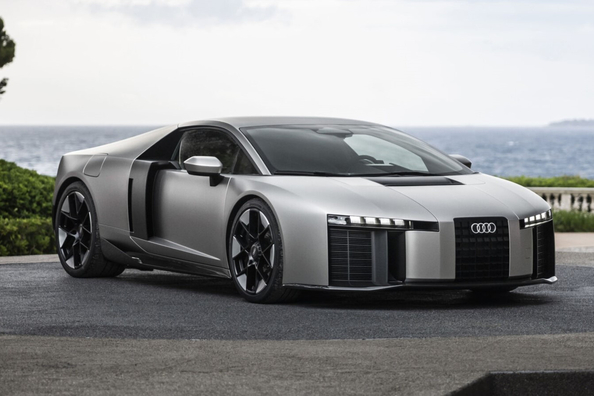
The 2026 Audi Nuvolari no longer looks like a show-stand fantasy built just to provoke a crowd reaction. Officially confirmed by the manufacturer: it’s a production-oriented prototype, unveiled on June 4, 2026 ahead of the Monaco Grand Prix, and described by the brand as a future technology flagship and the fastest, most powerful series-production Audi.
It’s important not to confuse two different cars that share the same name. The 2003 Nuvolari quattro was a pure 2+2 concept that never reached production, while today’s Nuvolari has a clear commercial launch schedule, a limited run, and a spec sheet that reads less like a design exercise and more like an almost production-ready road-going supercar.
As of now, the correct status for Nuvolari 2026 is not just “concept,” but a production-oriented prototype with an official public debut. The manufacturer has already named a run of 499 cars and provided order and delivery timelines, so this isn’t a “someday, maybe” story—it’s a model that’s nearly entering the production cycle.
In essence, Audi has shown a new top tier for its performance lineup. Viewed soberly, it’s more of a new image flagship for the brand than a bold stand-only experiment. Yes, the styling and presentation are demonstrative, but unlike the 2003 Nuvolari quattro, this car is already tied to a concrete production plan.
| What we know | What to expect | What’s unknown |
|---|---|---|
| Status: production-oriented prototype with an official debut in June 2026. Production run: 499 cars. | Role in the lineup: Audi’s new technology flagship and a successor to the Audi R8 in status, not necessarily in formula. | Final production spec: equipment packages, options, and possible differences versus the shown prototype. |
| Technical basis: mid-engine layout, hybrid powertrain, Audi Space Frame, carbon exterior. | Production finalization: chassis, aerodynamics, and electronics tuning will likely still change. | Weight, exact dimensions, EV range, charging: not officially announced. |
| Commercial plan: orders in Europe from Q4 2026, first deliveries in H1 2027. | Price level: expected to start around half a million euros and above. | Full sales geography outside Europe: not yet detailed. |
Audi has officially confirmed a mid-engine layout, an Audi Space Frame load-bearing structure, and a carbon exterior. For a car of this format, that signals a hard priority on handling, center of mass, and aerodynamics rather than versatility. Downforce is also claimed at over 400 kg, meaning Nuvolari is conceived from the start not only for straight-line speed, but also for high cornering speed.
At the same time, Audi has not yet named the base platform. Because of that, the theory of kinship with the Lamborghini Temerario architecture looks logical, but it’s not officially confirmed. In practice this matters: until the manufacturer fully reveals the chassis, you shouldn’t treat suspension design details, parts compatibility, or future service specifics as fact.
Here, the data is already sufficient—and official. Nuvolari gets a 4.0-liter V8 biturbo rated at 800 hp, three 110 kW electric motors, and a combined output of 1,001 hp. The ICE alone is rated at 730 N·m, and the front electric axle can deliver up to 2,150 N·m. The battery has a capacity of 7.3 kWh, so the electric side isn’t a decorative add-on—it’s a tool for instant torque, precise torque metering, and building speed on corner exit.
The transmission type has not been officially announced. In my view, the production car will use a very fast automated gearbox; otherwise, it will be difficult to deploy such a hybrid package without losses. Aggressive torque vectoring is also expected, but for now that’s an assumption rather than a confirmed specification.
DD Tuning expert comment: a common mistake with models like this is treating any leak or render as production fact and then planning wheels, brakes, or aero parts around it. In reality, track width, brake sizes, and even cooling configuration can change before final homologation. With a future expensive supercar, waiting for the production spec is almost always cheaper than making one wrong purchase.
Visually, Nuvolari is designed so it can’t be mistaken for any other Audi. It’s officially confirmed as the first production realization of the brand’s new design language, and the most noticeable element up front is a vertical grille with 64 individual elements. Combined with carbon panels, a wide rear, and a mid-engine stance, it delivers not a “grand tourer with ambitions,” but true supercar proportions.
There’s less information about the interior. The manufacturer hasn’t revealed the full cabin architecture yet, so assumptions have to be cautious: the seating position will be very low, ergonomics will be strongly driver-focused, and quick-mode controls should remain physically accessible. For a car like this, touchscreen minimalism without redundant buttons would be a strange choice, so I expect a more functional approach than just an eye-catching graphic.
The official numbers already place Nuvolari in the top segment: 0–100 km/h in 2.6 s, 0–200 km/h in 6.8 s, and a top speed above 350 km/h. Preliminary environmental figures have also been disclosed: 11.3 l/100 km in the combined cycle, 7.8 kWh/100 km, 270 g/km CO₂, and with a depleted battery—14.7 l/100 km. That honestly shows the car’s character: this isn’t a “green” experiment, but a very fast road supercar with a hybrid layer for performance.
What’s still missing for the full picture is weight, tire type, brake size, electric range, and charging time. These parameters will determine whether Nuvolari is more of a track tool or a fast but heavy hybrid for status driving. In my view, if Audi kept curb weight within reasonable limits, this model could turn out to be the sharpest road-going Audi in history.
By positioning, this isn’t another RS and not a designer side project. In brand role, Nuvolari is closest to the place once held by the Audi R8, but now with a much harder emphasis on hybrid performance, aerodynamics, and limited production. In other words, it’s not a mass-market sports model, but the peak of the range.
Looking at the market, Nuvolari logically sits alongside production hybrid supercars already populated by Lamborghini Temerario, Ferrari 296 GTB, and McLaren Artura. Each has its own school, but Audi is entering the segment not with a lighter “daily” coupe, but straight away with a very powerful, technology-heavy flagship.
| Model | Power format | How it puts pressure on Nuvolari | Where Audi can respond |
|---|---|---|---|
| Lamborghini Temerario | Mid-engine hybrid supercar | Very similar philosophy, strong emotional image, expected aggressive performance | Greater emphasis on technology, a more restrained but more expensive-looking design, and the status of Audi’s new flagship |
| Ferrari 296 GTB | Hybrid supercar | Proven brand reputation in this class, very strong track/road balance | Higher total output and a bet on a full-fledged image breakthrough for the brand |
| McLaren Artura | Hybrid supercar | Lightweight engineering school, sharp handling, less emphasis on showmanship | A stronger brand factor for Audi fans, likely higher top speed, and a more pronounced flagship status |
The timelines are already defined quite clearly. Officially confirmed: European orders open in Q4 2026, and first deliveries begin in H1 2027. That means the project is at a very late stage, and there shouldn’t be any major ideological U-turns left.
There’s no official price yet. Based on preliminary market estimates, the reference point is in the €500,000–€600,000 range, but for a limited series with this power package, I assume well-equipped examples could easily go higher. Outside Europe, the model will likely appear in selected quota markets, but this hasn’t been announced officially.
These are exactly the things that separate an impressive prototype from a truly understandable production product. Until they’re disclosed, it’s too early to draw final conclusions about practicality, running costs, and the car’s real character.
From a customer’s experience: we had a request from a sporty Audi owner who was already planning to switch to Nuvolari and wanted to understand in advance what could be carried over from the current car in terms of wheels and small accessories. After checking the facts, it became clear that betting on platform rumors was too risky, so the decision was simple: don’t buy anything “in advance” before the production parameters are published. In the end, the person kept their budget and avoided a very expensive mistake.
If we answer the headline question directly, Nuvolari 2026 is no longer just a bold concept. Officially, it’s a production-oriented prototype with a clear production plan, a limited run, and performance figures that put it at the top of Audi’s model hierarchy. That means we’re looking at a future brand flagship, not a show car with no follow-up.
The key right now is not to mix confirmed facts with nice-looking assumptions. Output, powertrain format, production run, and launch timing are already known; price, weight, platform, and part of the technical detail are not. This material is based on real selection experience, practical know-how, and real-world usage scenarios, so the conclusion is simple: Nuvolari is worth waiting for seriously, but it should only be judged definitively after the full production specification is published.
| ✔ | The most important practical details are still undisclosed: weight, exact platform, transmission type, electric range, and charging time. Without this, it is difficult to assess how convenient Nuvolari will be in real-world use. |
| ✔ | The official price is still unavailable, and the earlier estimate of €500,000-€600,000 makes the model accessible only to a very narrow circle of buyers. On top of that, the final cost of well-equipped cars may turn out even higher. |
| ✔ | Outside Europe, the sales geography is not detailed, so it is still unclear where exactly the model will actually be available to order. This makes it harder for potential customers outside the European market to plan a purchase. |
| ✔ | Due to the lack of data on the cabin, trunk, and road suitability, it is still impossible to say how practical the car will be in everyday use. At this stage, Nuvolari looks more like an emotional supercar than a versatile car. |
| ✘ | The officially confirmed production-oriented status and clear manufacturing plan make Nuvolari not just a show car, but a real future model. The order and delivery timelines are already known, so the project looks close to production. |
| ✘ | The powertrain looks very powerful: a 4.0-liter V8 biturbo together with three electric motors deliver a total of 1,001 hp and a claimed 0-100 km/h acceleration of 2.6 s. This places the car in a very fast segment even among hybrid supercars. |
| ✘ | The mid-engine layout, Audi Space Frame, and carbon exterior emphasize a focus on handling and aerodynamics rather than decoration. The claimed more than 400 kg of downforce hints at serious track potential. |
| ✘ | The limited run of 499 cars adds exclusivity to the model without completely detaching it from the real market. For Audi, this also looks like a new flagship level rather than another derivative of the existing lineup. |
| ✘ | The claimed specifications honestly show the car’s character: this is not a “green” experiment, but a hybrid supercar with a priority on performance. Such straightforwardness in the spec sheet helps explain exactly what the model was created for. |
Shipping to EU
Wholesale and retail
Own warehouse
Опис продукту
Подарунки не надаються при оформленні покупки у кредит під 0,01% або при покупці частинами.