22.07.2026
119
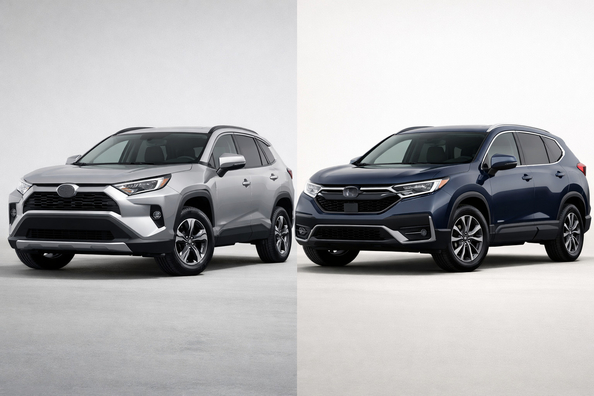

If you look at the 2026 model-year options for the U.S. market, the choice isn’t about which car is “better overall,” but about what matters more to you personally. The Honda CR-V makes more sense where you want quietness, a softer ride, family practicality, and a lower entry price. The Toyota RAV4 is stronger where you want hybrid efficiency, higher power, better pulling force, and the option of a plug-in hybrid.
The main trap is that the 2026 RAV4 no longer has conventional gasoline versions, while the CR-V is still sold both as gas and as a hybrid. So the fair comparison is: gas CR-V versus the base budget, hybrid CR-V versus hybrid RAV4, and the plug-in-hybrid RAV4 separately—for those who will actually charge the vehicle regularly.
In essence, these are two different approaches to a compact family crossover. The CR-V focuses on calm, everyday life: easier child seating, more usable space, and a softer feel on the highway. The RAV4 is more about tech and function: more powerful electrified versions, better fuel consumption, and noticeably higher ability to tow a trailer or drive with a full load.
So the choice comes down to a simple question: do you need a comfortable family crossover with no extra conditions, or a more versatile tool for travel, towing, and maximum fuel efficiency. Even simpler: the CR-V more often wins in daily life, the RAV4—in tasks.
The first criterion is price. The entry-level CR-V is cheaper, but that’s because it has gasoline versions. If you specifically want a hybrid, you should compare the hybrid CR-V to the hybrid RAV4, and then the difference looks different.
The second is noise and ride. If you’re sensitive to cabin acoustics, road texture, and suspension softness, the CR-V is usually perceived as calmer. The RAV4 can deliver more pull, but the driving feel is more often firmer.
The third is practicality. It’s not just cargo liters that matter, but also the opening shape, space for child seats, loading height, and usable volume in hybrid versions. In the CR-V, family logistics are usually easier, although you should check the exact trim.
The fourth is durability and operating complexity. On paper there’s no winner here. The gasoline CR-V is the simplest in terms of ownership logic. Hybrids are more efficient, but require an honest understanding of your driving pattern. The plug-in-hybrid RAV4 only makes sense where there will be regular charging.
The fifth is installing additional equipment. If the vehicle is for a roof rack, trips with gear, cargo-area protection, mud flaps, or other accessories, that’s also part of the decision. For a family or travel scenario, it’s important not only to buy the car, but also to build it for your needs without hassle.
| Option | Strengths | Weaknesses | Who it fits |
|---|---|---|---|
| Toyota RAV4 2026 | Electrified lineup only, higher power, lower consumption, towing up to 1588 kg, plug-in hybrid available | Firmer ride feel, the cabin may seem noisier, cargo space isn’t class-leading | Those who drive a lot, want better efficiency, tow, or are considering a plug-in hybrid |
| Honda CR-V 2026 gas | Lower starting price, simpler buying logic, spacious cabin and cargo area | Higher consumption, weaker acceleration, modest towing capability | Those who need a family crossover without paying extra for a hybrid |
| Honda CR-V 2026 hybrid | Quieter, softer character, good efficiency, a very strong family-friendly format | More expensive than the gas CR-V, weaker for towing and not as powerful as the RAV4 | Those who want a comfortable daily hybrid without focusing on pulling power |
DD Tuning expert comment: most often, people make mistakes when they look only at the starting price or only at the official fuel-consumption figures. In selection, it shows up quickly: some overpay for a plug-in hybrid without charging, others buy the cheaper gas version and then regret the highway consumption. Another common miss is not thinking ahead about luggage, child seats, and accessories for your scenario.
In 2026, the RAV4 is immediately either a hybrid or a plug-in hybrid. That’s where the main advantages come from: higher power, very strong fuel consumption for the class, and a real advantage in pulling force. If you need a trailer, active travel, a full load, or you simply want more reserve under your right foot, Toyota looks more convincing.
The downsides are also clear. For some drivers, the RAV4 feels firmer and noisier, and in small family-focused ergonomics the CR-V often feels simpler. The plug-in-hybrid version is only interesting when you truly can charge at home or at work—without that, its main advantage partly disappears.
The gasoline CR-V is a rational entry into the class with no extra conditions. It’s cheaper up front, roomy, family-friendly, and doesn’t require you to justify whether the hybrid part will pay off. If annual mileage isn’t very high and your priorities are comfort, cargo space, and a calm daily rhythm, it’s a very logical choice.
But it’s the gasoline CR-V that loses to Toyota fastest on consumption figures and the feeling of pull. If you often drive long distances, carry a lot of gear, or like having power in reserve for passing, it will be less convincing.
The hybrid CR-V is the most honest rival to the hybrid RAV4. It delivers noticeably better fuel consumption than the gasoline version while keeping the model’s strengths: quietness, a softer character, and family practicality. That’s why, for most families, it’s probably the most balanced option in the pair.
Its weak point isn’t comfort, but the limits of capability. In towing, peak power, and tool-like versatility, the RAV4 is stronger. If the car needs to do more than carry the family—also tow, run with a roof box, gear, or a heavy load—Toyota has a more noticeable reserve.
For city driving, kids, school runs, shopping, and highway trips without sporty ambitions, the easiest recommendation is the CR-V. It fits a family scenario better, especially when quietness and space matter more than towing numbers.
For someone who often drives long distances, carries lots of gear, may tow a trailer, or wants the most advantageous consumption right away, the RAV4 looks stronger. It’s a choice based less on emotion and more on function.
If the budget is limited and you’re not sure you truly need a hybrid, the gasoline CR-V looks like a healthy compromise. If you have reliable charging at home or at work, then the plug-in-hybrid RAV4 moves into its own league, because it lets you cover short trips with almost no gasoline.
| Scenario | What’s better to choose | Why |
|---|---|---|
| Family, two kids, daily city and highway | Honda CR-V hybrid | Quieter cabin, softer ride, more convenient family practicality |
| Need a lower entry budget | Honda CR-V gas | Cheaper up front, no overpayment for the hybrid system |
| Frequent trips with cargo or a trailer | Toyota RAV4 | Better pulling force, more power, stronger versatility |
| Maximum efficiency without a charging cable in daily life | Toyota RAV4 hybrid | Very low consumption and a higher power reserve than the CR-V |
| Home or workplace charging available, short daily routes | Toyota RAV4 plug-in hybrid | The most benefit from electric range day to day |
Paying extra for the RAV4 is justified when you truly use its strengths: long trips, towing, a fully loaded cabin, frequent highway driving, and for the plug-in hybrid—regular charging as well. In that scenario, the more expensive car pays you back not in advertising, but in lower consumption and greater functionality.
In a travel scenario, it’s logical to think about equipment right away: a roof rack for RAV4 makes sense if you often run out of space in the cabin, and mud flaps for RAV4 are useful for those who drive in rain, mud, or on poor roads.
Paying extra for the hybrid CR-V also makes sense if your main priorities are a quiet daily routine and lower consumption without switching to a firmer driving character. For family use, a practical add-on is often a CR-V cargo liner, especially if a stroller, bags, or sports gear ride there constantly.
From a customer’s experience: in a similar choice, a person first looked at the base CR-V because of the lower price, but after an honest mileage calculation switched to comparing hybrid vs hybrid. In the end, they chose the CR-V Hybrid, because the priorities were two kids, quiet on the highway, and a large cargo area. For another scenario with a trailer and regular trips outside the city, that same budget would more logically go to the RAV4.
The short verdict is this: the Honda CR-V 2026 is the stronger choice for most families who need quietness, smoothness, space, and a lower entry threshold. The Toyota RAV4 2026 is better where the priorities are efficiency, power, towing, and a plug-in-hybrid format.
The best decision here doesn’t come from a horsepower number or a marketing brochure, but from your scenario: city or highway, kids or cargo, charging or none, a calm ride or functional reserve. This material is based on real selection experience, practice, and real use cases, so the main advice is simple: compare not the model names, but how the car will actually live in your routine.
| ✔ | Honda CR-V is better suited for everyday family use: the article specifically highlights a quieter cabin, a smoother ride, and more convenient child seating. |
| ✔ | The gasoline CR-V has a lower entry price, making it a simpler option for those who do not want to overpay for a hybrid system. |
| ✔ | The hybrid CR-V looks very well balanced: it is more economical than the gasoline version, while keeping the model’s comfortable and practical character. |
| ✔ | Toyota RAV4 is stronger in load-bearing tasks: the text mentions better torque, higher power, and towing capability of up to 1588 kg. |
| ✔ | The 2026 RAV4 has a plug-in hybrid version that becomes especially useful with regular charging at home or at work. |
| ✘ | The 2026 RAV4 has more stiffness and road noise, so for some drivers it is less comfortable for everyday driving than the CR-V. |
| ✘ | The gasoline CR-V is weaker in fuel economy and dynamics, so with frequent long trips it may fall behind the RAV4 more quickly. |
| ✘ | The hybrid CR-V is more expensive than the gasoline one, and in towing and peak power it still does not match the RAV4. |
| ✘ | The RAV4 plug-in hybrid only makes sense with stable charging; without it, its main advantage is partly lost. |
Shipping to EU
Wholesale and retail
Own warehouse
Опис продукту
Подарунки не надаються при оформленні покупки у кредит під 0,01% або при покупці частинами.